Category: Asset Management

  • The Number Your Plant Missed Last Month, and Nobody Could Price It 

    The Number Your Plant Missed Last Month, and Nobody Could Price It 

    Last month your plant made money. It also missed the plan. Both of those things are on the same report, and if you walked into the morning meeting and asked what the miss was worth in contribution margin, you would most likely get silence, followed by three explanations, none of which carries a dollar sign. 

    That silence is worth about $1.5mm a year on a single asset. Here is how that number gets built. 

    The three explanations that never survive a follow up question 

    “We had a rough month.” This describes the result, not the cause. It cannot be sized, compared against last quarter, or attached to an action. It is a summary of the thing you were trying to explain. 

    “The equipment is old.” Age is not a loss category. Two identical assets, purchased the same year, installed on the same site, routinely run twenty points apart. If age were the cause, that would not happen. 

    “We are short people.” Sometimes true and usually incomplete. It rarely explains why the same crew delivered plan the month before with the same headcount. 

    None of these are dishonest. They are what capable people say when nobody has given them a counting system. The failure here is structural, not personal. 

    Why the number matters more than the excuse 

    Consider a packaging line with a case packer as the constraint. The plan for the month was 175,000 bags. Actual good output was 162,500. The gap is 12,500 bags. 

    Contribution margin on that product is $10 per bag, which is price less variable cost. Not gross margin, not revenue. Contribution margin, because the fixed cost base gets paid whether the line runs or not, so the full margin on recovered volume drops to the bottom line. 

    12,500 bags at $10 is $125,000 for the month. Annualized, that is $1.5mm on one asset. 

    That figure did not require new instrumentation, a software purchase, or a consultant. It required plan, actual, and one number from finance. 

    And here is the part worth sitting with: $1.5mm is the small number. It is the gap to a plan that was already discounted to what the line has been doing. The gap to what the asset can actually produce is considerably larger, and we will get to that. 

    Unmeasured margin never gets funded 

    This is the mechanism that keeps the money on the floor. 

    Finance cannot approve a number that does not exist. A capital committee is not hostile to reliability work, it is simply comparing proposals, and the proposal that arrives with a documented figure beats the one that arrives with a conviction. Capital flows toward the best documented problem, not the biggest one. 

    So the plant that describes its losses qualitatively competes for funding against a plant that describes them in dollars, and loses every time, regardless of which one actually has the larger opportunity. 

    Sizing the loss is not an accounting exercise you do after the improvement work. It is the first act of leadership on the problem, and it is what makes everything downstream possible. 

    What to do this week 

    Pick one asset. The one that sets the pace, where a stop stops the shipment. Pull plan against actual good output for the last eight weeks. Ask finance for contribution margin per unit, in writing, even if it is just an email. 

    Multiply the gap by the margin. Write the answer as one sentence with a dollar sign in it. 

    That sentence is a better management tool than any dashboard you will be sold this year, and it costs you fifteen minutes. 

  • Design for Reliability: Building Assets to Last

    Design for Reliability: Building Assets to Last

    In asset-intensive industries, the reliability of equipment and systems is a critical factor in ensuring operational efficiency, safety, and cost-effectiveness. While maintenance and repairs are essential for sustaining asset performance, the most cost-effective approach to reliability starts at the design phase. This concept, known as Design for Reliability (DfR), ensures that assets are engineered to be robust, durable, and capable of meeting performance expectations throughout their lifecycle. 

    By integrating reliability principles into the initial design and engineering stages, organizations can reduce unplanned downtime, lower maintenance costs, and enhance overall asset performance. 

    What is Design for Reliability (DfR)? 

    Design for Reliability (DfR) is a systematic approach to designing assets, equipment, and systems with reliability in mind. It involves incorporating failure prevention, predictive analytics, and maintainability principles into the engineering and development process. 

    Instead of reacting to failures after an asset is in operation, DfR ensures that potential failure modes are identified and mitigated before an asset is even built. 

    Why is Design for Reliability Important? 

    1. Reduces Lifecycle Costs

    Unreliable equipment leads to high maintenance costs, frequent breakdowns, and increased operational expenses. By designing assets with reliability in mind, organizations can: 

    • Reduce the need for costly repairs and emergency maintenance. 
    • Extend the useful life of assets, reducing capital expenditures. 
    • Minimize operational disruptions caused by unexpected failures. 


    1. Improves Equipment Availability and Performance

    Reliable design means that assets are more resilient and can operate for longer periods without failure. This results in: 

    • Higher uptime and productivity, as assets remain operational longer. 
    • Optimized performance, reducing variability in output. 
    • Lower spare parts consumption, as equipment wears out less frequently
       
    1. Enhances Safety and Compliance

    Asset failures can lead to safety hazards, environmental risks, and regulatory violations. A well-designed, reliable system ensures: 

    • Safer working conditions by reducing unexpected failures. 
    • Compliance with industry standards and regulations, such as ISO 55000 for asset management. 
    • Lower risk of catastrophic failures, protecting both people and the environment.
       
    1. Supports Sustainable Operations

    Reliability-driven design minimizes waste and energy consumption, leading to: 

    • Lower carbon footprint due to reduced material and energy use. 
    • Fewer replacements and less waste, supporting sustainability initiatives. 
    • Improved efficiency, reducing emissions and resource consumption. 

    Key Principles of Design for Reliability 

    1. Failure Mode and Effects Analysis (FMEA)

    FMEA is a proactive method used in DfR to identify potential failure modes, their causes, and their effects on system performance. It helps engineers: 

    • Recognize design weaknesses before production. 
    • Implement design changes to mitigate failure risks. 
    • Prioritize failure modes based on severity, occurrence, and detection. 
    1. Redundancy and Resilience

    Reliable systems are designed with redundant components to ensure continued operation even if one part fails. This can include: 

    • Backup power systems for critical equipment. 
    • Dual-pump configurations in fluid systems. 
    • Parallel processing units to prevent system-wide failures. 
    1. Predictive Maintenance Integration

    By incorporating condition monitoring technologies like IoT sensors, vibration analysis, and thermal imaging, assets can be designed to support predictive maintenance strategies. This allows for: 

    • Early detection of performance degradation. 
    • Scheduled interventions before failures occur. 
    • Reduced reliance on reactive maintenance approaches. 
    1. Standardization and Modularity

    Designing assets with interchangeable and standardized components makes maintenance easier and more cost-effective. This approach: 

    • Simplifies repairs by reducing the variety of parts needed. 
    • Ensures faster replacements, minimizing downtime. 
    • Improves supply chain efficiency by using common parts across multiple systems. 
    1. Ease of Maintenance (Maintainability)

    Good design considers how easily an asset can be inspected, repaired, and maintained. Key aspects include: 

    • Accessible components, reducing time spent on repairs. 
    • User-friendly interfaces, allowing operators to monitor performance easily. 
    • Simplified assembly and disassembly, enabling faster servicing. 

    Implementing Design for Reliability in Your Organization 

    1. Involve Reliability Engineers Early

    Reliability should be a core design consideration from the beginning, not an afterthought. Having reliability engineers involved in the design process ensures: 

    • Potential failure points are identified early. 
    • Design decisions prioritize longevity and durability. 
    • Maintenance and operability are considered before production. 
    1. Use Data to Drive Design Improvements

    Leveraging historical failure data, performance metrics, and real-world case studies can help improve designs. Organizations can use: 

    • Failure reports and maintenance records to identify common issues. 
    • Digital twins to simulate real-world performance before deployment. 
    • Machine learning and AI to predict design weaknesses. 
    1. Test and Validate Designs

    Prototype testing under real-world conditions helps verify that assets meet reliability expectations. Testing methods include: 

    • Accelerated life testing, simulating years of wear in a short time. 
    • Environmental stress testing, exposing assets to extreme conditions. 
    • Reliability growth testing, ensuring continuous design improvements. 

    Conclusion 

    Design for Reliability (DfR) is a proactive approach to building durable, high-performance assets that require minimal maintenance and deliver long-term value. By integrating reliability principles into the design phase, organizations can significantly reduce downtime, lower costs, improve safety, and optimize asset performance. 

    In today’s competitive and asset-dependent industries, companies that prioritize reliability at the design stage will gain a significant advantage, ensuring their equipment and systems remain productive and efficient for years to come. 


  • Workforce Management: The Key to Effective Asset Management

    Workforce Management: The Key to Effective Asset Management

    In asset-intensive industries, workforce management is just as critical as the physical assets themselves. No matter how advanced an organization’s maintenance strategies, asset monitoring systems, or predictive technologies are, the success of asset management depends on the people who operate, maintain, and optimize those assets. 

    Workforce management in relation to asset management is about ensuring that the right people, with the right skills, are in the right place at the right time to keep assets running efficiently and reliably. A well-managed workforce leads to higher productivity, lower costs, improved safety, and extended asset lifespan. 

    The Connection Between Workforce and Asset Management 

    Asset management involves optimizing the lifecycle of physical assets to maximize performance and minimize costs. But achieving this goal requires a skilled, well-coordinated workforce capable of performing the right tasks efficiently. Workforce management focuses on planning, scheduling, training, and resource allocation to ensure that maintenance teams operate at peak efficiency. 

    Without a strategic approach to workforce management, organizations may face challenges such as: 

    • Labor shortages affecting maintenance schedules. 
    • Skills gaps preventing effective asset maintenance. 
    • Inefficient scheduling, leading to increased downtime. 
    • High turnover, impacting reliability and asset care. 

    Addressing these challenges through proactive workforce management strengthens the overall asset management strategy. 

    Key Aspects of Workforce Management in Asset Management 

    1. Workforce Planning and Scheduling

    Effective workforce planning ensures that maintenance teams have the right number of skilled personnel to meet asset management goals. This involves: 

    • Forecasting workforce needs based on asset maintenance schedules and operational demands. 
    • Allocating the right personnel to high-priority assets. 
    • Using data-driven scheduling tools to optimize work order assignments. 

    Advanced Computerized Maintenance Management Systems (CMMS) or Enterprise Asset Management (EAM) software can automate scheduling, ensuring that technicians are assigned based on skills, availability, and priority. 

    1. Skills Development and Training

    With the increasing complexity of modern assets, maintenance teams need continuous training to stay effective. Organizations must invest in: 

    • Technical training on asset-specific maintenance and troubleshooting. 
    • Digital literacy training for using advanced maintenance technologies like IoT, AI, and predictive analytics. 
    • Safety training to reduce workplace risks. 

    A workforce with strong technical competencies ensures that assets are maintained efficiently, reducing failures and extending equipment lifespan. 

    1. Workforce Productivity and Performance Monitoring

    Measuring workforce performance is crucial in asset management. Organizations can track: 

    • Mean Time to Repair (MTTR) – How quickly technicians restore assets. 
    • First-time Fix Rate (FTFR) – The percentage of maintenance tasks completed correctly on the first attempt. 
    • Work order completion rates – Ensuring maintenance teams stay on schedule. 

    Using CMMS dashboards and real-time performance metrics, managers can identify areas for improvement and optimize workforce utilization. 

    1. Retention and Knowledge Management

    The retirement of experienced maintenance professionals is a growing concern in asset management. To prevent knowledge loss, organizations should: 

    • Implement mentorship programs for younger technicians. 
    • Document maintenance procedures in CMMS or digital knowledge bases. 
    • Use predictive analytics and AI to capture best practices for asset care. 

    Ensuring knowledge transfer between experienced workers and new hires maintains operational efficiency and asset reliability. 

    1. Contractor and Vendor Management

    Many organizations rely on external contractors for specialized asset maintenance tasks. Managing contractors effectively involves: 

    • Setting clear performance expectations and SLAs (Service Level Agreements). 
    • Tracking contractor work quality using CMMS data. 
    • Ensuring compliance with safety and asset management standards. 

    An integrated workforce strategy includes both internal teams and external contractors, ensuring seamless asset care. 

    Technology’s Role in Workforce and Asset Management 

    Digital tools like CMMS, EAM, and AI-powered scheduling software play a crucial role in workforce management. They help: 

    • Optimize workforce allocation based on real-time asset data. 
    • Automate maintenance planning to prevent unexpected downtime. 
    • Enable mobile workforce management, allowing technicians to receive and update work orders remotely. 

    By leveraging technology, organizations can improve workforce efficiency while reducing maintenance costs. 

    Conclusion 

    Workforce management is the backbone of effective asset management. Organizations that prioritize training, scheduling, performance tracking, and knowledge transfer create a maintenance workforce that maximizes asset reliability, reduces costs, and enhances operational efficiency. 

    By integrating smart workforce strategies with advanced asset management technologies, businesses can achieve long-term success, ensuring that their assets—and the people who manage them—are performing at their best. 


  • Understanding Asset Portfolio Management in Asset Management 

    Understanding Asset Portfolio Management in Asset Management 

    Understanding Asset Portfolio Management in Asset Management 

    In the world of asset management, the concept of an asset portfolio is crucial. Organizations that rely on physical assets—whether in manufacturing, energy, transportation, or utilities—must manage them strategically to maximize value, minimize risk, and ensure long-term sustainability. Just as investors manage a financial portfolio to balance risk and return, businesses must manage their asset portfolio to align with operational and financial goals. 

    What is an Asset Portfolio? 

    An asset portfolio refers to the collection of physical assets that an organization owns and operates. This includes everything from buildings, machinery, and vehicles to infrastructure and technology systems. Managing these assets as a portfolio rather than as standalone items enables organizations to make informed, strategic decisions about investments, maintenance, and asset lifecycle management. 

    Asset portfolio management is a key component of enterprise asset management (EAM) and helps organizations optimize asset performance while ensuring alignment with business objectives. 

    Why is Asset Portfolio Management Important? 

    1. Strategic Decision-Making

    A well-managed asset portfolio enables organizations to prioritize investments based on the criticality of assets, risk exposure, and financial impact. Not all assets are equally important—some directly impact production or service delivery, while others are secondary. 

    By categorizing assets into a portfolio framework, organizations can: 

    • Identify which assets require immediate attention (e.g., aging infrastructure or high-failure equipment). 
    • Determine which assets should be upgraded, replaced, or decommissioned. 
    • Balance short-term maintenance costs with long-term capital investments. 
    1. Risk Management and Resilience

    Managing assets as a portfolio allows organizations to evaluate and mitigate risks. This includes: 

    • Asset failure risks – Identifying high-risk assets that could cause operational disruptions. 
    • Regulatory risks – Ensuring compliance with safety and environmental regulations. 
    • Financial risks – Avoiding unexpected expenses due to poor asset performance or premature failures. 

    By implementing predictive maintenance and condition monitoring, organizations can proactively address risks and prevent costly breakdowns. 

    1. Lifecycle Cost Optimization

    Every asset has a lifecycle, from acquisition and operation to maintenance and disposal. An effective asset portfolio strategy ensures that organizations: 

    • Extend asset life through proactive maintenance. 
    • Minimize total cost of ownership (TCO) by balancing maintenance, energy, and operational costs. 
    • Optimize capital expenditures by replacing assets at the right time to avoid unnecessary spending. 

    For example, a manufacturing company might find that upgrading to energy-efficient machinery reduces long-term operational costs, even if the initial capital investment is high. 

    1. Performance Monitoring and Data-Driven Insights

    A data-driven approach to asset portfolio management helps organizations track key performance indicators (KPIs) such as: 

    • Asset utilization rates. 
    • Maintenance costs vs. asset value. 
    • Downtime and reliability statistics. 

    Leveraging a Computerized Maintenance Management System (CMMS) or Enterprise Asset Management (EAM) software, organizations can gain real-time insights into asset performance and make better investment decisions. 

    1. Sustainability and Environmental Impact

    As businesses face increasing pressure to reduce their carbon footprint, asset portfolio management plays a key role in sustainability efforts. Organizations can: 

    • Identify high-energy-consuming assets and replace them with greener alternatives. 
    • Implement recycling and waste reduction strategies for asset disposal. 
    • Ensure compliance with environmental regulations and industry standards. 

    By integrating sustainability goals into asset portfolio management, companies improve efficiency while reducing their environmental impact. 

    How to Implement an Effective Asset Portfolio Strategy 

    1. Categorize Assets by Criticality – Determine which assets are mission-critical vs. non-essential, allowing for better prioritization of resources. 
    2. Evaluate Asset Condition and Performance – Use data from maintenance records, IoT sensors, and inspections to assess which assets need repairs, upgrades, or replacements. 
    3. Align Asset Management with Business Goals – Ensure asset decisions support broader corporate objectives, such as cost reduction, reliability improvement, or sustainability initiatives. 
    4. Leverage Technology for Portfolio Optimization – Implement EAM and CMMS solutions to collect, analyze, and manage asset data efficiently. 
    5. Continuously Review and Adjust the Portfolio – Asset needs change over time, so organizations must regularly assess and optimize their asset portfolio strategy. 

    Conclusion 

    Managing an asset portfolio is not just about maintaining individual assets—it’s about taking a holistic, strategic approach to maximize the value, efficiency, and longevity of all assets within an organization. A well-structured asset portfolio strategy improves decision-making, reduces risks, controls costs, and aligns asset management with overall business objectives. 

    By leveraging technology, data analytics, and proactive maintenance practices, organizations can transform asset management into a competitive advantage—ensuring long-term success and sustainability in an ever-evolving business landscape.

    Need help building your strategy? Reach out at localhost/RX-Revamp/contact

  • The Importance of a Strategic Asset Management Plan (SAMP)

    The Importance of a Strategic Asset Management Plan (SAMP)

    Asset management is a critical function for any organization that depends on physical assets to deliver products or services. Whether in manufacturing, utilities, infrastructure, or healthcare, effectively managing assets ensures reliability, efficiency, and cost control. However, managing assets without a clear strategy can lead to inefficiencies, unexpected failures, and wasted resources. This is where a Strategic Asset Management Plan (SAMP) comes into play. 

    A SAMP is a high-level document that outlines how an organization’s asset management activities align with its business objectives. It serves as a roadmap, ensuring that decisions related to asset acquisition, maintenance, and disposal are strategic rather than reactive. Without a SAMP, organizations risk mismanaging their assets, leading to increased costs, operational disruptions, and lost opportunities. 

    What is a Strategic Asset Management Plan (SAMP)? 

    A SAMP is a long-term strategy that defines how an organization will manage its assets to support its overall mission and objectives. It provides guidance on: 

    • Asset lifecycle management: Acquisition, maintenance, renewal, and disposal. 
    • Performance targets: Key metrics to measure asset efficiency and reliability. 
    • Resource allocation: Budgeting, staffing, and technological investments. 
    • Risk management: Strategies to mitigate asset-related risks. 
    • Continuous improvement: How asset management processes will evolve over time. 

    A well-developed SAMP aligns with the principles of ISO 55001, the international standard for asset management, ensuring that best practices are followed. 

    Why is a SAMP Important? 

    1. Aligns Asset Management with Business Goals

    Every organization has strategic objectives—whether it’s maximizing production, reducing operational costs, improving safety, or achieving sustainability targets. A SAMP ensures that asset management decisions support these broader goals. 

    For example, a company aiming to reduce carbon emissions can use the SAMP to prioritize energy-efficient equipment and implement sustainability-driven asset management practices. 

    1. Improves Decision-Making and Resource Allocation

    Without a strategic plan, asset management decisions can become fragmented and short-sighted. A SAMP provides a structured approach, ensuring that investments in maintenance, upgrades, and new assets are based on data-driven insights rather than guesswork. 

    By identifying critical assets, organizations can prioritize resources effectively—focusing on assets that have the highest impact on operations and profitability. 

    1. Reduces Costs and Improves Financial Planning

    A SAMP promotes proactive asset management, helping organizations avoid costly emergency repairs and unplanned downtime. It enables: 

    • Optimized maintenance scheduling to prevent unexpected failures. 
    • Lifecycle cost analysis to ensure assets provide long-term value. 
    • Budget forecasting based on asset performance trends. 

    By focusing on total cost of ownership (TCO) rather than just upfront costs, organizations can make smarter investment decisions. 

    1. Enhances Reliability and Performance

    Asset failures can disrupt operations, reduce productivity, and lead to safety risks. A SAMP ensures that reliability and performance are prioritized by: 

    • Implementing condition-based maintenance strategies. 
    • Tracking asset performance using KPIs and predictive analytics. 
    • Standardizing best practices across different facilities or locations. 

    With a strategic approach, organizations can ensure that their assets remain efficient, reliable, and productive throughout their lifespan. 

    1. 5. Supports Compliance and Risk Management

    Industries with strict regulatory requirements—such as aviation, healthcare, and energy—must maintain detailed records and ensure compliance with safety standards. A SAMP helps organizations adhere to regulations by: 

    • Establishing clear maintenance and inspection protocols. 
    • Tracking asset history for audits and compliance reporting. 
    • Implementing risk management frameworks to address asset-related hazards. 

    By proactively managing risks, organizations can avoid costly fines, legal issues, and reputational damage. 

    1. Drives Continuous Improvement

    A SAMP is not a static document—it’s a living strategy that evolves with the organization. By continuously reviewing asset performance and integrating new technologies (such as IoT sensors and AI-driven analytics), organizations can adapt their asset management approach for continuous optimization. 

    Regularly updating the SAMP ensures that organizations stay ahead of: 

    • Emerging maintenance technologies. 
    • Industry best practices and innovations. 
    • Shifts in business priorities and market conditions. 

    Conclusion 

    A Strategic Asset Management Plan (SAMP) is essential for any organization seeking to optimize asset performance, control costs, and align maintenance practices with business objectives. Without a strategic plan, asset management becomes reactive, leading to inefficiencies and increased risks. 

    By implementing a clear and structured SAMP, organizations can make smarter decisions, improve reliability, reduce costs, and drive long-term value from their assets. Whether you manage industrial equipment, transportation networks, or facility infrastructure, a well-executed SAMP is the key to achieving operational excellence. 


  • Elevating Excellence: Unveiling the Art of Maintenance, Repairs, and Operations Process Development

    Elevating Excellence: Unveiling the Art of Maintenance, Repairs, and Operations Process Development

    In the intricate web of industrial operations, maintenance, repairs, and operations (MRO) process development stands as the unsung hero, optimizing workflows, minimizing downtime, and ensuring the seamless continuity of production. It’s a craft that requires precision, strategic planning, and a knack for efficiency. Let’s embark on a journey to uncover the art of MRO process development and why it’s the lynchpin of high-quality operations.

    The Artistry of MRO Process Development

    MRO process development is the science of creating a structured, efficient system to manage the maintenance, repairs, and operations of assets. It goes far beyond reactive fixes; it’s about proactive measures that enhance the reliability and longevity of equipment.

    Key Elements of MRO Process Development

    1. Asset Management: MRO process development begins with a comprehensive inventory of all assets. It involves meticulous cataloging, maintenance history tracking, and categorization based on criticality.
    2. Maintenance Strategy: Development of a well-defined maintenance strategy is crucial. This includes preventive and predictive maintenance schedules, maintenance plans, and a prioritization system.
    3. Spare Parts Inventory: Efficient MRO process development includes managing spare parts inventories, ensuring the right parts are available at the right time to minimize equipment downtime.
    4. Data-Driven Decisions: Advanced data analytics and condition monitoring play a pivotal role. Real-time data informs decision-making, allowing for predictive maintenance and reducing unexpected failures.
    5. Safety and Compliance: Safety is paramount. MRO process development incorporates safety protocols and ensures that equipment complies with industry standards and regulations.
    6. Supplier Relationships: It involves building and nurturing relationships with suppliers to ensure a reliable supply chain for spare parts and materials.
    7. Workflow Optimization: MRO process development streamlines workflows, reduces unnecessary steps, and eliminates bottlenecks to improve operational efficiency.

    The Impact on Operations

    Exemplary MRO process development has a profound impact on operations:

    1. Reduced Downtime: By ensuring equipment is well-maintained, MRO process development minimizes unplanned downtime, leading to increased productivity and operational continuity.
    2. Cost Efficiency: Well-developed MRO processes optimize resource allocation, reduce maintenance and repair costs, and extend asset life, contributing to significant cost savings.
    3. Enhanced Safety: Safety protocols integrated into MRO processes create a safer work environment, reducing accidents and protecting both personnel and assets.
    4. Energy Savings: Optimized equipment performs more efficiently, leading to energy savings and reduced environmental impact.
    5. Quality Assurance: High-quality equipment translates to consistent product quality, improving customer satisfaction.

    Integration of Technology

    MRO process development isn’t confined to the realm of manual labor; technology plays a pivotal role:

    1. Computerized Maintenance Management Systems (CMMS): These systems streamline work order management, asset tracking, and preventive maintenance scheduling, making processes more efficient.
    2. Condition Monitoring Systems: Real-time monitoring systems detect changes in equipment condition, enabling predictive maintenance. This allows for earlier parts ordering.
    1. IoT and Industry 4.0: Integration of IoT and Industry 4.0 concepts provides real-time data and insights for predictive maintenance. This also allows for earlier parts ordering.
    1. Data Analytics: Advanced analytics help in deriving actionable insights from data, making processes more informed and efficient.

    Continuous Improvement and Innovation

    MRO process development is not static; it’s a journey of continuous improvement. Teams work together to refine processes, adapt to technological advancements, and embrace innovative solutions. It’s a culture of learning and evolution.

    In conclusion, MRO process development is a strategic craft that ensures the harmony of industrial operations. It’s the heart of efficiency, cost savings, and operational excellence. It’s where precision meets productivity, where proactive measures outweigh reactive fixes, and where assets perform at their best. The artistry of MRO process development is an ode to the future, where operations remain seamless, costs remain contained, and quality remains uncompromised.

  • The 10 Habits of Highly Effective Reliability-AM professionals

    The 10 Habits of Highly Effective Reliability-AM professionals

    Over thirty years ago, Steven R Covey, renowned author, and business management guru, introduced to us “ The 7 Habits of Highly Effective People”, which presented an approach to being effective in attaining personal or business goals by aligning to what he called “True North” principles based on character ethics. This book has become a best seller, a must-read, and has sold 40 million copies worldwide.

    The first three habits moving from dependence to independence (Creating self-mastery) are:

    1) Be Proactive.

    2) Began with the end in mind.

    3) Put first thing first.

    The next three habits that talk about interdependence (working with others) are:

    4) Think win-win.

    5) Seek first to understand, then to be understood.

    6) Synergize.

    The final habit is…

    7) Continuous Improvement in both the personal and interpersonal spheres of influence.

    I have tried to follow these habits in my life; in fact, I have developed my own ten habits based on these principles to be successful in my journey in the Reliability- Asset Management arena. These Ten Habits of Effective Reliability -Asset Management Professionals (including engineers, technicians, and managers), are:

    • Define the Problem clearly: … Identify the problem and the issues behind it
    • Eliminate the root of the problem: … go to the root of the problem, don’t get trapped in correcting symptoms.
    • Use Data (facts) for decision-making: Use data to make the right decisions.
    • Make a Win-Win for both parties: … Resolve conflicts ensuring both parties have something to celebrate.
    • Develop teamwork: … All working together, no silos.
    • Communicate: …. Keep people informed.
    • Be Proactive: … Don’t wait for failure to happen to take action.
    • Prepare for change: …. Be ready to accept change-improvements.
    • Learning environment: …    Learning never stops
    • Adopt Continuous Improvement: … continuing improvement is must!


    Make these your regular habits to be successful in your Reliability- AM or any journey you take.

    Watch for more to come…

  • The Bathtub Curve

    George Williams, CEO of ReliabilityX, explains The Bathtub Curve and PF Curve.

  • Asset Management Systems for Small Groups

    Asset Management Systems for Small Groups

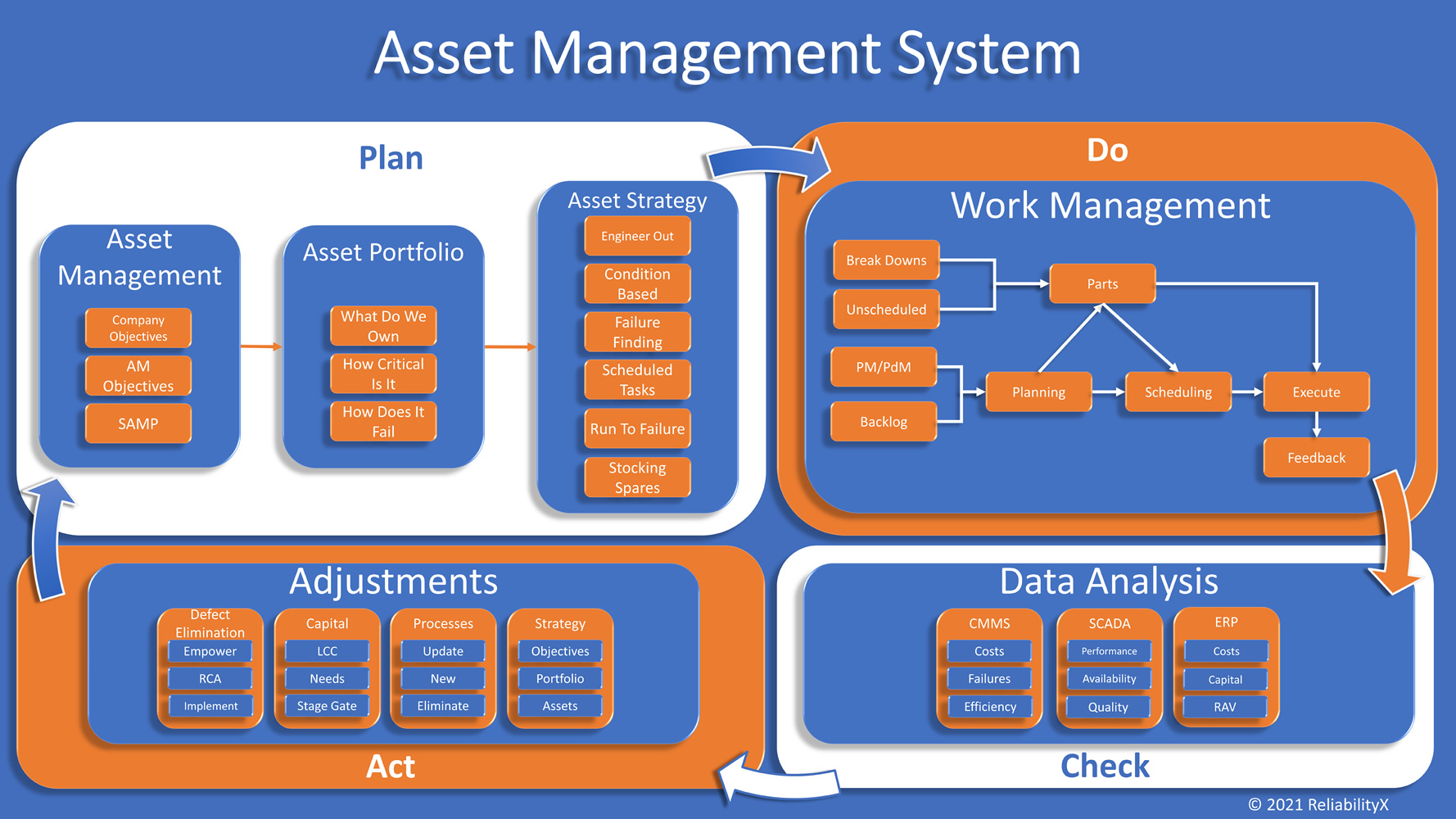
    An asset management system is comprised of all of the necessary processes, procedures, tools, systems, and methods necessary to meet business objectives in a manner which is controlled, measured, and improved upon.  The system, more often than not, takes on some visual representation as in the graphic below.  The purpose is to provide a simplified understanding of the overall process to meet asset management goals.

    The utilization of such a system generally allows an organization to develop standardized methods, train on those methods, and measure against the use and success of the methods.  These steps are typically seen as unnecessary or overkill to smaller organizations. Afterall, if you are the maintenance manager in control of 6 multi-craft technicians, why would you put in all the effort to utilize an asset management standard?  What benefit would such a small group see?

    Regardless of the size of the maintenance team, and asset management system can offer similar benefits.  In smaller teams, the asset management system may be less complex in the level of detail necessary to maintain control of the system but is it just as important to have control.  The asset management system’s level of detail should provide an organization with the ability to identify the right work against the right assets at the right time to ensure continued operation and achievement of company goals.  “Right” indicates understanding of what is important, what needs to be done, and how it will be completed.

    If you are the maintenance manager with a small team developing and implementing an asset management system may seem like a monumental task.  Afterall, you have a day job.  How can you develop the system, procedures, and tools necessary to implement?  I recommend starting with understanding.  There are many resources online and in books to help you understand the asset management system and component processes.  Do some research and find approaches to these elements which provide the right level of detail for your organizational size.  Remember, the goal is to create standards for the various components, not to make them overly complex.  You can improve them over time as necessary and as you mature as a group.

    Good luck!!