Category: Operational Reliability

  • Mastering Loss Management: Unlocking Equipment Efficiency

    Mastering Loss Management: Unlocking Equipment Efficiency

    Mastering Loss Management: Unlocking Equipment Efficiency 

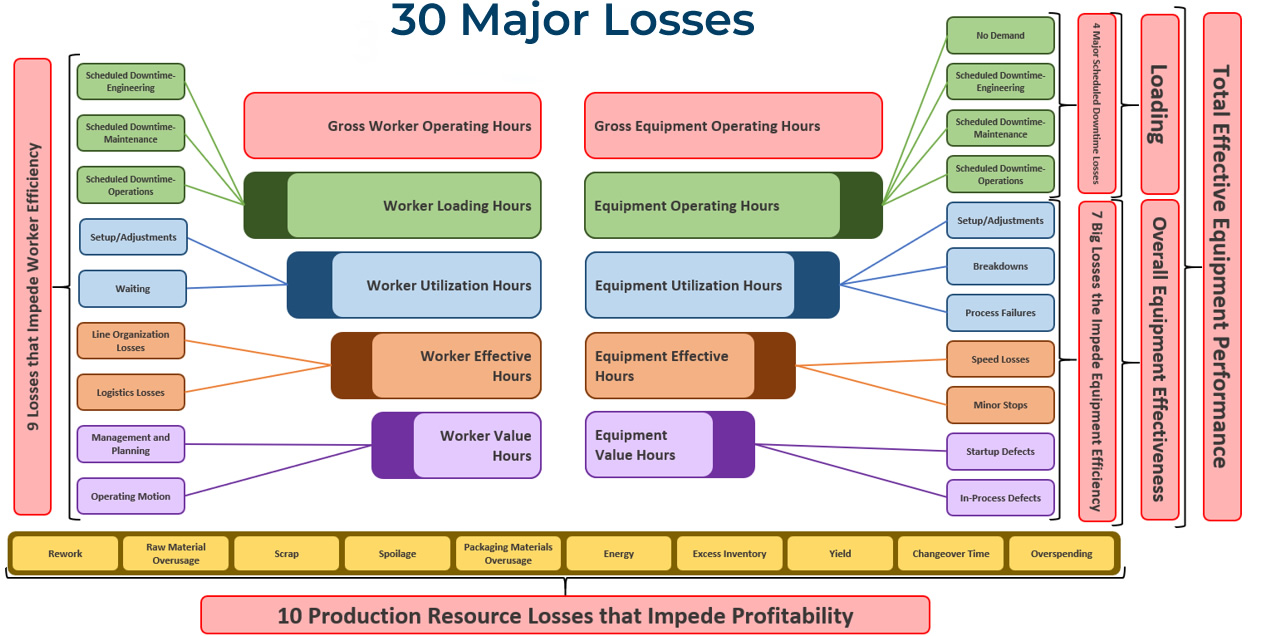
    Loss management is a critical yet often overlooked component of operational excellence. Understanding and addressing the various types of losses—minor stops, speed losses, setup and adjustment losses, process failures, and quality losses—are essential to maximizing equipment effectiveness and productivity. By identifying these losses and taking proactive steps to mitigate them, organizations can transform their operations, reduce waste, and enhance profitability. 

    Minor Stops: The Hidden Productivity Drain 

    Minor stops are brief interruptions that may seem inconsequential but add up to significant productivity losses. These could be due to small jams, sensor misalignments, or operator delays in restarting equipment. Because they don’t always require maintenance intervention, they’re often ignored in reporting. However, their cumulative effect on efficiency can be profound. 

    Mitigation Strategies: 

    • Standardized Work Processes: Clear, documented procedures help minimize operator-related stops. 
    • Operator Training: Educating operators to quickly resolve minor issues can reduce downtime. 
    • Automation Improvements: Upgrading sensors or automated systems can prevent frequent interruptions. 

    Speed Losses: Missing Full Potential 

    Speed losses occur when equipment operates below its designed capacity, reducing overall output. This can result from worn components, inefficient processes, or operator reluctance to push the equipment to its limits due to reliability concerns. 

    Mitigation Strategies: 

    • Precision Maintenance: Ensure machines are maintained to perform at optimal speeds. 
    • Real-Time Monitoring: Use sensors and software to identify performance bottlenecks. 
    • Process Optimization: Streamline workflows to support consistent, high-speed operations. 

    Setup and Adjustment Losses: The Downtime Culprit 

    Setup and adjustment losses occur during extended product changeovers, extended breaks, or any other time when an event exceeds the planned downtime. These interruptions are unavoidable in many operations, but they can often be reduced with proper planning and execution. 

    Mitigation Strategies: 

    • Quick Changeover Techniques: Employ SMED (Single-Minute Exchange of Dies) principles to minimize downtime. 
    • Pre-Staging: Prepare tools, materials, and instructions in advance of a changeover. 
    • Following Guidelines or Procedures: Ensure people are back from breaks on time 

    Process Failures: The Ripple Effect 

    Process failures result in significant downtime, misuse of maintenance personnel’s time and disrupt production schedules. These losses are highly visible and are often attributed to operations or engineering deficiencies. 

    Mitigation Strategies: 

    • Root Cause Analysis (RCA): Investigate failures to address underlying issues rather than symptoms. 
    • Cross-Functional Teams: Involve operators, engineers, and maintenance staff in solving complex process problems. 

    Quality Losses: Production’s Silent Killer 

    Quality losses arise from defects, rework, or scrap and represent wasted effort, materials, and time. They are not only costly but also detrimental to customer satisfaction and brand reputation. 

    Mitigation Strategies: 

    • Standardized Operating Procedures (SOPs): Consistent processes ensure product quality. 
    • Real-Time Quality Checks: Integrate quality checks into production to catch issues early. 
    • Employee Training: Equip employees with the skills to identify and prevent quality issues. 

    The Power of Proactive Loss Management 

    Loss management isn’t just about fixing problems after they occur—it’s about preventing them in the first place. By adopting tools like Overall Equipment Effectiveness (OEE), organizations can track and quantify losses, identify trends, and prioritize improvement efforts. 

    Conclusion 

    Addressing minor stops, speed losses, setup and adjustment losses, process failures, and quality losses requires a systematic and proactive approach. Organizations that prioritize loss management not only improve efficiency and reduce costs but also create a culture of continuous improvement. By mastering loss management, companies can turn operational challenges into opportunities for success. 

  • Defect Elimination: The Cornerstone of Equipment Reliability

    Defect Elimination: The Cornerstone of Equipment Reliability

    In the pursuit of operational excellence and equipment reliability, defect elimination stands as a powerful and proactive strategy. It focuses on identifying and addressing the root causes of failures and inefficiencies, rather than repeatedly treating the symptoms. By targeting the sources of defects, organizations can significantly reduce downtime, extend asset lifespans, and improve overall productivity. 

    What is Defect Elimination? 

    Defect elimination is the systematic process of identifying, analyzing, and removing defects that lead to equipment failure or suboptimal performance. These defects can take many forms, including design flaws, operational errors, poor maintenance practices, or even environmental conditions. The goal is to ensure that equipment operates as intended, reliably and efficiently, with minimal intervention. 

    The Importance of Defect Elimination 

    • Reduces Reactive Maintenance
      Addressing the root cause of defects reduces the frequency and severity of unplanned downtime. This shift from reactive maintenance to proactive problem-solving allows maintenance teams to focus on activities that add value, such as preventive maintenance and continuous improvement initiatives. 
    • Improves Equipment Reliability
      Eliminating defects directly enhances the reliability of equipment by ensuring it operates under optimal conditions. Reliable equipment translates to consistent production, reduced costs, and higher customer satisfaction. 
    • Increases Safety
      Defective equipment often poses safety risks to operators and maintenance personnel. By addressing the underlying causes of these defects, organizations create a safer working environment and reduce the likelihood of accidents. 
    • Optimizes Costs
      Defects can lead to frequent repairs, high spare parts consumption, and lost production time. Eliminating these defects helps to control maintenance costs and improve the bottom line. 

    Steps in Defect Elimination 

    • Identify Defects
      The first step is to recognize the defects affecting equipment performance. This can be done through maintenance records, operator feedback, and techniques like failure mode and effects analysis (FMEA) or root cause analysis (RCA). 
    • Analyze Root Causes
      Once defects are identified, it’s essential to determine their root causes. For instance, is a pump failure caused by improper alignment, insufficient lubrication, or a design flaw? Tools like the “5 Whys” or fishbone diagrams can be useful in this stage. 
    • Develop Solutions
      After identifying the root cause, teams must develop practical and sustainable solutions. This could involve redesigning a component, adjusting operational procedures, or implementing better maintenance practices. 
    • Implement and Monitor
      Solutions must be implemented effectively and their impact monitored. Continuous feedback ensures that the changes made are yielding the desired results and helps identify any residual issues. 
    • Standardize and Share Knowledge
      Successful defect elimination efforts should be documented and shared across the organization to prevent recurrence and foster a culture of learning. 

    Practical Example: Defect Elimination in Action 

    Consider a manufacturing plant that frequently experiences motor bearing failures. An investigation reveals that improper lubrication practices are the root cause. By implementing a lubrication management program, including better training for operators and the use of precision tools, the plant eliminates this recurring defect. The result? Reduced downtime, lower maintenance costs, and improved reliability. 

    Creating a Culture of Defect Elimination 

    For defect elimination to be successful, it must be ingrained in the organization’s culture. Leaders must champion this approach, encouraging teams to identify and address defects proactively. Collaboration between operators, engineers, and maintenance personnel is essential to uncover hidden issues and implement effective solutions. 

    Conclusion 

    Defect elimination is more than a maintenance strategy—it’s a mindset that prioritizes reliability and continuous improvement. By addressing the root causes of failures, organizations can achieve significant gains in equipment performance, operational efficiency, and cost control. Embracing defect elimination as a core principle positions businesses for long-term success in today’s competitive manufacturing environment. 


  • Cultivating Excellence: The Art of Building a Reliability Culture

    Cultivating Excellence: The Art of Building a Reliability Culture

    In the realm of industrial operations, a culture of reliability isn’t just a preference; it’s a necessity. It’s the bedrock of efficiency, safety, and sustainability, providing the fertile ground for organizations to thrive and adapt in an ever-evolving world. In this blog, we will explore the methods and principles that guide the development of a reliability culture, the essence of operational excellence.

    Understanding the Reliability Culture

    A reliability culture is a shared commitment within an organization to consistently deliver on promises and expectations. It’s about instilling a mindset where everyone, from top management to front-line employees, values reliability as a core principle.

    1. Leadership Commitment

    Building a reliability culture begins at the top. Leaders must set the tone by demonstrating unwavering commitment to reliability. Their actions and decisions should align with the organization’s reliability goals.

    1. Clear Vision and Values

    An organization’s reliability vision and values must be articulated and communicated clearly. This clarity provides a roadmap for all employees to understand the importance of reliability in achieving the organization’s goals.

    1. Education and Training

    Invest in education and training programs to equip employees with the skills and knowledge needed to promote reliability. These programs can cover areas like preventive maintenance, safety, and best practices.

    1. Employee Involvement

    In a reliability culture, employees are not just the recipients of policies; they actively contribute to their development. Encourage feedback and involvement in decision-making processes to empower and engage your workforce.

    1. Accountability and Measurement

    Reliability must be measurable. Set clear, quantifiable targets and hold individuals and teams accountable for meeting them. This fosters a sense of responsibility and ownership.

    1. Preventive Maintenance

    Preventive maintenance is a cornerstone of a reliability culture. Regular equipment inspections, maintenance schedules, and condition monitoring are essential to keep machinery in peak condition.

    1. Data-Driven Decision-Making

    Leverage data analytics and condition monitoring systems to make informed decisions. Real-time data provides insights for predictive maintenance and helps optimize schedules.

    1. Safety Protocols

    A culture of reliability goes hand-in-hand with safety. Safety protocols ensure that employees and assets are protected. A safe work environment is crucial for operational reliability.

    1. Continuous Improvement

    A reliability culture is not static; it’s dynamic. Encourage a culture of continuous improvement where employees are empowered to suggest changes and innovations. Regularly review and refine processes.

    1. Collaboration and Communication

    Foster collaboration and open communication across departments. Silos can lead to inefficiencies and breakdowns in reliability.

    1. Recognition and Rewards

    Recognize and reward reliability excellence. Acknowledging and celebrating achievements in reliability reinforces the importance of this culture.

    1. Resilience and Adaptation

    In a rapidly changing world, adaptability is crucial for reliability. Organizations must be resilient and ready to adapt to new technologies, regulations, and market conditions.

    1. Training Programs

    Offer training programs and resources to enhance the skills and knowledge of your employees. Knowledgeable and well-trained teams are more reliable.

    1. Ethics and Integrity

    Reliability goes beyond machinery; it’s also about ethical behavior. Uphold the highest standards of integrity and ethics within your organization to reinforce the reliability culture.

    In conclusion, a reliability culture isn’t just about machinery; it’s about fostering a mindset that values trust, responsibility, and continuous improvement. It’s an investment in long-term success, efficiency, and operational excellence. Organizations that embrace a reliability culture are better prepared to navigate the challenges of the modern business landscape and ensure that they deliver on their promises consistently. Reliability isn’t just a goal; it’s a culture that permeates every aspect of an organization, from leadership to daily operations.


  • Building Credibility: The Cornerstone of Professional Success

    Building Credibility: The Cornerstone of Professional Success

    Credibility, often described as the currency of trust, is a quality that sets the foundation for professional success. It’s the attribute that influences how others perceive your competence, reliability, and integrity. Whether you’re an individual striving to advance your career or a business aiming to gain the trust of your clients, credibility is your guiding star. In this blog, we’ll delve into the methods of developing and enhancing credibility to help you stand out in your professional journey.

    1. Expertise and Knowledge

    Building credibility begins with expertise. The more you know about your field, the more you can contribute meaningfully. Continuously expand your knowledge through education, training, and staying updated with industry trends. Becoming a subject matter expert in your area of focus is a surefire way to gain credibility.

    1. Consistency in Performance

    Reliability is a key component of credibility. Consistently delivering high-quality work, meeting deadlines, and keeping your promises builds trust. Whether you’re an employee, entrepreneur, or service provider, people value those they can depend on.

    1. Transparent Communication

    Clear and transparent communication is essential. Be honest about your capabilities, share your intentions, and openly address challenges. Transparency fosters trust, as people appreciate those who communicate openly, even when facing difficult situations.

    1. Authenticity

    Authenticity is a powerful credibility booster. Be true to yourself and your values. Pretending to be someone you’re not erodes credibility. Authenticity resonates with people and makes you more relatable.

    1. Consistent Personal Branding

    Your personal or professional brand should be consistent across various platforms and interactions. From your online presence to in-person meetings, a unified brand reinforces your image and credibility.

    1. Testimonials and Recommendations

    Third-party endorsements are powerful. Positive testimonials and recommendations from colleagues, clients, or superiors provide concrete proof of your credibility. Encourage satisfied clients or associates to share their experiences.

    1. Deliver Value

    Always focus on delivering value to others. Whether it’s through your work, advice, or products, a consistent commitment to creating value for others will establish you as a credible professional or business.

    1. Continuous Learning and Adaptation

    Credibility isn’t a static attribute; it requires continuous learning and adaptation. The world is constantly evolving, and those who stay updated and adapt to change remain credible and relevant.

    1. Uphold Ethical Standards

    Integrity is a non-negotiable component of credibility. Uphold ethical standards in all your actions and decisions. Unethical behavior can tarnish your credibility irreparably.

    1. Community and Industry Involvement

    Active involvement in your professional community and industry events enhances credibility. It demonstrates your commitment to your field and provides opportunities to network and learn.

    1. Thought Leadership

    Sharing your insights and knowledge through articles, presentations, or speaking engagements can position you as a thought leader in your industry. Thought leadership bolsters your credibility.

    1. Feedback and Improvement

    Welcome feedback and use it as a tool for improvement. Show your willingness to learn and adapt based on constructive criticism. It demonstrates your dedication to growth and credibility.

    1. Professionalism

    Maintain professionalism in all your interactions. How you conduct yourself, whether in negotiations, meetings, or daily communications, reflects on your credibility.

    In conclusion, credibility is an asset that opens doors, builds trust, and propels your career or business forward. It’s a combination of expertise, reliability, transparency, and integrity. By consistently focusing on these aspects and actively enhancing your credibility, you can establish yourself as a respected and trusted professional in your field. Credibility is not just about how others perceive you; it’s about the trust and respect you earn through your actions and character.


  • Exemplary Maintenance Leadership: The Backbone of High-Quality Operations

    Exemplary Maintenance Leadership: The Backbone of High-Quality Operations

    In the world of industrial and manufacturing enterprises, where precision and reliability are paramount, maintenance leadership stands as the unsung hero. Behind the scenes, these individuals and teams are the custodians of high-quality operations, ensuring that machinery hums with efficiency, downtime is minimized, and standards are not just met but exceeded. Let’s take a closer look at the essence of exemplary maintenance leadership and why it’s the cornerstone of a well-oiled operation.

    The Role of Maintenance Leadership

    Maintenance leaders are the linchpin of a successful operation. Their responsibilities encompass a wide array of crucial functions, from managing preventive and predictive maintenance to troubleshooting unexpected breakdowns. They oversee equipment health, spare parts inventory, and scheduling to ensure seamless production.

    Qualities of Exceptional Maintenance Leaders

    1. Technical Proficiency: First and foremost, maintenance leaders possess a deep understanding of the equipment and systems they oversee. They’re experts in the intricacies of machinery and are skilled in diagnosing and resolving issues efficiently.
    2. Analytical Acumen: Exceptional maintenance leaders are adept at analyzing data, be it from predictive maintenance tools, equipment logs, or incident reports. They use this information to make informed decisions, spot trends, and predict potential failures.
    3. Proactive Mindset: Rather than simply reacting to issues, top-notch maintenance leaders are proactive in their approach. They schedule regular maintenance and are continuously seeking ways to improve equipment reliability.
    4. Team Collaboration: Effective leadership often hinges on collaboration. Maintenance leaders work closely with operators, engineers, and other departments to ensure a harmonious working environment. They communicate effectively and bridge the gap between different parts of the organization.
    5. Problem-Solving Prowess: When things go awry, maintenance leaders are the problem solvers. They thrive in high-pressure situations, diagnosing the root causes of failures and implementing swift solutions.

    The Impact on Operations

    Exemplary maintenance leadership has a profound impact on an organization’s operations:

    1. Minimized Downtime: Through rigorous preventive and predictive maintenance, maintenance leaders minimize unplanned downtime, ensuring continuous production and delivery.
    2. Enhanced Efficiency: Well-maintained equipment operates more efficiently, saving on energy costs and boosting overall productivity.
    3. Cost Savings: By preventing major breakdowns and extending the life of equipment, maintenance leadership ultimately leads to cost savings for the organization.
    4. Safety and Quality: Maintenance leaders prioritize safety and quality by ensuring that equipment operates within design specifications and safety standards. This protects employees and product quality.

    Continuous Improvement and Training

    Exemplary maintenance leadership also emphasizes continuous improvement. Leaders invest in ongoing training and development for themselves and their teams. They stay updated on emerging technologies, industry best practices, and safety protocols. By nurturing a culture of learning, they ensure that their teams are equipped to handle the challenges of the future.

    In conclusion, maintenance leadership is not merely about fixing things when they break. It’s a strategic role that contributes to an organization’s overall success. These leaders are the guardians of high-quality operations, keeping the wheels of industry turning smoothly. Their technical prowess, problem-solving skills, and commitment to excellence make them indispensable in the world of maintenance and reliability. The next time you see a well-maintained machine running like clockwork, remember that behind it lies the dedication and expertise of exemplary maintenance leaders.

  • The 10 Habits of Highly Effective Reliability-AM professionals

    The 10 Habits of Highly Effective Reliability-AM professionals

    Over thirty years ago, Steven R Covey, renowned author, and business management guru, introduced to us “ The 7 Habits of Highly Effective People”, which presented an approach to being effective in attaining personal or business goals by aligning to what he called “True North” principles based on character ethics. This book has become a best seller, a must-read, and has sold 40 million copies worldwide.

    The first three habits moving from dependence to independence (Creating self-mastery) are:

    1) Be Proactive.

    2) Began with the end in mind.

    3) Put first thing first.

    The next three habits that talk about interdependence (working with others) are:

    4) Think win-win.

    5) Seek first to understand, then to be understood.

    6) Synergize.

    The final habit is…

    7) Continuous Improvement in both the personal and interpersonal spheres of influence.

    I have tried to follow these habits in my life; in fact, I have developed my own ten habits based on these principles to be successful in my journey in the Reliability- Asset Management arena. These Ten Habits of Effective Reliability -Asset Management Professionals (including engineers, technicians, and managers), are:

    • Define the Problem clearly: … Identify the problem and the issues behind it
    • Eliminate the root of the problem: … go to the root of the problem, don’t get trapped in correcting symptoms.
    • Use Data (facts) for decision-making: Use data to make the right decisions.
    • Make a Win-Win for both parties: … Resolve conflicts ensuring both parties have something to celebrate.
    • Develop teamwork: … All working together, no silos.
    • Communicate: …. Keep people informed.
    • Be Proactive: … Don’t wait for failure to happen to take action.
    • Prepare for change: …. Be ready to accept change-improvements.
    • Learning environment: …    Learning never stops
    • Adopt Continuous Improvement: … continuing improvement is must!


    Make these your regular habits to be successful in your Reliability- AM or any journey you take.

    Watch for more to come…

  • Certification and Competencies

    Certification and Competencies

    Competency is defined as the capability to apply or use the set of related knowledge, skills, and abilities required to successfully perform a task or work safely and consistently to a required standard. Simply stated, Competency is a critical skill set needed to do a job successfully. On the other hand, Certifications are designated credentials earned by an individual or organization to verify their legitimacy and competence to perform a job or produce something in a stated environment. Certification is typically displayed as a document stating that you have acquired appropriate knowledge, been trained, and are prepared to meet a specific set of criteria as a professional. This certification is awarded only after you’ve passed the proper assessments administered by a recognized third-party credentialing institution or organization. Generally speaking, there are three general types of certification: Organization -internal, Product-specific, and Profession-wide, such as reliability and maintenance professional. Some examples of professional certifications are CMRP, CMRT, CRL, CMM, MLT, CAMA, etc.

    Professional certification is not a replacement for accredited degree work but instead is supposed to complement your education or professional experience in your field. Once you’ve earned a certification, you are given a designation that you can use after your name as a way to distinguish certified professionals. Obtaining professional certification displays your dedication to your profession and verifies that you’re well-trained to use your industry’s best practices and tools effectively. Taking the time and effort to obtain these certifications can show potential employers that you are a valuable contributor to your profession and help you gain recognition for your commitment to continuous learning and self-improvement.

    The significant advantages of becoming certified in your work include:

    • Knowledge and skills to implement best practices
    • Professional credibility
    • Improved Efficiency
    • Competitive advantage
    • Improved earning potential

    If you have any questions on this topic or others, please fill out the form below or get in touch with us at ReliabilityX!

  • 7 Steps of Clean, Inspect, & Lubricate

    7 Steps of Clean, Inspect, & Lubricate

    Through daily inspections, cleaning, and lubrication practices we can measure, prevent, and restore deterioration to our equipment. The expectation is that a team is put together made up of maintenance, operations, and leadership employees to roll out strategy beginning with one piece of equipment. They will implement the following 7 steps:

    • Initial Cleaning
    • Eliminate sources of dirt and hard to clean & inspect areas
    • Create and maintain cleaning, inspection and lubrication standards
    • General Inspection
    • Operator Inspection
    • Activities standardized
    • Team Development and Operator Driven Reliability

    Step 1: Initial Cleaning

    1. Planning for initial cleaning
    2. Initial cleaning and defect identification preparation and planning (Log for tracking defects tied to work orders)
    3. Initial cleaning activities
    4. Defect identification logging through work order creation and promotion of continuous defect identification
    5. Introduction of first temporary standard
    6. Continuous follow up on completion of work orders related to found defects

    Step 2: Eliminate sources of dirt and hard to clean & inspect areas

    1. Analyze sources of dirt and hard to clean areas
    2. Implement solutions, update cleaning standard, monitor results
    3. Improve difficult to inspect areas

    Step 3. Create and maintain cleaning, inspection and lubrication standards

    1. Create and maintain cleaning and inspection standards
    2. Study the lubrication system
    3. Simplify the lubrication system
    4. Create a visible lubrication system
    5. Introduce a lubrication schedule
    6. Train the operators
    7. Monitor results

    Step 4. General Inspection

    1. Have leaders study the equipment
    2. Train the operators
    3. Apply everything learned about the equipment and solve problems
    4. Promote visual management
    5. Define inspection standards
    6. Check results

    Step 5. Operator Inspection

    1. Integrate cleaning and lubrication standards with General Inspection and introduce basic points
    2. Prepare checklists for full implementation by all shifts, all operators
    3. Implement Visual Management at operational level
    4. Promote communication and start Team Performance Control System (Metrics to measure how well the implementation going and meetings to analyze successes and opportunities)
    5. Check results from past to today

    Step 6: Area Activities Standardization

    1. Assess current operational standards and update them
    2. Apply 5S to work area
    3. Identify basic losses relating to equipment
    4. Systematically eliminate defects by applying Problem Solving Tools
    5. Develop a Weekly Team Performance Control System (Meeting to create action item lists, assigning people and dates for completion of tasks, and follow up and review. Also, create visible metrics to show area operations your progress)

    Step 7: Team Development and Operator Driven Reliability

    A. Integration & Management

    1. Integrate activities and Safety, Quality, and Maintenance Controls
    2. Apply suggestion system
    3. Manage the area’s material flow
    4. Develop a high value added Data Collection System
    5. Achieve 100% conformity to improve MTBF, MTTR, and other associated losses
    6. Develop a Daily Team Performance Control System (Daily Morning meeting to discuss performance, list top 3 factors needing problem solving tools applied, and follow up on outstanding tasks needed to be complete.)

    B. Analysis of Losses

    1. Analyze area costs and losses
    2. Apply Problem Solving tools to highest priority losses
    3. Identify and analyze hidden losses
    4. Identify countermeasures to eradicate hidden losses
    5. Acknowledge the area improvement targets, plan for improvement, and follow up actions
  • Clean to Inspect for Best in Class Operator Care

    Clean to Inspect for Best in Class Operator Care

    Cleaning is an important first step in Operator Care and reliability gains because:

    • Insufficient cleaning causes losses and
    • The cleaning activity itself exposes hidden defects

    Dirt in rotating parts, sliding parts, pneumatic and hydraulic systems, electrical and control systems, sensors, etc. causes malfunctions, reduce function, failure by wear, clogging, resistance, speed losses, etc. are different types of defects. Defects are anything that is abnormal from the expected ideal condition. Insufficient cleaning causes forced deterioration. All these losses are solved through a thorough cleaning of equipment and countermeasures to keep the equipment clean.

    Defect Identification while cleaning

    Since the key reason for cleaning is to identify abnormalities while cleaning, it is important to understand how to do this. Abnormalities will be found both while cleaning and ideally while the line is running since many abnormalities are undetected when the equipment is down. Anyone can find an abnormality through the use of their senses (touch, smell, see, hearing). Individuals on the team should become like human sensors. This thorough approach increases the chances of detecting hidden abnormalities such as abnormal vibration, noise, odor and overheating just to mention some. (Notice all of these can only be detected during equipment operations)

    Today, many defects are hidden because the equipment is dirty. Equipment inspections fail to expose these “hidden” defects. By cleaning the equipment thoroughly, we expose every defect. The key concept is: Cleaning is Inspection. When we clean, we touch every part of the equipment and therefore inspect every part of the equipment. The analogy that is often used to describe this idea is that of washing your car. When you wash your car by hand, you see every dent & scratch.

    This “inspection by cleaning” process is part of the daily work while operating the equipment. This skill is developed, practiced, and improved and it becomes part of daily work and is used throughout the entire plant.

    Teams should expect to reduce losses as a result of their Operator Care activity. Daily equipment loss data provides the picture of current and ongoing losses. Priority can be put first on that part of the equipment that experiences the most losses.

    Ongoing, daily data can then be used to:

    • Assess loss elimination progress
    • Review failures as they occur
    • Focus the daily cleaning and inspection activities

    Daily data should include things such as: Number of touches (the amount of times a person has to physically do something to keep the equipment running as designed), Number of minor stops, breakdowns, etc.

    As they review the data, teams should ask themselves the following questions:

    • Should our activities have prevented the loss?
    • Was the loss caused by insufficient cleaning?
    • Was there a problem we should have detected while cleaning, but failed to see?
    • Are we cleaning and inspecting the right areas?
    • If we found a problem did, we fix it in time, or was it fixed incorrectly?
    • Is the cleaning we are doing having no effect on the operation of the equipment?
    • Are we cleaning items more frequently than needed to maintain ideal?

    From this assessment, the team should adjust their work.

    They may need to:

    • Focus their cleaning to inspect in critical areas
    • Adjust how they are handling the problems they find
    • Obtain some training on how to detect the type of problems that are causing the losses they have

    Cleaning sounds easy but here are a few things to think about before you start cleaning:

      1. Preparation:

    Most deep cleaning will require the operation to be down which means preparation is critical. The boundaries of the Operator Care activity need to be clear; before pictures should be taken, cleaning supplies(rags, cleaning solution) and tools should be available; safety maps and risk prediction forms should be available, MSDS’s should be reviewed for the cleaning solutions to be used.

      1. Cleaning techniques:

    First of all, the most contaminated areas must be cleaned thoroughly. Following some tips to be considered during cleaning:

      1. Clean from top to bottom, center to outside in order to keep already clean areas clean.
      2. Touch every part of the equipment
      3. Lids and safety panels must be opened and internal parts of the machine inspected, cleaned, and checked for looseness of bolts, screws, nuts, photo-eyes, etc.
      4. Clean all auxiliary parts of the machine
      5. All objects near the machine that are not necessary must be eliminated.
      6. Closing out the cleaning activities:

    3. After the team has completed the cleaning activity it is important that before they leave the area they:

      1. Check the area for tools, trash, etc.
      2. Capture after pictures
      3. Put supplies away
      4. Perform a test run

    4. Turnover of cleaning activities to line operations:

    At the end of a cleaning session, it is important to make sure that the equipment is ready for operation. A summary of the teams’ activities should be provided to the oncoming team in case issues arise later. Cleaning activities should not cause any type of loss to the line.

    1. The Cleaning should take place at the end of the shift with the goal of setting the next shift up for success.

    And finally, keep a record of how much time your team is cleaning. All cleaning time is a loss; ideal is 0. Any progress to eliminate effort loss on keeping the machine clean should be captured.

  • Understanding Plant Losses

    Understanding Plant Losses

    The Way Losses are Calculated
    and OEE/TEEP Calculation

    In order to get a broad, clear picture of where to focus, you have to view your whole plant as a large system of fully manageable processes. No matter your role, your job is to improve plant processes, helping to produce the highest quality product, at the lowest price possible, in the safest manner. In order to see this big picture, you have to be honest and expose true problems within your facility. From that perspective, you will be able to recognize the different types of losses in your plant and how to secure significant gains in productivity by controlling those losses.

    How to determine where to focus

    The examples in this article use weekly numbers, but the same analysis can and should also be applied monthly, quarterly, and annually. Here we will look at how we apply metrics to some of the different loss types. Armed with an understanding of how your plant is losing productivity and how to measure those losses, you can effectively increase profitability. Let’s look at a few areas of loss.

    Available Time To Produce (Loading)
    1. First, you figure all scheduled downtime. Remember your buckets and put time scheduled in each of the buckets: Changeovers, Engineering Planned Shutdown, Maintenance Planned Shutdown, Operations Planned Shutdown, or No Customer Orders.
    2. Add them all together to come up with your Scheduled Downtime.
    3. Then subtract that from total hours in a week (168 hours available).

    Example: (Planned Maintenance of 24 hours) + (Changeovers of 4 hours) = 28 hours of scheduled downtime.
    (168 hours in a week) – (28 hours Scheduled Downtime) = 140 hours available to produce.

    Loading Calculation: (140 scheduled production hours) / (168 hours in a week) = 83%

    This gives you your Available Time To Produce, 140 hours per week or 83%.

    Quality Rate

    Start by taking your startup rejects and your in-process rejects, add them together, then subtract that value from your total units produced.

    Example: (35 Startup Rejects) + (35 In-Process Rejects) = 70 Rejects.
                   7,070 Total Units Produced.
    7,070 70 = 7,000 Good Units Produced.

    Quality Rate Calculation: (Good Units Produced) / (Total Units Produced) or 7,000 / 7,070 = 99%

    Net Good Processing Hours

    Find your Net Good Processing Hours by dividing your Average Weekly Throughput by your Weekly Design Rate.

    Example: Average Weekly Rate is 7,000 units produced.
    Weekly Design Rate is 100 units per hour.
    7,000 / 100 = 70 Net Good Processing Hours.

    Then, divide your Net Good Processing Hours by your Available Time To Produce.

    Example:  Available Time To Produce is 140 hours weekly.
    70 Net Good Processing Hours / 140 Available Hours To Produce = 50%

    Net Good Processing Hours Calculation: (Average Weekly Rate) / (Weekly Design Rate)
    That is, (Weekly Units Produced) / (Weekly Design Units per Hour)

    Availability

    Begin by taking your Average Breakdown Downtime, Process Failure Downtime and Set/Adjustment Downtime, adding them together, then subtracting the total from the Available Time To Produce.

    Example: (13 hours of Breakdowns) + (1 hour of Process Failures) + (1 hour of Setup/Adjustment) = 15 hours downtime
    (140 hours Available Time To Produce) (15 hours Downtime) = 125 hours Availability per week

    Availability Calculation: (125 hours Availability) / (140 hours Available Time To Produce) = 89% Availability

    Performance

    First, take your Actual Weekly Run Rate and subtract it from the Weekly Design Rate.

    Example: (Weekly Design Rate of 100 per hour) (Actual Weekly Run Rate of 85 per hour) = 15 units per hour lost.

    To convert that loss to hours, divide the Actual Weekly Run Rate by the Weekly Design Rate, subtract that quotient from 100, then multiply that difference by the Availability (in hours per week).

    Example: ( 100 (Actual Weekly Run Rate) / (Weekly Design Rate) ) x (Weekly Availability)
    ( 100 (85 units/hr / 100 units/hr) ) x (125 hours available to produce) = 19 hours in speed losses

    Now, subtract the hours in Speed Losses from the Weekly Availability hours to get Available Time To Produce.

    Example: (125 hours Weekly Availability) (19 hours in Speed Losses) = 106 hours Available Time To Produce.

    To find minor stops, subtract your Net Good Processing Hours from your Available Time To Produce.

    Example: (106 hours Available Time To Produce) (70 hours Net Good Processing Hours) = 36 hours of minor stops per week.

    Performance Calculation: (Speed Losses + Minor Stops) / Weekly Availability
    (19 hours in Speed Losses + 36 hours in Minor Stops) / (125 hours Weekly Availabilty)
    (19 + 36) / 125 = 56% Performance

    OEE/TEEP Calculations: OEE = Availability * Performance * Quality
    OEE = 89% * 56% * 99% = 49%
    TEEP = Loading * OEE     (Loading = Percentage Available Time To Produce)
    TEEP = 83% * 49% = 41%

    7 Big Losses: Minor Stops: 36 hours per week
    Speed Losses: 19 hours per week
    Breakdowns: 14 hours per week
    Process Failures: 1 hour per week
    Setup/Adjustment Losses: 1 hour per week
    Quality Startup Losses: 0.5 hour per week
    Quality In-Process Losses: 0.5 hour per week

    If these were your numbers, where would you focus?