
Just slip out the back, Jack.
Author: Anjelica
-

Self Awareness
The first step in any forward progress needs to be identifying the reality of where you are right now. If you’re trying to get to the North Pole, it doesn’t matter what map you’re given, if you don’t know where you’re starting.
This is a difficult conversation to have with yourself, but it is the foundation of a solid framework for success and is absolutely critical for any sustainable forward motion.
There are two types of self-awareness that need to be expanded on: Internal Self-Awareness and External Self-Awareness.
Internal Self-Awareness is how well you know yourself, and External Self-Awareness is how well you understand how others see you. Both of them are important, and neither alone is sufficient. The intersection of these two metrics is how you diagnose and solve the problems that you face personally.
Unless you’re highly self-aware both internally and externally, you’re not living up to your full potential as an employee, or as a person.
These two metrics were well explained by Dr Tasha Eurich, published in the Harvard Business Review and explained in the diagram to follow.
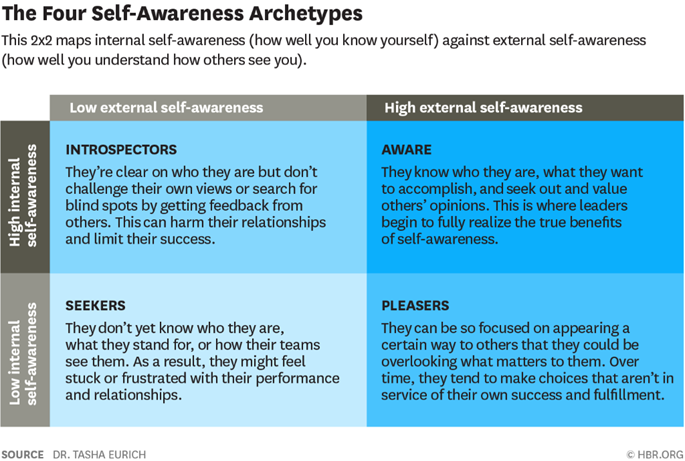
I can speak to this chart personally.
Early in my career I would focus on specific numbers, to the point where it was causing problems with work relationships, exactly what the “Introspectors” corner talks about in the diagram above.
I would only focus on how right my numbers were, and any other opinions be damned: I was right.
After years of frustration, I became more externally self-aware, realizing that the bottom line isn’t the end-all, be-all in arguments.
Without the external self-awareness, I was unable to see the whole picture, much less have a road map for where I should be going.
For yourself, you need to look inward and ask:
What characteristics are you utilizing to be successful?
What characteristics are you utilizing that you think should, but just aren’t working?
Are you willing to acknowledge that you have room to improve?.
These questions transition to talking about the above quadrants:
- Being honest about your current state, knowing who you are. This includes your identity, your communication style, your leadership style, core beliefs, biases and being aware of the biases
- Your reputation: are you a problem solver, do you eliminate problems, or do you simple give hope to people who will inevitably will be betrayed by your failure.
- Having a backbone
-

Self-Accountability Part 5
Step Three: Develop good habits
We will talk much more about this in the section on Self-Discipline, but good habits are building blocks that will get you to where your personal development plan, that we built in step one, is heading.
The first thing to focus on when starting to develop good habits is to remove bad ones, and one of the worst habits is creating excuses.
Excuses are like layers to an onion, once you peel one excuse back, you find a new bad habit every time you look closer.
If you turn in a report at work that’s full of typos and has errors that should have been caught, the excuse is “I only had 3 hours to write the report.”
If we peel that back, we see that you weren’t assigned the project at 1 pm, to present at 4 pm – you just failed to properly manage the much longer time you actually had for the project – and it’s very likely there was more than enough time.
Now the question is “why is your time managed so poorly?”
Are you staying up late watching TV, that leaves you scrambling the morning the report is due?
Are you not serious about the job, leading to sloppy work?
Are you blaming other people for your failures?
Either way, the burden of responsibility is on you and as long as you fail to hold yourself accountable, these mistakes are going to keep piling up.
You’ll continue to disappoint yourself, and you’ll continue failing to reach your goals in the personal development plan we outlined earlier in the chapter.
The good news is that you can turn it all around. It’s not easy for some people to honestly reflect on the causes of their problems, but it’s the most important work that you can do.
Now we’re self-aware of where we are, and now we’re holding ourselves accountable for how we got there. In the next chapter, we’ll discuss what comes after that.
-
Self-Accountability Part 4
Step Two: Be Honest With Yourself
Self-accountability is meaningless without honesty. It can be difficult to be honest with yourself, because then you’re pulling away all the excuses and rationalization that stand between you and what you want, but it’s the only way forward.
This is a two-part process, the first part of which is simply putting your ego aside and realize that you don’t know everything. No one does, and it might be a tough pill to swallow, but you aren’t the exception. Having the courage to admit that you don’t know everything opens the door to the second part of this process: asking for help.
I can speak personally about this, having spent around twenty years in my career thinking I knew everything and struggling all along the way.
– If you want to spend your career making every single mistake possible, at the end of your career you could be the wisest and most experienced person in your field. You also spent decades learning and likely re-learning the same mistakes over and over again.
– If you’re able to have a little humility and ask for help from people who have been where you are, you’ll find your growth will explode. Instead of a decade struggling on XYZ, you can find a veteran who can cut literally years off of your learning curve with a few sentences.
– The old phrase about touching a hot stove isn’t really how the world works. In reality, there’s about 90% of people who have touched the stove once, keep touching it and constantly wonder why their hands hurt so much. Then there’s 9% who touch it once, and realize “that was a terrible idea” and don’t touch it again.
Finally, we have the 1% who see everyone else cursing at the stove, holding their hands and have the courage to ask someone if they should touch the stove while everyone else gets burned.
When you compound all of the time that asking for help can get you, it’s almost unbelievable how much faster you can develop than your peers. There’s no reward for re-inventing the wheel, and the vast majority of problems you’ll face in your career are similar to problems other people have faced.
The best thing about asking others for help is they’ve already done the work, burned their hands and as long as you ask politely, you get the answers to the test.
Now that we’re taking the fast lane towards success, let’s talk about the final step in becoming more self-accountable.
Continued…
-
Self-Accountability Part 3
A great tool to help diagnose where these problems come into play is using the four quadrants from Stephen Covey’s great book, “The Seven Habits of Highly Effective People” or sometimes called “The Eisenhower Matrix” after the famous General and President.
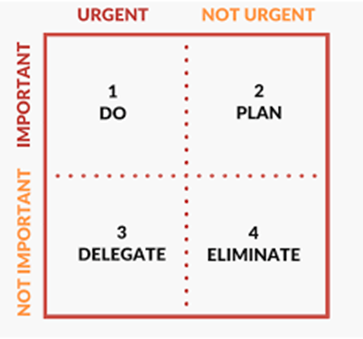
The quadrant is displayed at the left. Take any task that you need to perform and grade it on the two questions that follow.
- Is this urgent? – does this task require immediate attention or there will be negative consequences? Tasks that are urgent are like running water over a burned finger or paying rent on the first of the month. If you don’t handle them immediately, you’ll move significantly further from your goals.
- Is this task important? Will this specific task “move the needle” for whatever metrics you have designed in your personal development plan? This could be launching a marketing campaign for your business or applying to new jobs. The difficulty of a task can, but does not always, match the importance.
The simple nature of the matrix is intuitive and easy to use, especially if you have experience running a team.
The important and urgent (quadrant 1) is something you personally need to do immediately. This is the CEO returning the calls of the company’s attorneys: you don’t want the summer intern in charge of that, and you don’t wait until 3 months to call them back.
The important but not urgent (quadrant 2) means you personally need to plan out where the process is going. When a home builder sells a home, one of the first steps is planning all of the components and craftsmen necessary to get the entire project done. If windows are on a 3 month lead time, not the usual 2 weeks, that’s not a problem the day the house is sold, but it’s an incredibly serious problem a month before turning the house over to the new owners. Taking that time to plan out what could turn from just important into important and urgent, and preventing those problems from happening is a huge return from a time perspective.
Next is the urgent, but not important in quadrant 3. This could be something like “returning a current customer’s phone call about a non-critical issue”. If a customer wants clarification on a small item, it’s not something the CEO should focus on, but would be perfect for an hourly employee to do. The focus here is to delegate what is possible, to make sure you’re getting the best use of your time. Remember that as long as the task is done, you’re successful.
Finally we have quadrant four, the least important and least urgent tasks. These are the easiest traps to fall into on your path to success, and eliminating these tasks completely is the goal.
When entrepreneurs get started building their businesses, this is where so many get stuck in the mud: they want business cards, and logos, and talk about “what the company culture will be like”. Those tasks are great ways to avoid having to do the most important and urgent task entrepreneurs have: getting new, paying clients.
– Jim Koch, the man who created the Boston Beer Company, best known for their Samuel Adams beer line, had a great story about when he was starting out. He had picked out the perfect logo, was looking at office space and had his eye on a massive computer system to handle processing all the orders he’d have.
– The trouble was, he had zero orders. A family member who was an investor and had a background in finance finally sat him down and said “it doesn’t matter if you have the fanciest computer to process the orders, if you don’t have any orders to process.”
– Jim was failing to properly categorize tasks using the quadrant above. He was luckily just wasted time, and not the precious start-up money, on the unimportant and not urgent tasks. After the conversation with the family member, he went into a bar with a six pack, sold his first few cases and now employs around 2000 people, generating over one billion dollars per year in revenue
– Imagine what would have happened if he didn’t talk to the experienced family member? He could have spun his wheels for years, designing letterhead and who knows what other useless task, while the empire of Boston Beer Company faded away.
The entire American craft brewing renaissance might not have happened if Jim didn’t have that one conversation – and more importantly – implement the action that was recommended.
– How are you cutting yourself short in the impact that you’re able to make to the world? That’s what the quadrant is designed to improve, not just the insight, but how you can take the insights learned into action.
– When you’re assessing your personal development plan, you can use this matrix on the front and back end, as both a planning tool and one for diagnosis of failure. If you’re finished with your whole plan, but before you implement it you do a quick check of all of the daily plans against this matrix, you can save yourself a ton of wasted time on the front end: could half of these tasks be delegated, and a quarter totally eliminated?
– Next you can use it on the back end. Take time every three months, six months, whatever interval makes sense to do an audit of your activity. Were you actually delegating the urgent but not important? Did you spend two weeks building a social media presence for a business that isn’t necessary or likely to get new clients for your small consultancy? Did you prioritize your day to solve urgent and important problems, every single day?
Use the feedback to change habits, not feel sorry for yourself, and your creativity at solving the problems will skyrocket, and so will your progress towards your goals.
Once you’ve made the plan outlined above, you’re taking the daily action necessary to meet your specific goals that are all outlined and you’re taking a look at the plan every few months to make sure you’re not focused on unnecessary things, we can consider step one completed.
The next thing we need to focus on is step two.
Continued…
-
Self-Accountability Part 2
Step 1: Know your role and your responsibilities
The first step in creating more self-accountability is to start by making an assessment of what your role is and what those specific responsibilities are.
If you’re a father, your role and responsibilities are very different than if you’re the head of an emergency room, or if you’re coach of a basketball team. Every area of your life can have different roles, but the responsibilities of being a father, for example, can impact the responsibilities of being an entrepreneur. You will need to think about how late nights in the office can affect missing Timmy’s baseball game into your plan.
No matter what your specific role is, you need to sit down and describe specifically what your responsibilities are. Without explicitly stating what your responsibilities are, you will never be able to hold yourself accountable.
When you’re making this list of responsibilities, you’re going to break down each broad responsibility into the specific and measurable components that combine to form the responsibility. If the components are not specific, you won’t know that you’re working towards them, and if they’re not measurable, you won’t know if you’re succeeding or failing.
Within each of these components that make up the responsibility, there’s going to be tactical strategies that will get you closer to the goal. These will be things that will be more day-to-day, so you can take down a larger goal one piece at a time.
In practice, it could look like this:
Role: A Father & Husband
Responsibility 1) Make sure the family is financially stable
Component A) Pay off wife’s student loan debt in 3 years
- Restructure current debt to reduce interest rate
- Add $50 more per payment to shorten duration to pay
Component B) Increase income by $15,000 this year
- Pick up an extra shift every other weekend
- Earn a professional credential that raises your salary within the next six months
III. Help wife start tutoring local students
Component C) Decrease spending by $1000 per month
- Pack lunch every day, saving $100/week
- Explore free hobbies that the kids enjoy
Responsibility 2) Improve the family’s relationships
Component A) Make routines more consistent
- Eat dinner together 5 nights a week
Ii. Start a monthly tradition (family outing etc)
Component B, C, D etc…
You start by creating a list of just the responsibilities that the role requires: are you making sure that there are no injuries on the shift you supervise, reducing waste, mentoring junior employees, any imaginable amount of realistic responsibilities for whatever role you’re in.
The four kinds of accountability mentioned at the beginning of the chapter should spark some creativity for responsibilities that might not be immediately obvious. The second shift supervisor is directly accountable to the Operations Manager he reports to, but he also has responsibilities to not setup the third shift supervisor for failure. If second shift is above quota every day, but third shift has started falling behind it means that somewhere, something is going wrong.
Once you have the responsibilities, break them down into the components that would lead to success in that responsibility. Then break down each component into whatever metrics would be considered success in that component. This is where you’re going to focus your daily effort.
Once you have broken down the strategic (higher level) into the tactical (day-to-day) steps necessary to move forward, now you have something that you can focus on every single day.
Every day, you can look back and ask yourself if you were taking the steps necessary to get to the end position you want to be in, and this is what self-accountability is all about.
This list of responsibilities is a document that should be referenced as often as necessary to get where you want to go. You should reassess the strategic level goals every three, six or twelve months to make sure that you’re still on the right general path.
You should be checking weekly or every other week to see if you’re doing the tactical steps that will feed into the responsibilities success. If you spend two weeks without having done a single daily step, it’s critical to take a look at why you weren’t able to.
This is where the self-accountability comes into play. If you are looking at getting back into shape as a goal, and you spend 2 weeks without exercising once, then there’s feedback that something needs to change. It’s important to note that this doesn’t mean that you’re instantly a failure and it’s time to give up all together.
If your excuse was that you forgot your gym clothes at home, start putting a gym bag with two sets of clean work out clothes in the trunk of your car. If your gym is 30 minutes away, change your protocol to “if I don’t go to the gym on this day, I need to do 50 pushups before I can turn the TV on at home”.
Continued…
-
Self-Accountability Part 1
In the last blog, we discussed why Self-Awareness is the starting point for any real change. If you aren’t able to honestly know where you are, you’ll never get on the proper path towards where you want to go. The next step in making forward progress is understanding how you got to where you are.
This is where self-accountability comes into the conversation.
Simply put, self-accountability is the understanding that you are the combined result of all of the decisions you make, and actions that you take.
Throughout life, there’s roughly a 90/10 split on how much of life is based on your decisions, and 10% of what happens to you in life is just out of your control.
For example, on the first day of your new job, you can go to sleep early, get your lunch prepared, have any paperwork needed for HR, time out your commute with plenty of slack in case traffic is worse, make sure you have a full gas tank so you make good time, but if you get in a car accident on the way, that’s just out of your control.
The trouble most people have is that we spend the vast majority of our effort on the 10% that’s just beyond your control. People will blame circumstances, luck or whatever puts the burden of responsibility on anything but themselves.
The reality is that the 90% portion is the only thing you have control over: if you can’t control it, it’s not worth worrying about, because you can’t control it.
Once we’ve accepted the reality that the 10% is just out of our control, we get into self-accountability, and we’re able to start making serious progress on changing the path we’re on.
As we move forward with accountability, it’s important to understand that there’s four general types of accountabilities.
- Individual Accountability: this is when one person is a part of the solution, for example, a coach who’s responsible for other people’s growth.
- Reciprocal Accountability: This is a group being individually responsible for a single goal, for example, the first, second and third shift managers of a single factory line. If second shift leaves a large mess, that can affect third shift’s productivity even though it might not be their fault.
- Team Accountability: This is how everyone on the sales team is responsible for hitting the quota, and the failure of the team as a whole is unacceptable, even if there are specific people who performed well enough.
- Self-Accountability: This means that you are responsible for your own choices and actions. You are the first and last line of defense for your own integrity.
These four distinct areas of accountability can demonstrate the ways that you can have a single boss at your job, but that doesn’t mean you are only responsible to them. Salesmen might report into a sales manager, but if they can’t produce the revenue to cover payroll, the salesmen will find there’s quite a few people that rely on them!
Every one of the components discussed in this blog can be difficult to implement, but self-accountability is the toughest for many people. It’s not a common trait to be able to look yourself in the mirror and not only know that you’re responsible for the vast majority of your problems, but that you’re the only one who has the power to fix them. The benefit to that skill is once you’re able to admit to yourself you can fix the problems, the solutions to those problems can start to show themselves, and they aren’t as big of problems to face as you originally thought.
Now that we’ve outlined what self-accountability is we can talk more about what we can do to make ourselves more accountable. Luckily, we have a three-step plan to do just that!
Continued…
-

CMMS Principles for Success
First published in Plant Services August 2020.
Arguably, at the cornerstone of any sound asset management, reliability, or maintenance strategy is the Computerized Maintenance Management System (CMMS). From selection to setup and utilization through data analysis and continuous improvement, your CMMS plays a major role in your success in maintenance and reliability. As such, a poorly designed CMMS implementation can be a major inhibitor to achieving success. Over the years I have been fortunate enough to gain some experience in the arena. Some of those experiences have gone extremely well. Others have taught me lessons in what not to do a second time.
Let us look at some principles for implementation and utilization success. When you are finished reading this, and the rest of the amazing content in Plant Services, I encourage you to drop this on the desk of others who may need it. Or, better yet, send them a subscription.
Implementation Principle One: Do not be in a hurry when it comes to selection
Manufacturing operations have literally hundreds of CMMS options to choose from. The ultimate decision may have lasting effects, as you will likely be with this system a minimum of five years. Considering the additional work involved in migrating from one system to another, your company is likely to stick with this decision unless it encounters serious issues with the legacy system.
The overall selection process should include a Request for Information (RFI), where you ask general questions regarding functionality to ensure only vendors who can meet your needs move along the selection path. Questions within the RFI should be written clearly, such as, “Does your solution have out of the box functionality to automatically generate PM work orders based on meter reading inputs that hit an action limit set by user?” For each question within the RFI, the vendor should be directed to expand on the answer. Stay away from vendors who simply provide Yes/No answers. RFI responses should be scored to develop a shortlist of vendors who will provide demonstrations of their systems.
Create a scripted demonstration for your potential vendors to follow as part of their demos. What does this mean? Do not rely on their demos alone. They will likely demonstrate using previously created records, which does not help you truly understand how user friendly the system is. Below is a sample basic script. Be sure your script touches on areas that you are interested in, which may include reporting capabilities.
- Create a location record (if system uses location records).
- Create an asset/equipment record assigned to a location from step one.
- Create an inventory record.
- Create a basic job plan with two tasks and assign the inventory record from step three.
- Create a PM record for an asset/equipment from step two and assign the job plan from step four.
- Generate the PM work order and show the inventory record reservation.
- Assign the work order and walk through to completion with the steps.
Implementation Principle Two: Know your needs
Management may expect you to use the capabilities that exist within an existing ERP system. Ensure the functionality meets your needs, helping you to see value and make business decisions. Evaluate the existing ERPs capability in this space as you would when selecting any other system. Remember, just because you can put a table in a Word document does not mean you can do without Excel. You need a system that can deliver results. A list of user requirements will help ensure results..
A User Requirement Specification (URS) contains the needs of the business – what capabilities must exist or what information should be required on different record types. While this may need some revisions based on the system you ultimately choose, it is recommended to have a URS before final vendor selection. Also, vendors can use the URS to help develop the statement of work and provide a more accurate estimate of costs.
Implementation Principle Three: Take advantage of the opportunity
An upgrade or change of CMMS provides a great opportunity to improve data quality and processes associated with work execution. Take advantage of this. Ensure your equipment hierarchy is accurate, fix naming and numbering conventions, and standardize value lists. Taking the time to ensure data quality will pay dividends throughout the lifecycle of the new system.
In addition to data quality, an upgrade or new CMMS implementation is also a great time to assess best practice processes for managing maintenance work. Ensure the new system contains enough work order statuses to align to your business process. A good rule of thumb is this: each status should be owned by only one role in the maintenance org chart. The maintenance manager should know exactly who to call by a work order’s status. If in “Planning,” call the planner. If in “Awaiting Materials,” call the storeroom. Each role may have multiple statuses, but each status should belong to only one role.
Implementation Principle Four: Standardize what should be standardized
This is particularly important if you have multiple locations. Value lists such as statuses, equipment classes, or priorities should be standardized to ensure clean data reporting. Equally important will be decisions such as using smart numbers or auto numbers for records. My recommendation is to avoid smart numbers wherever possible. Inevitably they lead to being forced to modify the logic to accommodate what was not thought of before or due to exceeding character limits.
Implementation Principle Five: If you want it, require it
Data quality will have a direct impact on your reporting, performance tracking, and deeper data analysis. If you expect downtime to be tracked for breakdown maintenance, require it. If you need failure reporting to be utilized, require it. Assurance of available data will provide greater datapoints and should improve accuracy.
There are two methods for data requirements: system enforced required fields and process enforced required fields. Clearly, system enforced required fields ensure the data will exist. However, some systems lack the ability to do this conditionally. For instance, if you want only corrective orders to have failure codes, but the CMMS you have chosen does not provide that capability, you may be forced to acquire the data through process. While less accurate, you can use reporting methods to monitor this behavior until it is instilled in the organization. Develop a report to track percentage of corrective orders with failure codes and a detailed report by technicians, so you can coach those who may need to improve.
Utilization Principle One: Training, Training, Training
Probably the most critical step in ensuring CMMS success will be training. Carefully consider several factors here, such as the length of training for each user role, how training will be delivered, and what additional resources should be available to users after training.
In person or virtual live training should be role based to ensure users are not required to sit through functional learnings they will not use. Training, where possible, should allow users to do live training in a replicated environment. Watching the instructor use the system will have limited success.
Online training modules where users must enter information and follow along are effective for step by step instruction but do not allow for questions or deeper dives into functional capabilities. It is recommended to use online training modules as refresher or online help.
Utilization Principle Two: Listen to the users
Feedback on functional capabilities, points of frustration, and/or system glitches should be considered critical. Although you may not be able to deliver all of the functional capabilities users may request, getting a handle on their needs will provide the basis for either business process changes, system changes, or even tickets back to CMMS vendor if the system is not performing as designed. When users provide feedback be sure to communicate the status and where the request sits in the priority list. If requests are, seemingly, ignored, users will stop providing feedback. While this may lighten the load, it will not continually improve your CMMS utilization.
Utilization Principle Three: Do not skimp on system administration
Another huge point of failure in CMMS utilization is a fundamental lack of understanding when considering the volume of administrative work to keep the system clean. From work orders, inventory, PMs, task lists, and equipment records, someone needs to keep it all together. Consider this scenario: if when replacing a pump the equipment record is not decommissioned and a new equipment record created, all of the costs associated with the replaced pump will be included in the new pumps lifecycle cost.
From cycle counting to equipment replacements, it’s important to ensure that the system you have spent a significant amount of money on stays clean. Over time, an unmanaged system will become frustrating for users as they weed through records that should no longer exist or cannot find records that should exist. A disorganized system is one that will lack utilization.
Utilization Principle Four: All work must be a work order
Let’s face it, this is probably one of the more difficult principles to achieve. It’s also the most important. The CMMS should be much more than a filing cabinet. It doesn’t exist only to remind us to do PMs or issue parts. At its core, the CMMS is designed to provide information to help manage assets. This includes an understanding of costs, reliability, MTTR, and many other points of data for analysis. Unless all work is accounted for, the data is skewed. If technicians are tapped on the shoulder to perform work and a work order is not generated, the data is lost. In my estimation and based on years of teaching both planning and scheduling and CMMS utilization, the average organization accounts for about 40% of technician time within the CMMS. If this is true, the data used for analysis is lacking substantially.
Let’s consider a common analysis within the CMMS, such as top 10 lists for cost and reactivity. You pull the data and see which assets are costing the most and which are the most reactive on-site. You take this information to the engineering department and ask to have these assets put on the capital plan for replacement. Sounds like a good strategy. Except the data could be significantly different if all the work was accounted for. I recall, when working for a previous employer, who expanded the cafeteria and added 27 drains to an existing system without increasing the grease trap size or main drain size. We went from spending minimal time maintaining the system yearly to literally having to chop up grease in the lift station because it was passing the trap. We were able to prove a yearly cost increase of $25K, go back to engineering with this information, and justify the spend to increase the trap to adequate sizing. We would not have been able to win the battle if we did not account for our work. All other data in the CMMS is inaccurate if you are not accounting for all work.
Utilization Principle Five: Track all costs
A step further than just accounting for the work is accounting for all costs. Costs associated with a technician’s time is common. Parts costs are also common, but sometimes lacking if the use of P-Cards is allowed or too frequent. Less common is capturing service related PM and repair work, equipment rentals, and vendor costs associated with collecting condition monitoring points. Learn how your CMMS can help track these costs. Commonly, a service requisition (similar to a parts requisition) can be generated with a PO issued and assigned to one or more assets. Work orders generated against the PO, when closed, act like parts receipts allowing invoicing to go against the PO and costs to be assigned to the equipment. This works for many CMMS solutions and for service contracts as well.
Tracking all costs will allow for more accurate lifecycle costing models and help integrate into your capital replacement strategy. Getting to this level will allow you to flex your CMMS muscle and have a more respected seat at the table when it comes to capital planning.
Hopefully, these principals for CMMS implementation and utilization help guide you as you continue your journey toward reliability sustainability. For more information contact me at ask@reliabilityx.com
Use the comments section on the web version of this article to provide your feedback on additional principles that should be included in this list. We would love to hear your feedback.
-

7 Steps of Clean, Inspect, & Lubricate
Through daily inspections, cleaning, and lubrication practices we can measure, prevent, and restore deterioration to our equipment. The expectation is that a team is put together made up of maintenance, operations, and leadership employees to roll out strategy beginning with one piece of equipment. They will implement the following 7 steps:
- Initial Cleaning
- Eliminate sources of dirt and hard to clean & inspect areas
- Create and maintain cleaning, inspection and lubrication standards
- General Inspection
- Operator Inspection
- Activities standardized
- Team Development and Operator Driven Reliability
Step 1: Initial Cleaning
- Planning for initial cleaning
- Initial cleaning and defect identification preparation and planning (Log for tracking defects tied to work orders)
- Initial cleaning activities
- Defect identification logging through work order creation and promotion of continuous defect identification
- Introduction of first temporary standard
- Continuous follow up on completion of work orders related to found defects
Step 2: Eliminate sources of dirt and hard to clean & inspect areas
- Analyze sources of dirt and hard to clean areas
- Implement solutions, update cleaning standard, monitor results
- Improve difficult to inspect areas
Step 3. Create and maintain cleaning, inspection and lubrication standards
- Create and maintain cleaning and inspection standards
- Study the lubrication system
- Simplify the lubrication system
- Create a visible lubrication system
- Introduce a lubrication schedule
- Train the operators
- Monitor results
Step 4. General Inspection
- Have leaders study the equipment
- Train the operators
- Apply everything learned about the equipment and solve problems
- Promote visual management
- Define inspection standards
- Check results
Step 5. Operator Inspection
- Integrate cleaning and lubrication standards with General Inspection and introduce basic points
- Prepare checklists for full implementation by all shifts, all operators
- Implement Visual Management at operational level
- Promote communication and start Team Performance Control System (Metrics to measure how well the implementation going and meetings to analyze successes and opportunities)
- Check results from past to today
Step 6: Area Activities Standardization
- Assess current operational standards and update them
- Apply 5S to work area
- Identify basic losses relating to equipment
- Systematically eliminate defects by applying Problem Solving Tools
- Develop a Weekly Team Performance Control System (Meeting to create action item lists, assigning people and dates for completion of tasks, and follow up and review. Also, create visible metrics to show area operations your progress)
Step 7: Team Development and Operator Driven Reliability
A. Integration & Management
- Integrate activities and Safety, Quality, and Maintenance Controls
- Apply suggestion system
- Manage the area’s material flow
- Develop a high value added Data Collection System
- Achieve 100% conformity to improve MTBF, MTTR, and other associated losses
- Develop a Daily Team Performance Control System (Daily Morning meeting to discuss performance, list top 3 factors needing problem solving tools applied, and follow up on outstanding tasks needed to be complete.)
B. Analysis of Losses
- Analyze area costs and losses
- Apply Problem Solving tools to highest priority losses
- Identify and analyze hidden losses
- Identify countermeasures to eradicate hidden losses
- Acknowledge the area improvement targets, plan for improvement, and follow up actions