Category: Articles

  • Compliance Theater: Why Your Corporate Standards Aren’t Driving Real Change

    Compliance Theater: Why Your Corporate Standards Aren’t Driving Real Change

    Large operating companies have a corporate team. Sometimes called operations support, technical excellence, a center of excellence, or a governance function whose job is to develop standards, best practices, and governance documentation for the sites that report up through the organization. The team writes the standards. The sites are expected to adopt them. Audits or self-assessments confirm compliance. The cycle repeats. 

    If you’ve worked in or led one of these teams, you’ve watched the cycle break down in roughly the same way every time. The standards are technically excellent. The intent is right. The work that goes into them is real. But adoption is theatrical. Plants submit improvement plans on time. Boxes get checked. Audits pass. And on the ground, almost nothing actually changes. 

    This is compliance theater, and it’s the default state of nearly every centrally governed corporate function I’ve encountered. This post is the diagnosis: why it happens, and what the root cause actually is. 

    The Default Push Model 

    Most corporate teams operate on what I call the push model. It looks like this: 

    • Corporate develops a standard, often with limited input from the sites. 
    • The standard is published with an expectation of adoption. 
    • Sites are required to incorporate it into their local documentation. 
    • Adoption is verified through audits or self-assessments. 
    • Nonconformance findings trigger increased audit frequency, escalation, or corrective action plans. 

    On paper, this looks like rigorous governance. In practice, it produces three predictable failure modes. 

    Failure Mode 1: Orphaned Standards. The document gets written, signed off, published and then sits. Technically accurate, formally adopted, but never actually implemented in any meaningful way. The site has its own priorities, its own competing initiatives, its own resource constraints. The standard is real on paper and invisible in operations. 

    Failure Mode 2: Compliance Theater. Improvement plans are submitted on schedule, but the plans reflect what governance wants to hear, not what’s actually happening at the plant. Sites become expert at managing the audit, not at adopting the standard. The improvement plan is a deliverable to the corporate team, not a roadmap for the site. 

    Failure Mode 3: The Auditing Spiral. When a nonconformance event happens, the corporate response is to audit more frequently. More pressure. More documentation. More attention from the central team. The site sees this as additional burden, punishment, even rather than support. The relationship becomes adversarial. Adoption gets even harder. 

    These three failure modes compound. Over time, the corporate team is perceived as something to be avoided, managed, or worked around. Not as a resource that helps the site succeed. 

    The Underlying Perception Problem 

    Step into the shoes of a site leader for a moment. You have a P&L to run, production targets to hit, a workforce to manage, safety incidents to respond to, regulatory obligations to satisfy, capital projects to deliver, and your own continuous improvement initiatives in flight. You are constantly competing for finite resources: time, money, people, attention. 

    Now corporate hands you a new standard. From their seat, this is the obvious next priority. From your seat, it’s one more demand on a stack that was already overflowing. 

    If you don’t see how the standard helps you hit your numbers, it’s additive. And additive work, by definition, gets pushed to the bottom of the list. 

    This is the perception problem at the heart of every failed corporate initiative. Corporate teams that are perceived as additive will be avoided. It doesn’t matter how good the standard is, how much technical work went into it, or how clearly leadership communicated the expectation. If the site doesn’t see the corporate team as a force multiplier on their own goals, the standard will not be adopted in any meaningful way. It will be tolerated. 

    The default push model practically guarantees this perception. The standard arrives without context. The audit shows up to verify compliance. The escalation happens when compliance falls short. From the site’s vantage point, every interaction with corporate is something being done to them, never for them. 

    Compounding the problem: most large operating companies have multiple corporate teams pushing standards at the same sites simultaneously. Operations support, EHS, quality, IT governance, compliance, supply chain, sustainability; they all report to different corporate executives, all develop their own standards, and all believe theirs is the obvious priority. From the site’s seat, they’re not facing one corporate team’s expectations. They’re facing twelve. And often the same site SME is the touchpoint for several of those teams. Each corporate team is competing knowingly or not for the same finite local capacity. 

    The Reframe: Push vs. Pull 

    The fix isn’t a better standard, a better audit, or a better escalation process. The fix is a fundamentally different operating model. One where the corporate team is pulled in by the sites because they’re useful, instead of pushing standards that the sites resist. 

    In a push system, the optimization is for the corporate team. Activities are the metric, standards issued, plans submitted, audits completed. Sites are the recipients of governance. Adoption is mandated. The relationship is adversarial because the incentives are misaligned. 

    In a pull system, the optimization is for the receiver. Outcomes are the metric, site performance, gap closure, business results. Sites are co-owners of the governance. Standards exist because they solve real problems the sites need solved. Corporate is a resource that gets called in because it’s helpful not avoided because it’s additive. 

    The shift is philosophical before it’s procedural. It changes who the corporate team is for. In a push model, corporate exists to enforce standards on the sites. In a pull model, corporate exists to help the sites get more value from their assets. 

    The North Pole Analogy 

    Here’s the way I describe the difference to corporate teams trying to make this transition. 

    Imagine you’re sending someone on an expedition to the North Pole. 

    The push approach sounds like this: “Here’s exactly how you’re going to get to the North Pole. Here are the steps. Here’s the timeline. Here’s the gear list. We’ll be auditing along the way — checking how much water you drank, whether you wore your hiking boots, whether you turned left when we said to turn left. Don’t deviate from the plan.” 

    That’s how most corporate standards land at the site level. Prescriptive. Auditable. Disconnected from the conditions actually being faced. 

    The pull approach sounds different: “Here’s what the North Pole looks like, and why getting there matters to the company. Tell us where you currently are — we don’t know your terrain, you do. As you encounter challenges, we have resources to help. When you hit the desert, we’ve already designed the canteen for that. When you hit the mountains, we have a guide who’s been there. If you encounter something we don’t have a resource for yet, work with us to develop one — because the next site facing the same challenge will benefit from what you’ve built.” 

    In the second approach, corporate sets the destination and provides standardized solutions for known terrain. The site owns the route, the pace, and the day-to-day execution. The relationship is one of mutual usefulness, not enforcement. 

    Shared Ownership of the Outcome 

    Here’s the move that makes the pull model work: shared ownership of the outcome. 

    Under a push model, corporate owns the standard and the site owns the adoption. They’re separate ownerships, and they often have separate incentives. Corporate gets credit for issuing the document. The site gets credit (or blame) for adopting it. Neither feels accountable for whether the underlying business problem was actually solved. 

    Under a pull model, both parties own the outcome together. Corporate owns the development of the standard, the curation of best practices across the network, and the removal of systemic barriers. The site owns the gap analysis, the implementation plan, and the actual results. But they share accountability for whether the result was achieved. 

    This sounds like a small distinction. It is not. It changes every conversation that follows. When both sides own the outcome, the standard isn’t a deliverable. It’s a tool both parties are using to solve a real problem. The standard exists because the site needs it, not because corporate wrote it. 

    What Comes Next 

    This is the diagnosis. Compliance theater is the symptom. The push model is the disease. A pull system is the cure. 

    Making that shift is harder than it sounds. It requires changing who the corporate team is talking to (and who they’re not), how progress gets measured, what gets standardized and what doesn’t, and how the corporate function rebrands itself in the eyes of the sites. 

    Two principles in particular deserve their own treatment, and the next two posts in this series go after them: 

    • The most counterintuitive rule for corporate teams trying to operate without direct authority, the principle that your peer group is not your working group and what that means in practice. 
    • The practical mechanisms of a pull system, governance charters, site-led review meetings, the one-issue-per-site discipline, and the measurement shift from compliance to behaviors and outcomes. 

    If you’re running a corporate team that’s struggling to drive change at the site level, the answer isn’t more pressure. It’s a different operating model. Start by recognizing the pattern in your own organization. Compliance theater is rarely intentional, but it’s almost always the default. Naming it is the first step toward replacing it with something that actually works. 
  • Turning Underperformance into Profit: The Little Potato Company’s Multivac Line Rebuilt

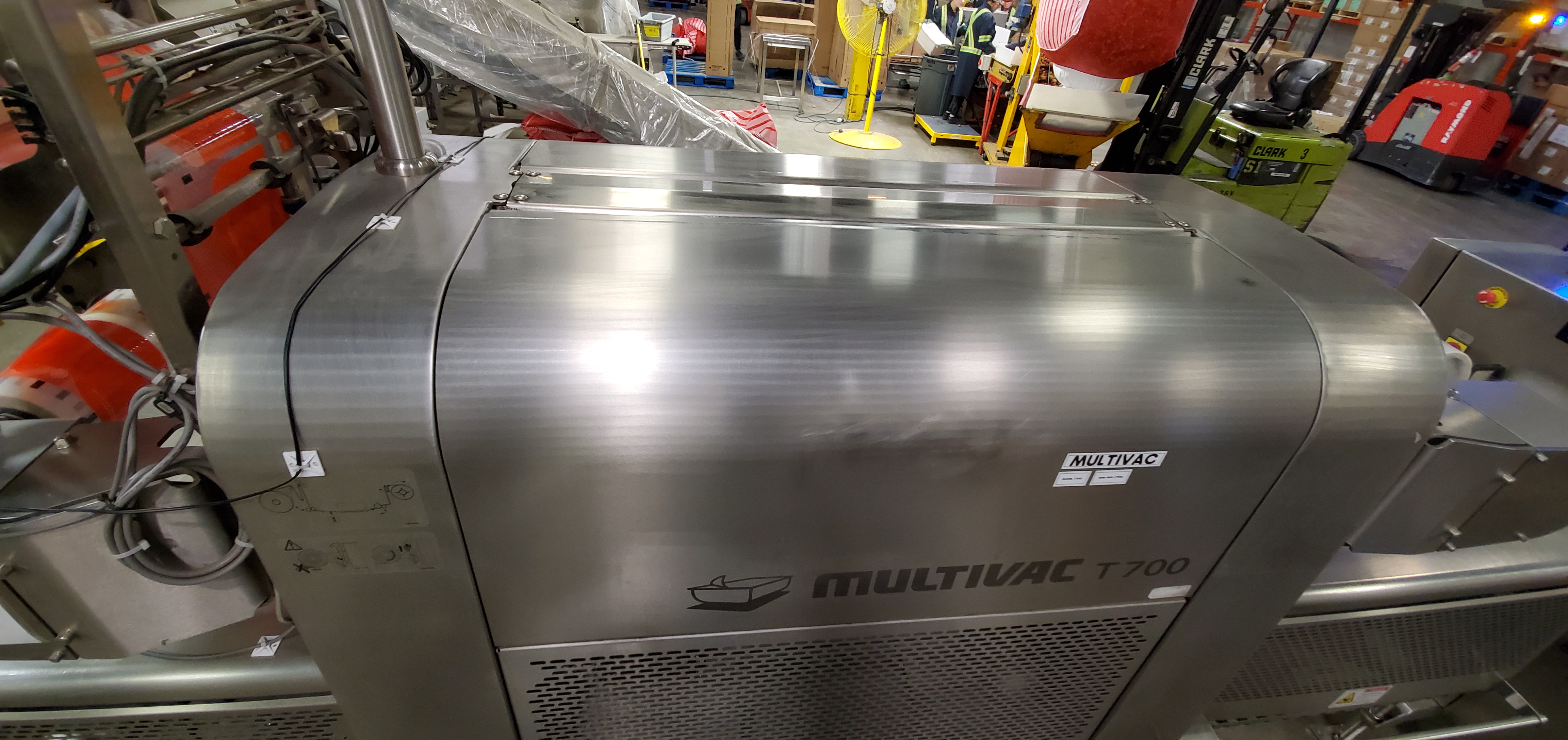
    Turning Underperformance into Profit: The Little Potato Company’s Multivac Line Rebuilt

    The Problem

    The Little Potato Company’s Multivac production line in Edmonton, Alberta was operating far below its intended capability. What should have been a stable, high‑performing asset had become a bottleneck. Equipment was not running at design rate, minor defects were compounding into major losses, and operators did not have the tools or training to identify issues before they escalated. The line was experiencing chronic downtime, inconsistent performance, and rising operational costs.

    These issues were not isolated. They were symptoms of deeper systemic problems. Variability in equipment condition, lack of standardized operating practices, and limited workforce capability were creating a cycle of firefighting instead of controlled, predictable production. Leadership recognized that without a structured, reliability‑driven intervention, the plant would continue to fall short of customer demand while absorbing unnecessary cost.

    The goal was clear. Restore throughput. Reduce waste. Build a workforce capable of sustaining long‑term reliability. Do it in a way that created measurable financial impact.

    The Solution

    We partnered with The Little Potato Company to deliver a comprehensive, hands‑on transformation of the Multivac line. Our approach was designed to stabilize the equipment, strengthen the workforce, and eliminate the operational barriers that were limiting performance.

    Our strategy included:

    -Conducting a full mechanical and operational assessment to uncover hidden defects, process losses, and sources of variability that were driving downtime and inefficiency.
    -Executing targeted cleaning and restoration events to return equipment to optimal operating condition and eliminate the chronic issues that had become normalized.
    -Delivering specialized training that equipped operators and technicians to identify, troubleshoot, and resolve issues at the source instead of relying on reactive maintenance.
    -Implementing center lining and operational standards that locked in consistency, reduced drift, and created predictable, repeatable performance.
    -Coaching leaders and frontline teams to reinforce reliable behaviors, maintain process control, and sustain improvements long after the engagement ended.

    This was a structured reliability intervention that combined technical precision with cultural alignment. The plant gained not only restored equipment performance but also a workforce that understood how to maintain and grow that performance every day.

    The Results

    The improvements were immediate, measurable, and financially significant. The Multivac line shifted from a chronic constraint to a reliable, high‑performing asset.

    -Throughput increased by 56%, expanding annual capacity from 4 million to 10.5 million units
    -Yield improved by 10%, generating $377,000 in savings
    -Labor savings totaled $417,000 through improved flow and reduced intervention
    -Material waste was reduced by 58%
    -Cost of Goods Sold per unit decreased by $0.17

    These results were not temporary. They were the outcome of restored equipment, standardized processes, and a workforce capable of sustaining reliability. The Little Potato Company now operates with greater efficiency, lower cost, and a stronger foundation for future growth.

    Conclusion

    We helped The Little Potato Company transform a struggling production line into a stable, predictable, and profitable operation. By restoring equipment condition, elevating workforce capability, and implementing operational standards, we delivered sustainable results that continue to scale across the facility.

    If your plant is experiencing throughput loss, rising costs, chronic downtime, or instability on critical equipment, you do not have to accept those conditions as normal. A structured reliability approach can change the trajectory of your performance.

    Schedule a free consultation and see what ReliabilityX can unlock for your operation.

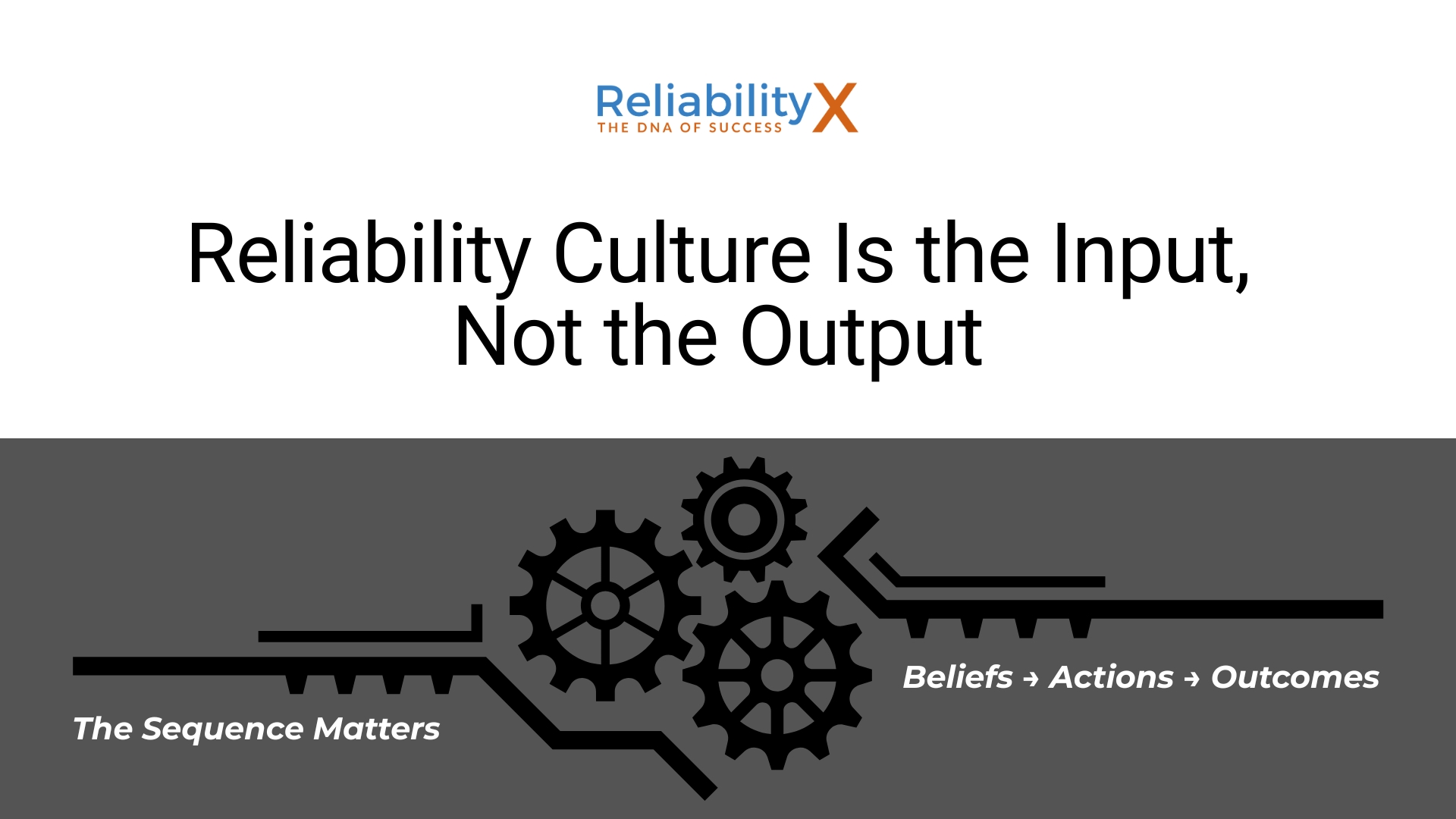
  • Reliability Culture Is the Input, Not the Output

    Reliability Culture Is the Input, Not the Output

    Organizations get the relationship between reliability and culture backward.

    The common belief is simple. Roll out the reliability program, get planning and scheduling in place, install predictive technologies, drive PM compliance, hit the KPIs, and eventually a reliability culture will appear. The work creates the culture. The culture is the output.

    This belief is widespread. It is also the reason many reliability programs fail to sustain.

    Here is the shift that changes everything. Reliability culture is not the output. It is the input.

    If you want a reliable plant, the culture has to come first. The work flows from the culture, not the other way around. Until that sequence is understood, every program launched will fail in the same predictable way twelve to eighteen months after kickoff.

    Belief Drives Action

    Culture is a set of beliefs and the actions that follow from those beliefs.

    If your team believes that taking care of assets matters, the actions follow naturally. They take the time to perform precision alignment correctly. They lubricate properly. They write up the work order even for the quick fix. They notice developing problems before they become failures.

    You do not need to push them to do these things. They do them because of who they are.

    If those beliefs are missing, no process will produce the right actions. You can write the best PM procedure available. If the technician does not believe the work matters, the result will be a checked box and a half-finished job. You can install the most advanced CMMS on the market. If the people using it do not believe the data matters, the records will be unreliable.

    This is the part many reliability programs miss. They treat the work as the goal and assume the behavior will follow. The sequence is reversed. The right beliefs produce the right behaviors. The behaviors produce reliable assets. Reliable assets produce business results. If the first step is skipped, the rest of the chain collapses.

    The Organizational Sabotage Problem

    Here is where many plants quietly undermine the culture they claim to want.

    Leadership says they want craftsmanship, precision, and pride in the work.

    The operational reality often tells a different story. Technicians are rushed because the line is down. They are sent out without proper job packages because planning is reactive. They are told to skip alignment because the changeover is late. They are praised for speed and criticized for delays, regardless of the quality of the work.

    In that environment, posters about craftsmanship do nothing. The real culture being built is one where speed wins, shortcuts are rewarded, and technicians learn that leadership’s stated values do not match operational expectations.

    You cannot ask for one culture while creating conditions that produce another. The day-to-day operational reality is the only culture-building input that matters. The poster is decoration. The supervisor’s tone during a line stoppage is data. People notice. They calibrate their behavior to what gets rewarded and what gets punished.

    If you want a belief in craftsmanship to take root, you must create conditions where craftsmanship is possible and valued in real operational moments. The shift at 2 AM matters more than the orientation slide deck.

    Culture Is Evolved, Not Changed

    This idea sits at the center of every credible reliability framework. You do not change a culture. You evolve people.

    The people in your plant are where they are for legitimate reasons. Their experience, education, skill sets, organizational pressures, and reward structures have shaped how they show up today. None of it is wrong. It is simply who they are.

    When leadership announces a culture change initiative, the implied message is that who they are today is the problem. People reject that message. The initiative fails because the framing is flawed.

    Cultures evolve through education and experience. You give people new information that shifts how they see the work. You then create experiences that confirm what they are starting to believe. Education without experience is a slide deck. Experience without education is noise. Together, repeated over time, they evolve the culture.

    This is how a reliability culture is built. Not through mandates or reorganizations. Through repeated educational moments and aligned experiences that make new beliefs feel natural.

    Why Culture Sits at the Foundation

    Culture and leadership sit at the foundation of every credible maintenance and reliability framework because everything else depends on them.

    Planning and scheduling depends on a culture that values planned work over reactive heroics. Predictive maintenance depends on a culture that trusts data. Operator care depends on a culture where operators see themselves as owners of the asset. Precision maintenance depends on a culture where craftsmanship matters more than speed. RCM depends on a culture willing to challenge inherited PM strategies.

    Every reliability discipline sits on top of cultural assumptions. If those assumptions are missing, the discipline will not take hold. The program will appear to work for a short time, then erode back to the underlying culture.

    This is why many reliability programs feel like pushing a boulder uphill. The leader is not failing on the procedural side. The slope is shaped by the existing culture. Until the culture evolves, the boulder rolls back.

    What This Means for Leadership

    If reliability culture is the input, the leader’s first job is not to launch programs. The first job is to evolve beliefs and shape conditions that make the desired actions possible.

    Lead with the why. Programs and procedures are downstream of belief. Audit operational reality against stated values. The conditions are the message. Protect craftsmanship in the moments that matter. Treat education and experience as the actual program. Be patient with the timeline. Cultural evolution takes years.

    The Sequence Matters

    Beliefs → Actions → Outcomes.

    Reliability culture is upstream. Reliable assets are downstream. Many plants try to drive the downstream result without addressing the upstream cause. They install predictive technology and wait for culture to follow. They roll out planning and scheduling and assume discipline will emerge.

    It does not work that way. You must build the input before you can extract the output. The input is human. It is belief, evolved through education and experience, sustained through aligned operational conditions and consistent leadership.

    Start there. Everything else flows from it.

  • Benchmarking: The Missing Foundation in Plant Strategies

    Benchmarking: The Missing Foundation in Plant Strategies

    There is a predictable pattern in plants that want to improve. Leadership defines a vision. They want best-in-class safety, world-class reliability, a specific OEE target, or recognition as the lead site in the network. The vision is announced. The goal is clear. The team begins building the strategy to achieve it.

    The strategy fails for a simple reason. The starting point was never verified. The team assumed they knew where the plant stood. The assumption was wrong.

    Benchmarking is the step most plants skip between defining the destination and planning the route. It is not optional. It is the step that makes every other step work.

    You Cannot Plan the Route Until You Know the Terrain

    I use a simple analogy with leadership teams.

    If you tell a group of people to reach the North Pole, the worst thing you can do is hand out identical instructions. Some people are starting in the desert. Some are in the jungle. Some are already on the tundra. The route, the gear, the timeline, and the obstacles are completely different for each starting point.

    If you do not know where people are standing, you cannot equip them. You cannot allocate resources intelligently. You cannot predict where they will struggle. A single set of instructions will be wrong for almost everyone.

    This is exactly what happens when a plant defines a vision and jumps straight to action without a real assessment of current state. Leadership believes they know the starting point. Front-line teams believe they know it. The truth remains unknown until the benchmarking work is done. Strategies built on assumption fail quietly over the next twelve months.

    The Sequence That Works

    The correct sequence is simple.

    Define the vision, mission, and values. Benchmark the current state. Identify the gaps. Build the strategy. Execute.

    Most plants complete step one and jump directly to step four or five. They write a vision and launch initiatives. The initiatives feel productive because they are visible. Training is delivered. Programs are deployed. Technology is installed. The activity creates the illusion of progress. The skipped steps create the reality of misalignment.

    Benchmarking prevents this.

    Three Levels of Benchmarking

    Benchmarking is not a single activity. There are three forms, and strong plants use all of them.

    Internal benchmarking against a recognized framework. This is a structured assessment of your plant against an external reference. The output is a clear picture of capability across leadership, culture, work management, planning, scheduling, materials management, predictive maintenance, operator care, and more. The specific framework matters less than the discipline of honest evaluation. The goal is a clear view of current state with quantified gaps.

    Formal industry benchmarking. This compares your plant to peer plants with similar assets and operational profiles. It reveals practices others have adopted, metrics they achieve, and investment patterns that differ from yours. It answers the question of what is possible for someone with your constraints.

    Informal network benchmarking. This is the most accessible form. It happens through professional networks, LinkedIn conversations, peer plant tours, conferences, and practitioner relationships. A thirty-minute call with someone who solved your current problem is often more valuable than hours of research. The reliability community is unusually open. Any practitioner who avoids building a network misses a powerful benchmarking channel.

    What Good Benchmarking Produces

    A strong benchmarking exercise produces a clear gap analysis that becomes the foundation for strategy. It is not a 200-slide deck. It is not a generic improvement list. It is a specific, prioritized view of current state, target state, and the gaps that matter most.

    That gap analysis drives every strategic conversation.

    Resource allocation. Dollars and people go to the gaps that matter. Sequencing. Initiatives follow the order that unlocks the most value. Realistic goals. Targets become evidence-based and grounded in current state. Credibility. Plans are supported by data, not opinion.

    Benchmarking transforms strategy from a creative exercise into an analytical one.

    Disciplines That Make Benchmarking Effective

    If you invest in benchmarking, do it with intention.

    Be honest about current state. Generous grading destroys the value of the exercise. Use multiple data sources. Self-assessment alone is unreliable. Benchmark capability, not only metrics. Capability explains why the numbers look the way they do. Refresh on a cadence. Annual reassessment keeps the strategy aligned with reality. Build the network early. The most valuable benchmarking insights come from peers.

    Do Not Skip the Step

    Vision defines the destination. Strategy defines the path. Benchmarking connects the two. Without it, the gap between current state and future state becomes a guess. Strategies built on guesses do not survive contact with reality.

    Plants that benchmark honestly and use the gap analysis to guide strategy move forward. Plants that skip the step stay busy and stay stuck.

    If your plant wants a clear, evidence-based starting point for strategy, our team can help. Contact ReliabilityX to schedule a benchmarking assessment that gives you the clarity needed to move with confidence.

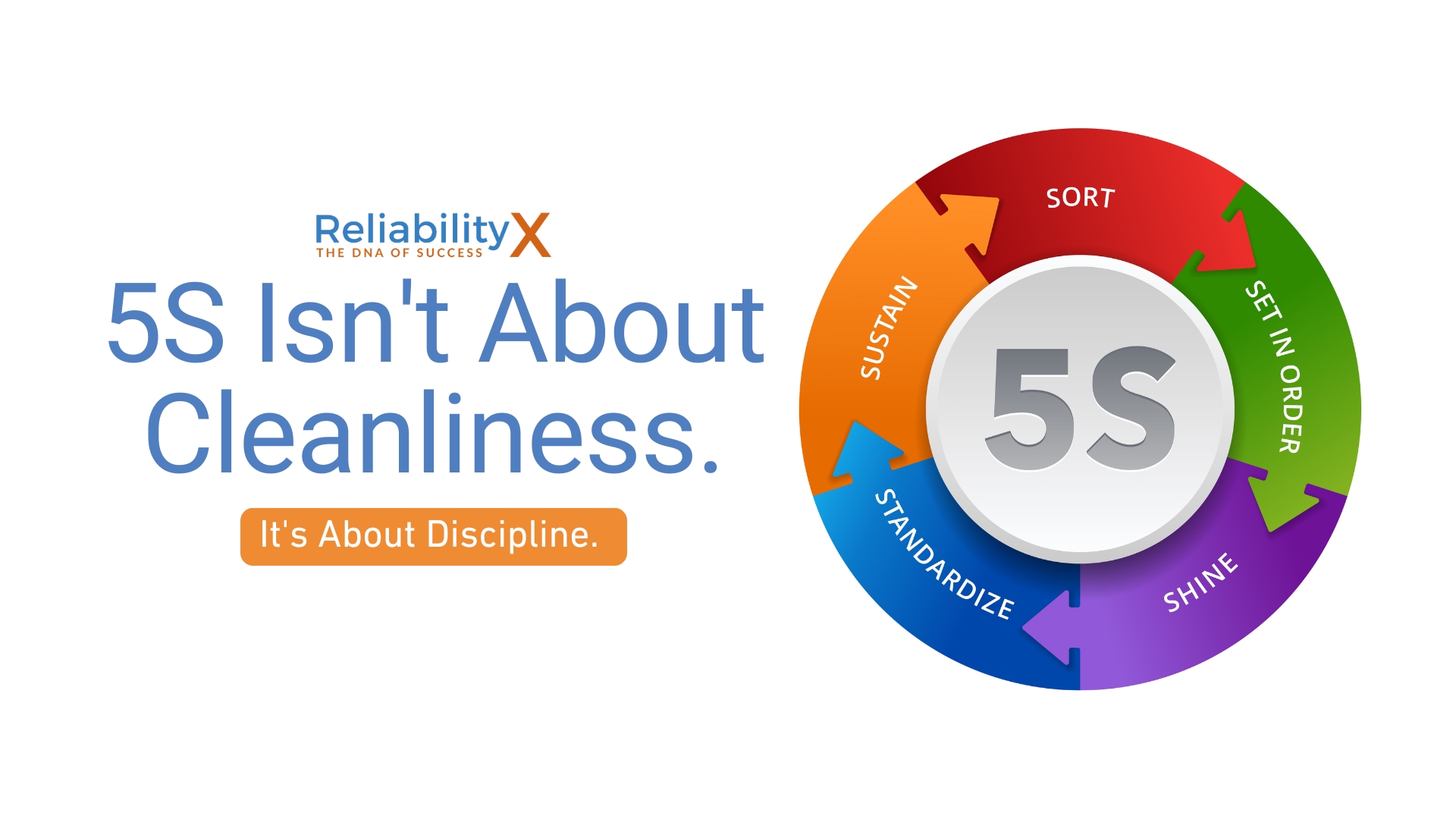
  • 5S Isn’t About Cleanliness. It’s About Discipline.

    5S Isn’t About Cleanliness. It’s About Discipline.

    Walk into any plant in North America and ask about 5S, and you’ll get one of two responses. Either an enthusiastic explanation of the program leadership is rolling out for the first time or a tired half-laugh and the words “we’ve tried that, didn’t stick.” 

    That second response is more common than people want to admit. I’ve worked in plants that have launched and abandoned 5S programs five, ten, fifteen times over a couple of decades. Every time, leadership rolls it out with new energy, new posters, new audit forms. Every time, it falls apart within a year or two and gets quietly shelved until the next leadership team picks it up again. 

    Here’s what most people miss: the reason 5S keeps failing in your plant isn’t because 5S is the wrong tool. It’s because 5S isn’t actually about cleanliness. It’s about something much bigger and most organizations have no idea what that is. 

    This post isn’t aimed at any one department. It’s aimed at every leader in your plant from operations, quality, safety, engineering, warehouse, maintenance, to the front office because what 5S is really building belongs to all of you, equally. 

    A Quick Walk Through the Five Steps 

    Let’s get the basics out of the way fast. 5S is five sequential steps. Japanese terms with English equivalents that conveniently all start with the letter S: 

    • Sort. Throw out what isn’t being used. Strip the workspace down to what’s actually needed. 
    • Set in order. Define a place for everything that remains. Color-code it. Shadow-board it. Tape it off. Make it visually obvious where each item belongs. 
    • Shine. Clean the area thoroughly and design it to be easy to inspect. The cleanliness isn’t the point but the inspectability is. A clean, well-lit, organized workspace is one where developing problems surface before they bite. 
    • Standardize. Make sure the color coding, the layouts, the boards, the visual signals are consistent across the entire plant in every department, every area. Same conventions everywhere. So that anyone walking from one part of the facility to another understands the visual language immediately. 
    • Sustain. Keep doing it. Audit. Coach. Hold the standard. 

    Most 5S training spends 90% of its airtime on the first four S’s. The plant tour shows you the labeled boards, the taped-off floor lanes, the color-coded racks. It’s all very tangible. Very Instagram-able. 

    Then the trainer waves their hand at the fifth S, sustain, and says something generic like “and of course you have to keep it up over time” and moves on. 

    That’s the entire reason your 5S program keeps failing. 

    Sustain Is the Whole Point 

    Here’s the reframe that changes how you think about this. 

    The first four S’s deliver a visible workspace. The fifth S delivers something invisible and far more valuable: organizational discipline. 

    Discipline is the muscle that lets an organization hold a standard over time, even when no one is watching, even when leadership is distracted, even when the easy thing to do is let it slide. That muscle has to be built. It doesn’t appear because you wrote it on a poster. It appears because the organization repeatedly showed up, did the work, audited honestly, coached when standards slipped, and refused to let the discipline degrade. 

    That’s what sustain is. It’s not a janitorial activity. It’s the deliberate construction of the organizational reflex you’ll need to make every standard, in every department, hold over time. 

    This Diagnoses the Rest of Your Plant 

    Here’s the real value of understanding what 5S is actually building. 

    If your organization has launched and abandoned 5S programs multiple times, ask an honest question: how does discipline hold anywhere else? 

    • Does standard work on the production line hold over time, or does it drift the moment a new shift takes over? 
    • Do changeover times stay close to standard, or do they balloon? 
    • Do quality SOPs get followed precisely, or do operators improvise their own variations? 
    • Are safety procedures followed when no supervisor is watching? PPE, lockout/tagout, hot work permits, near-miss reporting? 
    • Does training compliance stay current, or do people drift months or years past their certification dates? 
    • Do continuous improvement projects actually get sustained after the kickoff, or do they fade out three weeks after the kaizen event ends? 
    • Do planned maintenance schedules hold, or do they erode into reactive habits? 

    The pattern is almost always the same. Plants that can’t sustain 5S, can’t sustain anything else either. All of those programs depend on the same underlying capability which is organizational discipline. That capability is precisely what sustain was supposed to build. 

    When clients tell me, “We can’t get anyone in this plant to follow a standard. Every initiative we launch dies in 18 months,” my first question back is, “Tell me about your 5S program.” 

    Nine times out of ten, that program is in shambles. And that’s the diagnosis. The lack of discipline showing up across every department is the same lack of discipline that’s been quietly killing your 5S program for years. They share a root cause. 

    The Fix: Go Back and Get Sustain Right 

    If this is hitting close to home, the fix isn’t a new initiative. It’s revisiting 5S and getting the sustain step right this time. Three things to change about how you approach it: 

    1. Audit against the standard, on a real cadence across every department. Not a once-a-year leadership walkthrough of the production floor. Weekly area audits owned by each department, monthly cross-functional audits where leaders from operations, quality, safety, engineering, maintenance, and warehouse all walk each other’s areas. Documented findings. Real action items. The audit isn’t punitive. It’s the mechanism that makes the standard real. If no one is checking, the standard isn’t a standard. It’s a wish.

    2. Coach the why, not just the what. When a tool isn’t on its shadow board, the conversation isn’t “put the tool back.” The conversation is, “tell me why we have shadow boards in the first place.” When floor markings get scuffed and ignored, the conversation is about why we standardize visual cues across the plant. Every audit finding is a coaching opportunity. A chance to reinforce the purpose of the discipline. Coaching is the work that converts compliance into ownership, and ownership is what sustains.

    3. Treat sustain as a leadership behavior, not a worker behavior. Sustain dies when leadership stops modeling the discipline they’re asking for. If a plant manager, an operations supervisor, a quality lead, or a department head walks past a 5S violation without engaging with it, every employee in line of sight just learned that the standard doesn’t matter. Discipline is built top-down, and it crosses every department. The plant manager has to be visibly engaged with sustaining the standard, the department heads have to mirror it, and the front-line supervisors have to hold the line every day. If any layer of that chain disengages, the whole program collapses and so does every other initiative downstream of it. 

    The Bigger Payoff 

    When you get sustain right, something interesting happens. The visible benefits of 5S show up on schedule. The bigger payoff is the muscle you’ve built underneath the program. 

    Once your organization can sustain 5S, you’ll find that other things start sticking too: 

    • Operations — standard work compliance holds. Changeover times come down and stay down. 
    • Quality — SOPs are followed precisely. Defect rates fall and stay fallen. 
    • Safety — PPE compliance, lockout/tagout, and near-miss reporting all become reflexive rather than reactive. 
    • Engineering and CI — project follow-through improves. Kaizen events leave durable changes behind instead of flashes in the pan. 
    • HR and Training — certification compliance stays current. Onboarding consistency improves shift over shift. 
    • Warehouse and Logistics — staging discipline holds. Inventory accuracy stops degrading the week after the count. 
    • Maintenance — planning and scheduling sticks, PM compliance holds, predictive programs don’t slip back into reactive habits. 

    That’s the real reason 5S sits at the foundation of so many lean and operational excellence frameworks. It’s not because clean shops produce better products, though they do. It’s because the discipline you build through sustaining 5S is the same discipline you need to sustain every initiative, in every department, anywhere in the plant. 

    The Tip in Practice 

    If you take one thing from this post, take this: the next time you hear someone in your plant talk about 5S as a housekeeping or cleanliness program, push back. That misunderstanding is what kills the initiative. 5S is a discipline-building program with a clean workspace as a side effect, not the other way around. 

    Three concrete moves: 

    • Audit your current 5S state honestly, across every department. Walk operations, walk quality, walk maintenance, walk the warehouse, walk engineering, walk the offices. Be honest about how far each area has slipped against the standard you set the last time you rolled it out. 
    • If it has slipped, restart with sustain as the central focus. Don’t relaunch with new posters and a kickoff meeting. Relaunch with a real audit cadence, real coaching conversations, and real leadership engagement at every level; plant manager, department heads, front-line supervisors. 
    • Connect 5S explicitly to every other initiative in the plant. Make the link visible. When you talk to your people about 5S, talk about it as the foundation that makes standard work, safety procedures, quality SOPs, maintenance programs, training compliance, and CI projects all stick. Help them see that the discipline they’re building here is what unlocks everything else. 

    We underestimate the power of 5S because we don’t understand the purpose of sustain. Get that right, and every other standard you’ve ever tried to hold in your plant has a real shot at sticking this time. If you want support rebuilding the systems, behaviors, and leadership habits that make reliability sustainable, reach out. Your plant can hold the line. It just needs the right structure to do it.

  • The Maintenance Blame Bucket: What’s Actually Inside OEE Availability

    The Maintenance Blame Bucket: What’s Actually Inside OEE Availability

    Talk to anyone who has worked in a manufacturing plant for any length of time, and they’ll tell you the same thing: when the line goes down, somebody’s looking at the maintenance team. The OEE dashboard lights up, the availability number drops, and the natural reflex of operations leadership is to walk over to the maintenance shop and ask what happened.

    That is why I call the availability bucket of OEE the maintenance blame bucket. It is the loss category most people instinctively assign to maintenance, and it is the one your maintenance organization gets held accountable for in most plants.

    Here is the problem with that reflex: a substantial portion of what is actually living in the availability bucket does not belong to maintenance at all. If you do not understand what is really inside that bucket and how to measure it, you will spend your career defending a number you do not fully control.

    Let us break it open.

    Three Losses Live Inside Availability

    OEE, Overall Equipment Effectiveness, has three buckets: availability, performance, and quality. We are focused on availability today.

    Inside availability, there are three distinct loss types. They get lumped together into a single percentage on the dashboard, although they have very different causes and very different owners. Knowing the difference between them is the entire game.

    Loss One: Breakdowns

    A breakdown is the textbook maintenance loss. The clean definition:

    A stop of 10 minutes or more, where a part is replaced.

    That is the standard. Both conditions need to be true. A two-minute glitch is not a breakdown. A long stop where nothing was replaced is not a breakdown either. We will get to that one in a second.

    There is a small edge case worth mentioning. If a wire gets frayed, you cut it back, strip it, and reuse the same wire, that can still count as a breakdown depending on how strict your definition is. The spirit of the metric is whether the asset suffered a physical failure that required intervention, and a reused wire after damage typically does. The bright-line rule for most plants is simple: 10 minutes or more, and a part replaced.

    This bucket is squarely in maintenance’s lane. If the breakdown number is bad, your maintenance organization needs to look hard at PM strategy, precision craft, lubrication, alignment, and predictive coverage. Own that one.

    Loss Two: Process Failures

    This is where the conversation with operations gets interesting. The definition:

    A stop of 10 minutes or more, where no part is replaced.

    That second condition matters. If maintenance got called, walked out to the line, looked at the asset, and walked away without replacing anything, that probably was not a maintenance issue.

    A few classic examples:

    Somebody bumped the e-stop and could not figure it out. Eventually they call maintenance. Maintenance walks over, looks at the panel, resets the e-stop, and walks back to the shop. That is not a maintenance failure. That is a process failure.

    Materials were not staged properly. The line was supposed to be running, although the operator did not have what they needed and spent twenty minutes hunting it down. Process failure.

    The operator was not trained on a basic recovery procedure. A condition that an operator on a well-run line would resolve in two minutes consumed thirty minutes of maintenance time because the operator did not know what to look at. Process failure.

    These are not maintenance issues. They are standards issues. Training issues. Line readiness issues. Operations own them.

    Here is the catch: if you do not measure them separately, they all look like the same thing. The line was down, where was maintenance.

    Loss Three: Setup and Adjustment

    The third loss is the most often overlooked:

    Anything that exceeds the standard for a changeover.

    If operations are given a 10-minute standard for a changeover and it takes 15, that is a 5-minute setup and adjustment loss. Multiply that by every changeover in a week and you will find a quietly enormous number of available production hours bleeding away.

    Setup and adjustment are operations’ loss to own. It is about SMED practices, changeover procedures, training, parts kits, and fixturing. It is not about the maintenance department.

    The CMMS Move That Proves Out Process Failures

    Here is the move that turns this from a definition into a defensible business conversation.

    The biggest lever you have to recover unfair credit in the availability bucket is proving out how often maintenance is being called to handle process failures. There is a clean way to do that inside your CMMS:

    Pull every work order written against a given production line over a defined period. A quarter is a good window.

    Filter for work orders where no parts were issued and no materials were charged.

    Look at the labor hours on those work orders.

    That bucket, labor hours spent on the line with no parts replaced, is your process failure response time. It is maintenance hours burned on issues that were not maintenance issues.

    Now you can walk into a meeting with operations leadership with something concrete:

    “Last quarter, my team responded to 312 calls on Line 4. On 187 of them, 60 percent, no parts were replaced. That is roughly 240 maintenance labor hours spent on issues that were not maintenance failures. Every one of those calls also represented production time lost while the line was down waiting on us. We need to fix the line standards, not the maintenance program.”

    That is a fundamentally different conversation than saying you need more maintenance people.

    Why You Have to Track Everything as a Work Order

    This entire technique depends on one upstream discipline: every maintenance touch on the line has to be a work order.

    I see this constantly. A maintenance tech walks out to the line, fixes a five-minute problem, walks back, and never writes it up because it was just a quick one. Multiply that by every tech, every shift, every day, and you have an invisible mountain of process-failure response that never shows up in your data.

    Without the work order, you have no record. Without the record, you have no conversation. Operations can keep blaming maintenance for the availability number because maintenance has no evidence to push back with.

    Make it a non-negotiable. Every interaction with the line gets a work order. Every time. Even the quick ones, especially the quick ones, because those are the process failures you are trying to surface.

    Arm Yourself With Knowledge, Then Partner

    Here is the bigger point underneath all of this. The goal of breaking apart the availability bucket is not to dump the blame on operations. The goal is to partner with operations to solve the right problems.

    When you can show operations leadership that 60 percent of your line calls were process failures, that operations was bleeding production time and burning maintenance hours on issues that better standards or better training would have eliminated, you are not making them defensive. You are handing them a roadmap to recover capacity. That is a gift.

    The conversation shifts from asking why maintenance is so bad to asking how both sides can stop wasting capacity on preventable losses. Operations gets back production hours. Maintenance gets back labor hours to spend on actual reliability work. The plant gets a lower cost per unit. Everyone wins.

    None of this happens without the data. The data does not exist without the discipline to write the work order, define the loss buckets correctly, and have the conversation with structure.

    The Tip in Practice

    Three concrete moves to take this from a blog post into a Monday-morning action:

    Make your loss definitions crisp. Breakdowns equal 10 minutes and a part replaced. Process failures equal 10 minutes, no part replaced. Setup and adjustment equal anything exceeding the changeover standard. Print them and post them in both the maintenance shop and the operations break room.

    Enforce the work order discipline. Every line interaction gets written up, no exceptions. The quick fixes are the data you need most.

    Run the CMMS query. Pull a quarter of work orders at your worst-performing line, filter to no parts replaced, and quantify the process failure response. Bring the number to your next operations review.

    The maintenance blame bucket is not going to fix itself. Once you understand what it is actually inside, you can start having a very different conversation about who owns what and how to recover the capacity that is quietly leaking out of every shift.

    If you want support turning this approach into a repeatable process in your plant, connect with us. Our team can help you put the right structure in place.

  • Closing the Skill Gap: Why Manufacturers Are Struggling and How to Fix It

    Closing the Skill Gap: Why Manufacturers Are Struggling and How to Fix It

    One challenge has quietly grown into a full‑scale operational threat: the widening skill gap. Plants are onboarding new technicians who lack foundational mechanical aptitude, while experienced employees retire faster than organizations can replace them. The result is a workforce that is eager but underprepared, and a leadership team that is stretched thin trying to compensate for inconsistent skills on the floor.

    This is not a theoretical problem. It shows up every day in the form of preventable downtime, repeat failures, reactive work, and frustrated teams who want to do the job well but were never given the tools or training to get there. Many manufacturers are feeling the pressure as they try to maintain production targets with a workforce that has uneven capability and limited exposure to modern maintenance practices.

    Skill Gaps Are Now a Direct Threat to Reliability

    Most plants are experiencing the same pattern. New hires arrive with limited hands‑on experience, and even seasoned employees often lack exposure to precision maintenance, structured troubleshooting, or reliability fundamentals. Supervisors spend more time coaching basic tasks than leading improvement. Planners struggle to build accurate job plans because the work varies depending on who performs it. Operators rely on tribal knowledge that disappears the moment someone retires.

    This skill gap creates a ripple effect across the entire operation:

    • Work quality becomes inconsistent
    • PMs are completed but not effective
    • Root cause analysis stalls because the team lacks the technical depth to identify true failure mechanisms
    • Equipment health declines
    • Production loses confidence in maintenance
    • Leadership loses visibility into what is actually happening on the floor

    The most painful part is that none of this is due to lack of effort. It is a capability problem, not a motivation problem. Teams want to perform at a high level. They simply have not been trained in a way that matches the complexity of the assets they are responsible for.

    Build Capability Before You Build Expectations

    Manufacturers often try to solve performance issues by adding more metrics, more accountability, or more urgency. But none of that works if the team does not have the skills required to meet those expectations. The most effective path forward is to build capability first.

    A practical starting point is to evaluate three areas:

    1. Skill clarity
      Define the skills required for each role and compare them to the skills your team currently has. Most organizations discover gaps they did not know existed.
    2. Technical depth
      Prioritize training that improves troubleshooting, precision maintenance, and reliability fundamentals. Compliance training alone will not close the gap.
    3. Consistency of practice
      Standardize how work is performed so that quality does not depend on who is on shift that day.

    When capability improves, everything else becomes easier. Work quality stabilizes. PMs become meaningful. RCA becomes faster and more accurate. Supervisors can lead instead of firefight. Production sees the difference immediately.

    Our Maintenance and Reliability Best Practices Framework was built to solve this exact problem. It gives manufacturers a structured, proven approach to developing a skilled, consistent, reliability‑focused workforce.

    The framework covers the full spectrum of maintenance excellence, including:

    • Work management
    • PM optimization
    • Precision maintenance
    • Asset strategy development
    • Troubleshooting and defect elimination
    • Operator care
    • Planning and scheduling
    • MRO and storeroom management
    • Reliability leadership and decision making

    Each building block reinforces the others. When teams understand how their daily work connects to asset health, production stability, and long‑term reliability, performance improves quickly and sustainably.

    What Happens When Skill Gaps Are Closed

    One food manufacturer we worked with saw a 40 percent reduction in unplanned downtime within six months after implementing structured training aligned with their asset needs. Another facility reduced repeat failures by more than half simply by teaching technicians how to perform precision alignment and lubrication correctly. These improvements did not come from new equipment or major capital projects. They came from building capability and giving teams the knowledge to execute work the right way every time.

    When people understand what good looks like, they deliver it.

    On‑Site Training Tailored to Your Facility

    Every plant has different equipment, different challenges, and different levels of experience on the floor. That is why our training is delivered on site and tailored to your operation. We focus on the skills your team needs most and build capability in a way that fits your environment, your assets, and your goals.

    Schedule Training at Your Facility

    If you want to strengthen your workforce, improve reliability, and close the skill gaps that are holding your plant back, we can help. Contact us to schedule on‑site training at your facility and start building a more capable, consistent, and confident maintenance organization.

  • Planning and Scheduling: The Difference Between Controlled Work and Constant Chaos

    Planning and Scheduling: The Difference Between Controlled Work and Constant Chaos

    Every maintenance leader knows what a reactive week feels like.
    The schedule collapses by Tuesday.
    Technicians bounce between emergencies.
    Parts are missing.
    Production is frustrated.
    Maintenance is exhausted.
    Everyone feels like they are working hard, yet nothing improves.

    This is what happens when planning and scheduling are weak.

    Planning and scheduling are not administrative tasks. They are the mechanisms that turn strategy into predictable execution. When they are strong, the entire plant feels the difference.

    Here is a real example:
    A manufacturing plant struggled with constant break‑ins. Technicians spent half their day searching for parts or clarifying instructions. Wrench time hovered around 25 percent. After implementing disciplined planning and scheduling, wrench time rose above 50 percent. Break‑ins dropped by 40 percent. Technicians stopped firefighting and started executing planned work. Production gained confidence because maintenance became predictable.

    Another example:
    A facility had planners, but they were constantly pulled into emergencies. Jobs were planned on the fly. Schedules were built around who was available instead of what the equipment needed. The CMMS was used as a record of what happened, not a tool for controlling what should happen. After leadership protected the planner role and enforced scheduling discipline, the plant saw a dramatic reduction in reactive work.

    Planning answers the questions:
    What work needs to be done?
    How will it be done?
    What parts, tools, and instructions are required?

    Scheduling answers the questions:
    When will the work be done?
    Who will do it?
    How will it fit with production?

    When both are strong, maintenance becomes a controlled process instead of a daily crisis.

    Chapter 4 reinforces a truth that every high performing plant understands.
    Planning and scheduling are the backbone of reliable execution. Without them, even the best strategies collapse under daily pressure.


    If your organization needs help improving planning and scheduling, strengthening work management, or building a system that reduces reactive work, we can help you put the right processes in place. https://www.reliabilityx.com/contact

  • Maintenance Is a System, and Systems Fail When One Piece Is Missing

    Maintenance Is a System, and Systems Fail When One Piece Is Missing

    Many maintenance teams work incredibly hard yet still feel like they are losing ground. They complete PMs, respond to breakdowns, and support production, but failures continue. Backlogs grow. Costs rise. Morale drops.

    This happens because maintenance is not a list of tasks. It is a system. And when one part of the system is weak, the entire system suffers.

    Consider a plant where technicians perform lubrication routes faithfully. They hit every point. They follow the intervals. They use the correct lubricant. Yet bearings still fail. Why? Because no one identified the failure modes. The lubrication tasks were not addressing contamination, misalignment, or over‑greasing. The work was being done, but it was not solving the problem.

    Or a facility where operators are not involved in basic care. They walk past leaks, vibration, and abnormal sounds because they assume maintenance will catch it. By the time maintenance sees the issue, the failure is already in motion. The system is missing early detection.

    Or a site that measures PM completion but not PM effectiveness. The numbers look good, but the equipment still fails. The metric is being met, but the purpose is not. The system is missing feedback.

    Chapter 3 pushes organizations to understand maintenance as a connected system that includes:
    • failure mode identification
    • task alignment
    • operator involvement
    • planning and scheduling
    • precision execution
    • measurement and feedback
    • continuous improvement

    When one of these elements is missing, the system becomes reactive.
    When all of them are aligned, the system becomes reliable.

    This is why some plants with fewer technicians outperform plants with larger teams. They are not working harder. They are working within a system that supports reliability.

  • Culture and Leadership: The Hidden Forces That Decide Whether Reliability Succeeds

    Culture and Leadership: The Hidden Forces That Decide Whether Reliability Succeeds

    Walk into any plant that struggles with reliability and you will see the symptoms long before you see the root cause.
    Technicians rushing from one emergency to the next.
    Operators hesitant to report issues.
    Planners pulled into reactive work.
    Supervisors rewarding speed instead of quality.
    Leaders frustrated that nothing seems to improve.

    These symptoms are not caused by a lack of tools or training. They are caused by culture.

    Culture is the unwritten rulebook of the organization. It determines how people behave when no one is watching. It shapes how teams respond under pressure. It influences whether reliability practices stick or collapse.

    Here is a real scenario many leaders will recognize:
    A plant launches a new defect elimination process. Operators are trained to identify abnormalities. Maintenance is trained to investigate root causes. Leadership announces support. For two weeks, everything looks promising. Then production falls behind. Operators stop reporting issues because they fear slowing the line. Maintenance stops investigating because they are pulled into emergencies. Leadership shifts focus to output. The process dies quietly.

    The problem was not the process.
    The problem was the culture.

    Another example:
    A facility invests in predictive technologies. Vibration sensors. Ultrasound. Thermal imaging. The tools are excellent. The data is accurate. But technicians do not trust the findings. Supervisors do not adjust schedules based on the results. Planners do not incorporate the data into job plans. Leadership does not reinforce the importance of using the tools. The program never gains traction.

    Again, the issue is culture.

    Chapter 2 reminds us that culture and leadership alignment are not optional. They are the foundation that determines whether improvement efforts survive the realities of daily operations.

    A strong culture looks like this:
    • Operators report issues early because they trust the process.
    • Planners are protected from reactive work so they can plan.
    • Technicians follow procedures because they believe in the purpose.
    • Leaders reinforce reliability even when production is under pressure.

    A weak culture looks like this:
    • Silence instead of communication.
    • Shortcuts instead of discipline.
    • Blame instead of learning.
    • Firefighting instead of planning.

    Culture takes time to build, but once established, it becomes the force that sustains reliability long after the initial push.

    If your organization is working to strengthen culture, align leadership, or build an environment where reliability can thrive, we can help you create the structure needed for long term success. https://www.reliabilityx.com/contact