Organizations get the relationship between reliability and culture backward.
The common belief is simple. Roll out the reliability program, get planning and scheduling in place, install predictive technologies, drive PM compliance, hit the KPIs, and eventually a reliability culture will appear. The work creates the culture. The culture is the output.
This belief is widespread. It is also the reason many reliability programs fail to sustain.
Here is the shift that changes everything. Reliability culture is not the output. It is the input.
If you want a reliable plant, the culture has to come first. The work flows from the culture, not the other way around. Until that sequence is understood, every program launched will fail in the same predictable way twelve to eighteen months after kickoff.
Belief Drives Action
Culture is a set of beliefs and the actions that follow from those beliefs.
If your team believes that taking care of assets matters, the actions follow naturally. They take the time to perform precision alignment correctly. They lubricate properly. They write up the work order even for the quick fix. They notice developing problems before they become failures.
You do not need to push them to do these things. They do them because of who they are.
If those beliefs are missing, no process will produce the right actions. You can write the best PM procedure available. If the technician does not believe the work matters, the result will be a checked box and a half-finished job. You can install the most advanced CMMS on the market. If the people using it do not believe the data matters, the records will be unreliable.
This is the part many reliability programs miss. They treat the work as the goal and assume the behavior will follow. The sequence is reversed. The right beliefs produce the right behaviors. The behaviors produce reliable assets. Reliable assets produce business results. If the first step is skipped, the rest of the chain collapses.
The Organizational Sabotage Problem
Here is where many plants quietly undermine the culture they claim to want.
Leadership says they want craftsmanship, precision, and pride in the work.
The operational reality often tells a different story. Technicians are rushed because the line is down. They are sent out without proper job packages because planning is reactive. They are told to skip alignment because the changeover is late. They are praised for speed and criticized for delays, regardless of the quality of the work.
In that environment, posters about craftsmanship do nothing. The real culture being built is one where speed wins, shortcuts are rewarded, and technicians learn that leadership’s stated values do not match operational expectations.
You cannot ask for one culture while creating conditions that produce another. The day-to-day operational reality is the only culture-building input that matters. The poster is decoration. The supervisor’s tone during a line stoppage is data. People notice. They calibrate their behavior to what gets rewarded and what gets punished.
If you want a belief in craftsmanship to take root, you must create conditions where craftsmanship is possible and valued in real operational moments. The shift at 2 AM matters more than the orientation slide deck.
Culture Is Evolved, Not Changed
This idea sits at the center of every credible reliability framework. You do not change a culture. You evolve people.
The people in your plant are where they are for legitimate reasons. Their experience, education, skill sets, organizational pressures, and reward structures have shaped how they show up today. None of it is wrong. It is simply who they are.
When leadership announces a culture change initiative, the implied message is that who they are today is the problem. People reject that message. The initiative fails because the framing is flawed.
Cultures evolve through education and experience. You give people new information that shifts how they see the work. You then create experiences that confirm what they are starting to believe. Education without experience is a slide deck. Experience without education is noise. Together, repeated over time, they evolve the culture.
This is how a reliability culture is built. Not through mandates or reorganizations. Through repeated educational moments and aligned experiences that make new beliefs feel natural.
Why Culture Sits at the Foundation
Culture and leadership sit at the foundation of every credible maintenance and reliability framework because everything else depends on them.
Planning and scheduling depends on a culture that values planned work over reactive heroics. Predictive maintenance depends on a culture that trusts data. Operator care depends on a culture where operators see themselves as owners of the asset. Precision maintenance depends on a culture where craftsmanship matters more than speed. RCM depends on a culture willing to challenge inherited PM strategies.
Every reliability discipline sits on top of cultural assumptions. If those assumptions are missing, the discipline will not take hold. The program will appear to work for a short time, then erode back to the underlying culture.
This is why many reliability programs feel like pushing a boulder uphill. The leader is not failing on the procedural side. The slope is shaped by the existing culture. Until the culture evolves, the boulder rolls back.
What This Means for Leadership
If reliability culture is the input, the leader’s first job is not to launch programs. The first job is to evolve beliefs and shape conditions that make the desired actions possible.
Lead with the why. Programs and procedures are downstream of belief. Audit operational reality against stated values. The conditions are the message. Protect craftsmanship in the moments that matter. Treat education and experience as the actual program. Be patient with the timeline. Cultural evolution takes years.
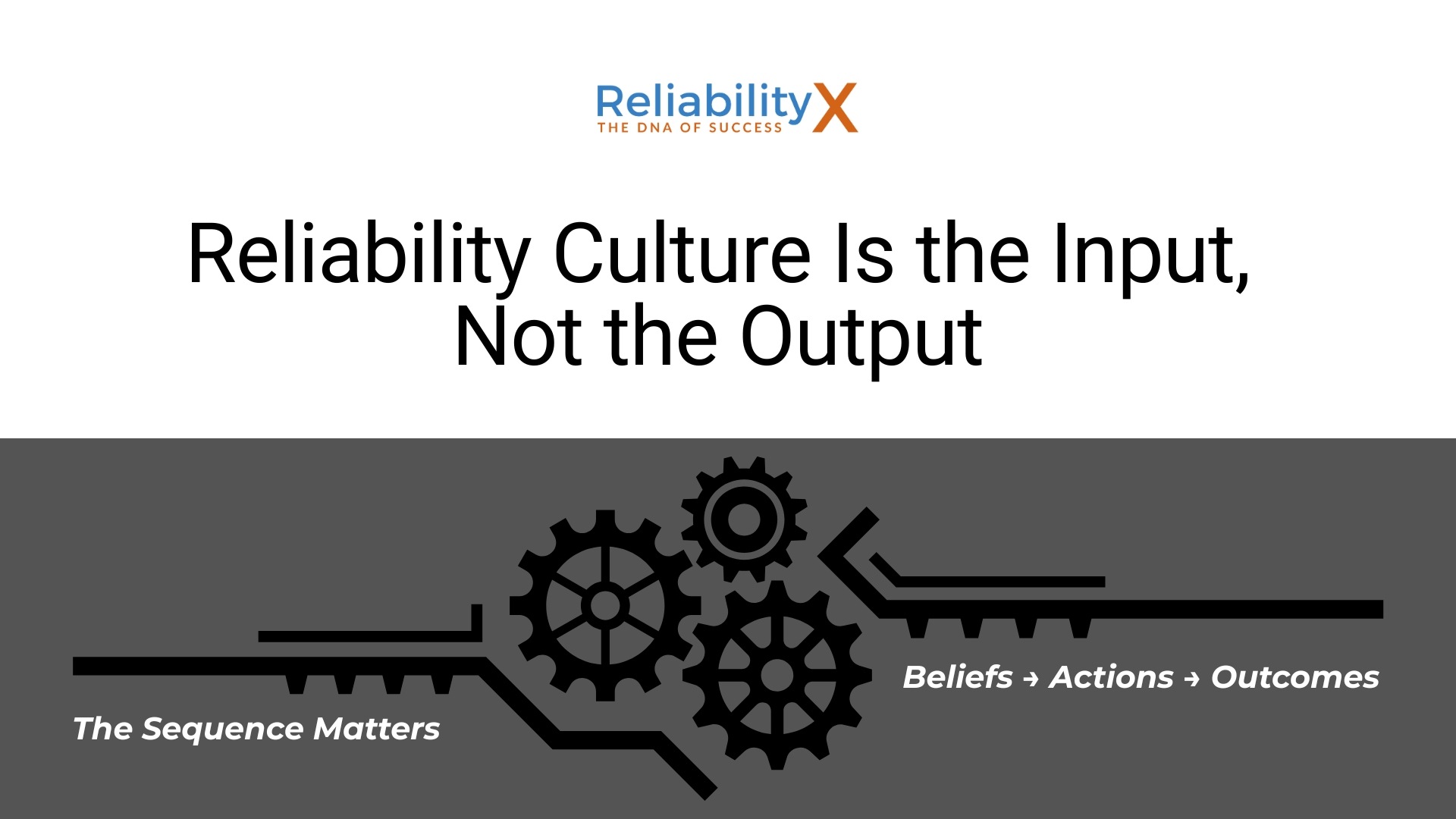
The Sequence Matters
Beliefs → Actions → Outcomes.
Reliability culture is upstream. Reliable assets are downstream. Many plants try to drive the downstream result without addressing the upstream cause. They install predictive technology and wait for culture to follow. They roll out planning and scheduling and assume discipline will emerge.
It does not work that way. You must build the input before you can extract the output. The input is human. It is belief, evolved through education and experience, sustained through aligned operational conditions and consistent leadership.
Start there. Everything else flows from it.