
Description
Most reliability proposals fight over ROI, the case for acting. They almost never quantify the case against waiting, and that is the argument that actually moves a room. Because on a constraint, an hour lost is not just downtime. It is a fixed number of units and a fixed number of dollars of contribution that no buffer ever gives back.
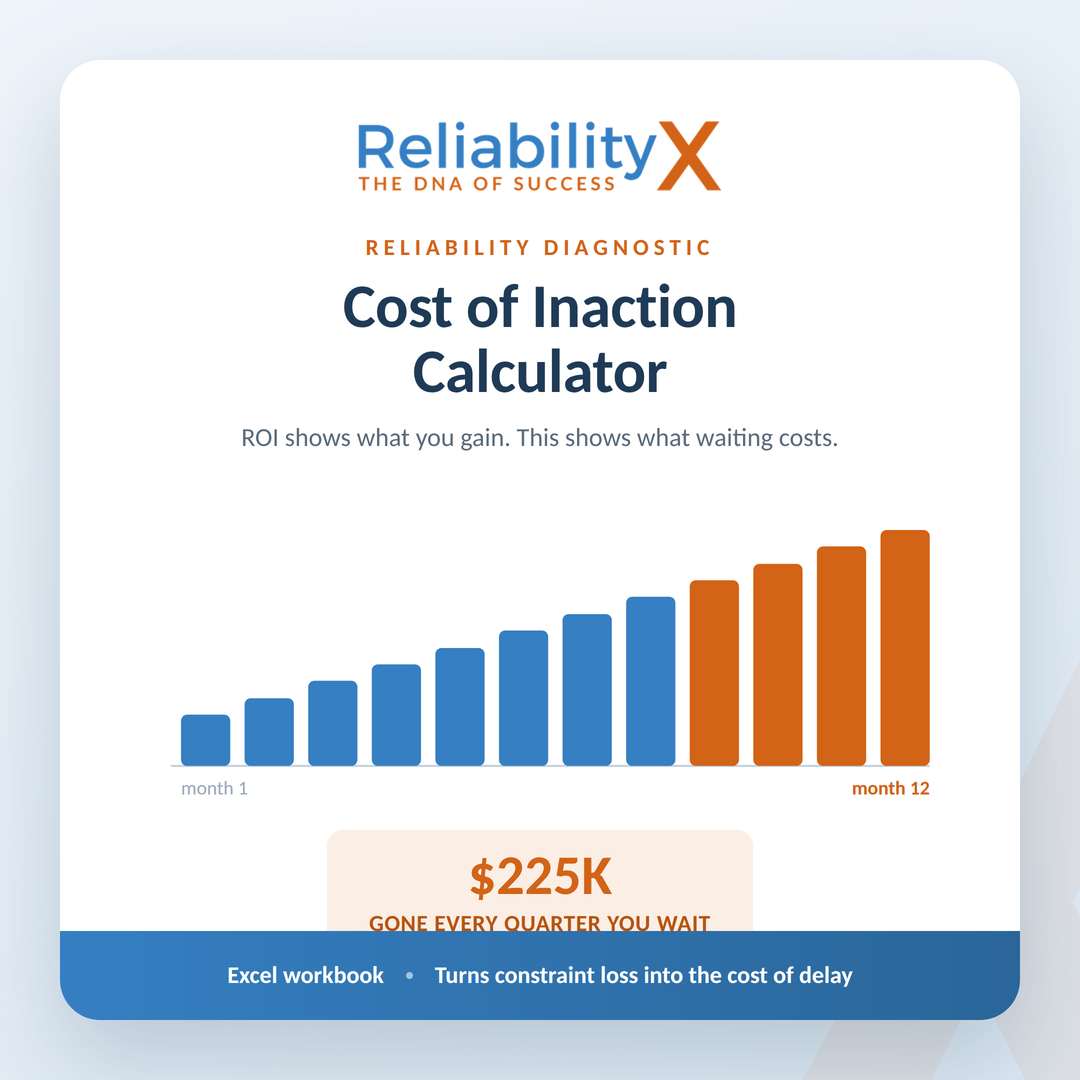
This tool prices that. You enter your unit economics, your constraint’s run rate, and the avoidable loss you are chasing, and it converts hours into money: the cost of a single idle hour on the constraint, the loss per week, and the recoverable dollars per quarter and per year. Then it does the part that creates urgency. It shows what happens if the problem is left alone. When a loss compounds, waiting does not just keep costing you the same amount. You start paying interest on it, and a year of delay can cost far more than the steady annual loss.
The tool lays that out month by month, so the cost of waiting stops being abstract and becomes a number with a date on it. And it ends with a board-ready summary that states the case in your own figures, in the order that lets the dollars carry the weight, so you can walk it straight into a leadership meeting.
It is the natural counterpart to a business case. One shows the return on acting. This one shows the cost of delay. Together they end the conversation.
What you get:
- Loss-to-dollars logic that prices an hour on your constraint
- Recoverable loss per week, quarter, and year
- A month-by-month cost-of-inaction view for losses that compound
- An optional break-even context for the line
- A board-ready summary that writes the case in your own numbers
- Built on constraint economics, in the ReliabilityX brand
- Runs in Excel, instant download, recalculates as you change inputs
Built for the reliability and operations leaders who need to turn “we should fix this” into “here is what every quarter of waiting costs us.”
Stop selling the upside and losing to inertia. Put a price on waiting. For $19.99, delay becomes the number nobody in the room can ignore.