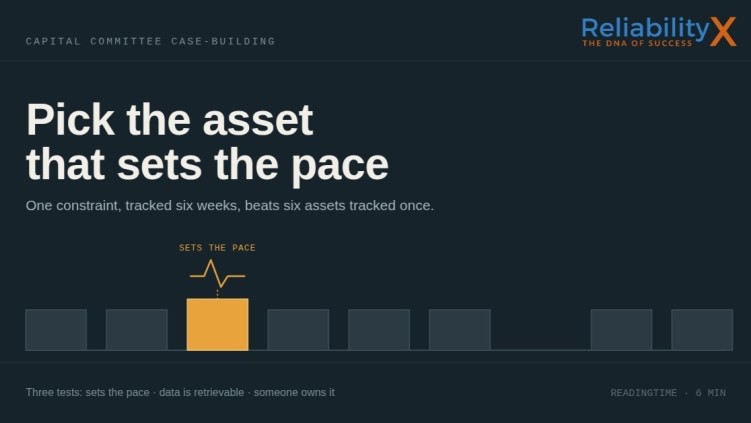
Most efforts to quantify plant losses fail in week two, and the cause is almost always the same. Somebody decides that if one asset is worth measuring, the whole line is worth measuring, and by the end of the month there are eleven partial data sets and no defensible number.
One asset, followed for six weeks, produces a case you can take to a capital committee. Six assets, followed for six weeks, produce a spreadsheet nobody trusts.
Here is how to choose the one.
Test 1: It sets the pace
When this asset stops, does the line stop and does the shipment move?
That is the whole test. If output upstream of the asset simply accumulates and gets processed later, you have found a busy asset, not a constraint. Recovering an hour there costs you the same effort and returns nothing to the plant, because the hour was never the limiting factor.
The constraint is usually obvious to the people who run the line and frequently invisible in reporting. Ask two operators and a supervisor where the line backs up. They will agree, and they will be right.
A caution: the constraint moves. Product mix, seasonal demand, and a maintenance backlog can all shift it. For a six week exercise, pick the asset that is the constraint most of the time and stay with it. Chasing a moving constraint week to week is how the effort dies.
Test 2: You can get the data
You need run time and output for at least eight weeks of history, plus the ability to observe the asset for two weeks going forward.
Perfect data is not the standard. Retrievable data is. A production log in a binder is enough. A shift handover sheet is enough. If the asset is instrumented and you can export it, that is faster, but nothing here requires it.
If the data does not exist in any form, that is itself a finding worth reporting, and it usually means picking a different asset for this first pass rather than starting a data collection project you will not finish.
Test 3: Somebody owns it
There has to be a named person, an operator, a planner, or a supervisor, who can actually change something about how the asset runs.
This is the test people skip, and it is the one that determines whether your number turns into money. An asset nobody owns produces an interesting figure, a good slide, and no change at all. When the analysis is done, someone has to be able to act on it without waiting for a reorganization.
Write it down and say it out loud
Once you have chosen, commit publicly. Tell your plant manager which asset you are following and why. Put the name in an email.
This sounds like a small thing. It is the difference between an exercise that survives the first busy week and one that quietly stops. Named commitments get kept.
Your fifteen minutes this weekend
- Name the asset.
- Pull plan against actual good output for the last eight weeks.
- Email finance and ask for contribution margin per unit, which is price less variable cost. If they push back, that conversation is itself worth having, because a finance blessed margin figure is nearly impossible to attack later.
- Multiply the eight week gap by the margin.
- Write the result as one sentence.
You now have one asset and one dollar figure, which is more than most plants have, and it is the input for everything that follows.