Category: Values

  • Self-Accountability Part 5

    Self-Accountability Part 5

    Step Three: Develop good habits

    We will talk much more about this in the section on Self-Discipline, but good habits are building blocks that will get you to where your personal development plan, that we built in step one, is heading.

    The first thing to focus on when starting to develop good habits is to remove bad ones, and one of the worst habits is creating excuses.

    Excuses are like layers to an onion, once you peel one excuse back, you find a new bad habit every time you look closer.

    If you turn in a report at work that’s full of typos and has errors that should have been caught, the excuse is “I only had 3 hours to write the report.”

    If we peel that back, we see that you weren’t assigned the project at 1 pm, to present at 4 pm – you just failed to properly manage the much longer time you actually had for the project – and it’s very likely there was more than enough time.

    Now the question is “why is your time managed so poorly?”

    Are you staying up late watching TV, that leaves you scrambling the morning the report is due?

    Are you not serious about the job, leading to sloppy work?

    Are you blaming other people for your failures?

    Either way, the burden of responsibility is on you and as long as you fail to hold yourself accountable, these mistakes are going to keep piling up.

    You’ll continue to disappoint yourself, and you’ll continue failing to reach your goals in the personal development plan we outlined earlier in the chapter.

    The good news is that you can turn it all around. It’s not easy for some people to honestly reflect on the causes of their problems, but it’s the most important work that you can do.

    Now we’re self-aware of where we are, and now we’re holding ourselves accountable for how we got there. In the next chapter, we’ll discuss what comes after that.

  • Self-Accountability Part 4

    Self-Accountability Part 4

    Step Two: Be Honest With Yourself

    Self-accountability is meaningless without honesty. It can be difficult to be honest with yourself, because then you’re pulling away all the excuses and rationalization that stand between you and what you want, but it’s the only way forward.

    This is a two-part process, the first part of which is simply putting your ego aside and realize that you don’t know everything. No one does, and it might be a tough pill to swallow, but you aren’t the exception. Having the courage to admit that you don’t know everything opens the door to the second part of this process: asking for help.

    I can speak personally about this, having spent around twenty years in my career thinking I knew everything and struggling all along the way.

    – If you want to spend your career making every single mistake possible, at the end of your career you could be the wisest and most experienced person in your field. You also spent decades learning and likely re-learning the same mistakes over and over again.

    – If you’re able to have a little humility and ask for help from people who have been where you are, you’ll find your growth will explode. Instead of a decade struggling on XYZ, you can find a veteran who can cut literally years off of your learning curve with a few sentences.

    – The old phrase about touching a hot stove isn’t really how the world works. In reality, there’s about 90% of people who have touched the stove once, keep touching it and constantly wonder why their hands hurt so much. Then there’s 9% who touch it once, and realize “that was a terrible idea” and don’t touch it again.

    Finally, we have the 1% who see everyone else cursing at the stove, holding their hands and have the courage to ask someone if they should touch the stove while everyone else gets burned.

    When you compound all of the time that asking for help can get you, it’s almost unbelievable how much faster you can develop than your peers. There’s no reward for re-inventing the wheel, and the vast majority of problems you’ll face in your career are similar to problems other people have faced.

    The best thing about asking others for help is they’ve already done the work, burned their hands and as long as you ask politely, you get the answers to the test.

    Now that we’re taking the fast lane towards success, let’s talk about the final step in becoming more self-accountable.

    Continued…

  • Self-Accountability Part 3

    Self-Accountability Part 3

    A great tool to help diagnose where these problems come into play is using the four quadrants from Stephen Covey’s great book, “The Seven Habits of Highly Effective People” or sometimes called “The Eisenhower Matrix” after the famous General and President.
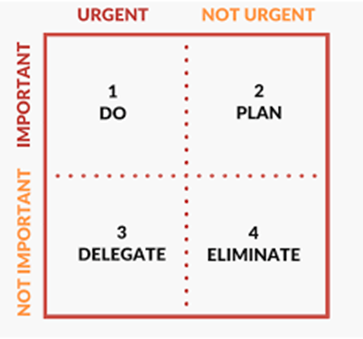
    Quad

    The quadrant is displayed at the left. Take any task that you need to perform and grade it on the two questions that follow.

    1. Is this urgent? – does this task require immediate attention or there will be negative consequences? Tasks that are urgent are like running water over a burned finger or paying rent on the first of the month. If you don’t handle them immediately, you’ll move significantly further from your goals.
    2. Is this task important? Will this specific task “move the needle” for whatever metrics you have designed in your personal development plan? This could be launching a marketing campaign for your business or applying to new jobs. The difficulty of a task can, but does not always, match the importance.

    The simple nature of the matrix is intuitive and easy to use, especially if you have experience running a team.

    The important and urgent (quadrant 1) is something you personally need to do immediately. This is the CEO returning the calls of the company’s attorneys: you don’t want the summer intern in charge of that, and you don’t wait until 3 months to call them back.

    The important but not urgent (quadrant 2) means you personally need to plan out where the process is going. When a home builder sells a home, one of the first steps is planning all of the components and craftsmen necessary to get the entire project done. If windows are on a 3 month lead time, not the usual 2 weeks, that’s not a problem the day the house is sold, but it’s an incredibly serious problem a month before turning the house over to the new owners. Taking that time to plan out what could turn from just important into important and urgent, and preventing those problems from happening is a huge return from a time perspective.

    Next is the urgent, but not important in quadrant 3. This could be something like “returning a current customer’s phone call about a non-critical issue”. If a customer wants clarification on a small item, it’s not something the CEO should focus on, but would be perfect for an hourly employee to do. The focus here is to delegate what is possible, to make sure you’re getting the best use of your time. Remember that as long as the task is done, you’re successful.

    Finally we have quadrant four, the least important and least urgent tasks. These are the easiest traps to fall into on your path to success, and eliminating these tasks completely is the goal.

    When entrepreneurs get started building their businesses, this is where so many get stuck in the mud: they want business cards, and logos, and talk about “what the company culture will be like”. Those tasks are great ways to avoid having to do the most important and urgent task entrepreneurs have: getting new, paying clients.

    – Jim Koch, the man who created the Boston Beer Company, best known for their Samuel Adams beer line, had a great story about when he was starting out. He had picked out the perfect logo, was looking at office space and had his eye on a massive computer system to handle processing all the orders he’d have.

    – The trouble was, he had zero orders. A family member who was an investor and had a background in finance finally sat him down and said “it doesn’t matter if you have the fanciest computer to process the orders, if you don’t have any orders to process.”

    – Jim was failing to properly categorize tasks using the quadrant above. He was luckily just wasted time, and not the precious start-up money, on the unimportant and not urgent tasks. After the conversation with the family member, he went into a bar with a six pack, sold his first few cases and now employs around 2000 people, generating over one billion dollars per year in revenue

    – Imagine what would have happened if he didn’t talk to the experienced family member? He could have spun his wheels for years, designing letterhead and who knows what other useless task, while the empire of Boston Beer Company faded away.

    The entire American craft brewing renaissance might not have happened if Jim didn’t have that one conversation – and more importantly – implement the action that was recommended.

    – How are you cutting yourself short in the impact that you’re able to make to the world? That’s what the quadrant is designed to improve, not just the insight, but how you can take the insights learned into action.

    – When you’re assessing your personal development plan, you can use this matrix on the front and back end, as both a planning tool and one for diagnosis of failure. If you’re finished with your whole plan, but before you implement it you do a quick check of all of the daily plans against this matrix, you can save yourself a ton of wasted time on the front end: could half of these tasks be delegated, and a quarter totally eliminated?

    – Next you can use it on the back end. Take time every three months, six months, whatever interval makes sense to do an audit of your activity. Were you actually delegating the urgent but not important? Did you spend two weeks building a social media presence for a business that isn’t necessary or likely to get new clients for your small consultancy? Did you prioritize your day to solve urgent and important problems, every single day?

    Use the feedback to change habits, not feel sorry for yourself, and your creativity at solving the problems will skyrocket, and so will your progress towards your goals.

    Once you’ve made the plan outlined above, you’re taking the daily action necessary to meet your specific goals that are all outlined and you’re taking a look at the plan every few months to make sure you’re not focused on unnecessary things, we can consider step one completed.

    The next thing we need to focus on is step two.

    Continued…

  • Self-Accountability Part 2

    Self-Accountability Part 2

    Step 1: Know your role and your responsibilities

    The first step in creating more self-accountability is to start by making an assessment of what your role is and what those specific responsibilities are.

    If you’re a father, your role and responsibilities are very different than if you’re the head of an emergency room, or if you’re coach of a basketball team. Every area of your life can have different roles, but the responsibilities of being a father, for example, can impact the responsibilities of being an entrepreneur. You will need to think about how late nights in the office can affect missing Timmy’s baseball game into your plan.

    No matter what your specific role is, you need to sit down and describe specifically what your responsibilities are. Without explicitly stating what your responsibilities are, you will never be able to hold yourself accountable.

    When you’re making this list of responsibilities, you’re going to break down each broad responsibility into the specific and measurable components that combine to form the responsibility. If the components are not specific, you won’t know that you’re working towards them, and if they’re not measurable, you won’t know if you’re succeeding or failing.

    Within each of these components that make up the responsibility, there’s going to be tactical strategies that will get you closer to the goal. These will be things that will be more day-to-day, so you can take down a larger goal one piece at a time.

    In practice, it could look like this:

    Role: A Father & Husband

    Responsibility 1) Make sure the family is financially stable

    Component A) Pay off wife’s student loan debt in 3 years

    1. Restructure current debt to reduce interest rate
    2. Add $50 more per payment to shorten duration to pay

    Component B) Increase income by $15,000 this year

    1. Pick up an extra shift every other weekend
    2. Earn a professional credential that raises your salary within the next six months

    III.          Help wife start tutoring local students

    Component C) Decrease spending by $1000 per month

    1. Pack lunch every day, saving $100/week
    2. Explore free hobbies that the kids enjoy

    Responsibility 2) Improve the family’s relationships

    Component A) Make routines more consistent

    1. Eat dinner together 5 nights a week

    Ii. Start a monthly tradition (family outing etc)

    Component B, C, D etc…

    You start by creating a list of just the responsibilities that the role requires: are you making sure that there are no injuries on the shift you supervise, reducing waste, mentoring junior employees, any imaginable amount of realistic responsibilities for whatever role you’re in.

    The four kinds of accountability mentioned at the beginning of the chapter should spark some creativity for responsibilities that might not be immediately obvious. The second shift supervisor is directly accountable to the Operations Manager he reports to, but he also has responsibilities to not setup the third shift supervisor for failure. If second shift is above quota every day, but third shift has started falling behind it means that somewhere, something is going wrong.

    Once you have the responsibilities, break them down into the components that would lead to success in that responsibility. Then break down each component into whatever metrics would be considered success in that component. This is where you’re going to focus your daily effort.

    Once you have broken down the strategic (higher level) into the tactical (day-to-day) steps necessary to move forward, now you have something that you can focus on every single day.

    Every day, you can look back and ask yourself if you were taking the steps necessary to get to the end position you want to be in, and this is what self-accountability is all about.

    This list of responsibilities is a document that should be referenced as often as necessary to get where you want to go. You should reassess the strategic level goals every three, six or twelve months to make sure that you’re still on the right general path.

    You should be checking weekly or every other week to see if you’re doing the tactical steps that will feed into the responsibilities success. If you spend two weeks without having done a single daily step, it’s critical to take a look at why you weren’t able to.

    This is where the self-accountability comes into play. If you are looking at getting back into shape as a goal, and you spend 2 weeks without exercising once, then there’s feedback that something needs to change. It’s important to note that this doesn’t mean that you’re instantly a failure and it’s time to give up all together.

    If your excuse was that you forgot your gym clothes at home, start putting a gym bag with two sets of clean work out clothes in the trunk of your car. If your gym is 30 minutes away, change your protocol to “if I don’t go to the gym on this day, I need to do 50 pushups before I can turn the TV on at home”.

    Continued…

  • Self-Accountability Part 1

    Self-Accountability Part 1

    In the last blog, we discussed why Self-Awareness is the starting point for any real change. If you aren’t able to honestly know where you are, you’ll never get on the proper path towards where you want to go. The next step in making forward progress is understanding how you got to where you are.

    This is where self-accountability comes into the conversation.

    Simply put, self-accountability is the understanding that you are the combined result of all of the decisions you make, and actions that you take.

    Throughout life, there’s roughly a 90/10 split on how much of life is based on your decisions, and 10% of what happens to you in life is just out of your control.

    For example, on the first day of your new job, you can go to sleep early, get your lunch prepared, have any paperwork needed for HR, time out your commute with plenty of slack in case traffic is worse, make sure you have a full gas tank so you make good time, but if you get in a car accident on the way, that’s just out of your control.

    The trouble most people have is that we spend the vast majority of our effort on the 10% that’s just beyond your control. People will blame circumstances, luck or whatever puts the burden of responsibility on anything but themselves.

    The reality is that the 90% portion is the only thing you have control over: if you can’t control it, it’s not worth worrying about, because you can’t control it.

    Once we’ve accepted the reality that the 10% is just out of our control, we get into self-accountability, and we’re able to start making serious progress on changing the path we’re on.

    As we move forward with accountability, it’s important to understand that there’s four general types of accountabilities.

    1. Individual Accountability: this is when one person is a part of the solution, for example, a coach who’s responsible for other people’s growth.
    2. Reciprocal Accountability: This is a group being individually responsible for a single goal, for example, the first, second and third shift managers of a single factory line. If second shift leaves a large mess, that can affect third shift’s productivity even though it might not be their fault.
    3. Team Accountability: This is how everyone on the sales team is responsible for hitting the quota, and the failure of the team as a whole is unacceptable, even if there are specific people who performed well enough.
    4. Self-Accountability: This means that you are responsible for your own choices and actions. You are the first and last line of defense for your own integrity.

    These four distinct areas of accountability can demonstrate the ways that you can have a single boss at your job, but that doesn’t mean you are only responsible to them. Salesmen might report into a sales manager, but if they can’t produce the revenue to cover payroll, the salesmen will find there’s quite a few people that rely on them!

    Every one of the components discussed in this blog can be difficult to implement, but self-accountability is the toughest for many people. It’s not a common trait to be able to look yourself in the mirror and not only know that you’re responsible for the vast majority of your problems, but that you’re the only one who has the power to fix them. The benefit to that skill is once you’re able to admit to yourself you can fix the problems, the solutions to those problems can start to show themselves, and they aren’t as big of problems to face as you originally thought.

    Now that we’ve outlined what self-accountability is we can talk more about what we can do to make ourselves more accountable. Luckily, we have a three-step plan to do just that!

    Continued…