Category: Direction Setting

  • Self-Leadership-Part 2

    Self-Leadership-Part 2

    Self-leadership is the constant step of focusing on forward motion, and taking out your compass to make sure you’re always still heading north. Constant action in the wrong direction can be just as harmful as standing still, sometimes worse.

    This is a constant three step process. As your journey keeps moving forward, you need to keep checking your sails to make sure the wind is moving you in any direction: this is self-leadership.

    Next, you need to make sure you’re constantly checking the compass for due north: this is self-awareness. Finally, having the courage to look at your compass and know that north actually means north, and not “let the wind take me where it wants” is self-accountability.

    The good thing is that as long as you’re constantly checking the compass for true north, don’t lie to yourself about what true north is, and that there’s always wind in the sails – you don’t need to worry much more about getting to your goals, it’s just going to be a bit more time until you’re having hot chocolate with Santa.

    The trouble that most people run into with this is realizing that you need to keep running through the cycle. It’s not a recipe to cook, and then you’ve “succeeded”; it’s a constant turning of a crank through those three steps mentioned above.

    It’s easy to become complacent after the first few miles of the journey, and believe that the journey is “on a good trajectory”. The reality is that currents and wind can change direction in an instant, much faster in real life than in a sailboat.

    Industries can be destroyed in a blink of an eye, ask any travel agent what happened when the internet came along. Your personal goals can change as quickly as a car accident or a family member gets sick. This is why it’s a constant cycle, in good times and bad, to keep rotating through these three steps.

    One of the important reasons that self-leadership is so important is because of passion. Passion is great when it’s getting you to jump out of bed, ready to conquer the day, but that’s not always there, and relying on that is setting yourself up to fail.

    “The difference between a professional and an amateur is that while the amatuer relies on passion for progress, the professional relies on habits and self-discipline to fill in for the days passion doesn’t show up.” – Greg Gylling, Author

    The reality of life is that everyone on Earth has 24 hours in their day, 7 days in their week and 365 days in the year. The difference between people who have achieved everything they want, and people who sit and suffer silently is the ability to really look at how their time is used.

    The best way to show your true motivations is to look at the difference between where your plan was, and where you actually focused your efforts.

    If you’re serious about getting your finances under control, take a month and look at what your budget was against the receipts of everything you bought. Sure you “really wanted to save money” but when you’re forced to look at each lunch eaten out, or money spent at the bar, or any other thing you promised you’d avoid, you’re getting what your true motivations are.

    It turns out that getting out of debt just really wasn’t as important as a taco lunch with two beers and appetizers.

    This same strategy is even more powerful when you focus it on the only finite resource you have: your time.

    A funny part of life is that people who would drive 15 minutes to save a penny a gallon on gasoline rarely treat their time as valuable as a few dollars. You can always make more money, but you can’t make more time.

    A great exercise to show your real preferences is as follows.

    Attorneys are known for billing every single minute possible to their clients, so they have to keep meticulous records. Attorneys can tell you what they were doing from 3:30-3:40 on January 17th, 10 years ago; and if you want to focus your time as effective as they do, then copy what they do!

    Take two pieces of paper, and along the left hand side, divide it into 12 sections vertically, and label them one through twelve. These are going to represent the time from midnight to noon on the first page, and then noon to midnight on the second page. Then make 3 rows of 2 lines within each of the twelve rows. Each of these lines is going to represent a 10 minute segment, meaning you’ll have 3:00-3:10 on one line, 3:10-3:20 on the next and so on, until your full day is accounted for in ten minute increments.

    First comes the simple part!

    You’re going to record everything you do in a single day, in ten minute increments. It will take 5 seconds per section, and if you work for 3 hours on something you don’t need to fill in multiple lines, just draw an arrow until you’re done and moved onto another task.

    Now comes the painful part!

    What we have are the “receipts” for how you actually spend your time. Sure you budgeted for 30 minutes in the gym, but it turns out 30 minutes was actually spent “settling in the office” in the beginning of your day. Between getting a cup of coffee, catching up with co-workers about last night’s big game, refilling the coffee and finally sitting down at your desk, it’s been almost 45 minutes before you actually start the work you’re hired to do!

    Add in 15 minutes talking about where to get lunch with co-workers, 10 minutes on how the boss is a jerk and the quota’s we have are totally unachievable, 45 minutes at lunch, and then 15 more minutes to “settle back in” to work, plus 20 minutes of “checking facebook”, you’ve burned close to an hour and a half on something that gets you nowhere.

    The point of this exercise isn’t to make it so you’re going crazy over not wasting a single minute of your time, or not being polite to colleagues, but to make you conscious of the time that you are wasting now without thinking.

    When you do this for a whole week, which is enough for most people to consciously observe their behavior, you’ll see how quickly things like Facebook become (unpaid and totally unproductive) part-time jobs, with minutes adding into hours faster than you’d think. How many of these jobs have you signed yourself up for without ever thinking about it?

    Over the course of six months, even ten minutes in the morning, ten at lunch and ten at night turn into almost 3 work-weeks! Imagine what you could do if you didn’t let yourself get off course like that and found 3 free weeks of work you could bring back to your life, how much faster would you achieve your goals?

    • Would you have been able to get a realtor’s license and have a new source of income?
    • Would you have been able to complete a professional certification and brought your career to the next level?
    • Would your relationship with your kids be better if you could spend 3 extra weeks with them?

    Even just taking the time to write down a few days can be enough for your subconscious to kick in, whenever you open up Facebook, or start up the Xbox, or think about heading to the bar for what you know is another night of wasted time, money and likely brain cells.

    You know that no one but yourself is going to know, maybe you’re not really wasting your time, but when you shut the TV off, that’s when you’re exercising the self-leadership it takes to get what you want out of life.
  • Self-Leadership-Part 1

    Self-Leadership-Part 1

    Let’s do a quick recap of where we’ve come from. First we had to figure out where you are on your journey to success, in a totally honest way, which we covered in the chapter of Self-Awareness.

    Next we had learned how to hold ourselves accountable for what got us to where we are today. We discussed how to create a personal development plan to map out our different responsibilities in life, what those mean in specific, day-to-day terms, and how to monitor and measure our success on aiming for and achieving those goals.

    We’re able to quantify success in each of those categories and can use those to influence our behavior every day. After a few months, we’re able to look back at how we spent our time and how to audit whether or not we’re spending our time on the most important and most urgent tasks and what to do with tasks that don’t fall into that category to keep us focused on our highest and best use of our limited free time.

    Now we’re going to focus on self-leadership. Self-leadership is the next step, the one that develops and implements the strategy to improve yourself.

    This is where you set the vision for where you want to be. The best professional athletes visualize the game before they step on the court, seeing their path to victory in their mind. After that, all they need to do is execute on the path to victory – the hard work was visualizing what success would look like.

    Similarly, you need to visualize what kind of leader you want to be. This isn’t just for tomorrow but one month, six months, even five years down the road, what skills will you have acquired? How will you have grown your circle of influence? How have you set yourself up for success – if it’s through reward systems, what do those look like?

    When we talked about self-awareness and self-accountability, the name of the game was having to develop habits. Now that we’re here in self-leadership, you’re going to set what changes you’re going to put in place so that you can develop good experiences that then become habits. These habits accumulate, either positively or negatively, over time and will transform you into the leader that you focused on becoming.

    Notice that I didn’t say “the leader you want to be” but the “leader you focused on becoming”. Everyone wants to be an incredible leader, but like six pack abs or a big bank account, it doesn’t matter what you want, it matters what you consistently do.

    That’s where self-leadership comes in.

    Imagine, conceptually, that you wanted to sail a boat to the North Pole.

    Self-awareness is you understanding whether your starting point is in Maine or Mexico City. Both journeys will require very different preparation, and different help along the way, and self-awareness is going to dictate what clothes to pack, who to talk to, are there rivers nearby you can travel on?

    Self-accountability is you understanding that you’re the one who somehow ended up in Mexico City or Maine, and no amount of pouting or complaining is going to change where you are right now. It also means you realize that you’re going to have to move forward if you ever want to get to the North Pole.

  • Self Awareness

    Self Awareness

    The first step in any forward progress needs to be identifying the reality of where you are right now. If you’re trying to get to the North Pole, it doesn’t matter what map you’re given, if you don’t know where you’re starting.

    This is a difficult conversation to have with yourself, but it is the foundation of a solid framework for success and is absolutely critical for any sustainable forward motion.

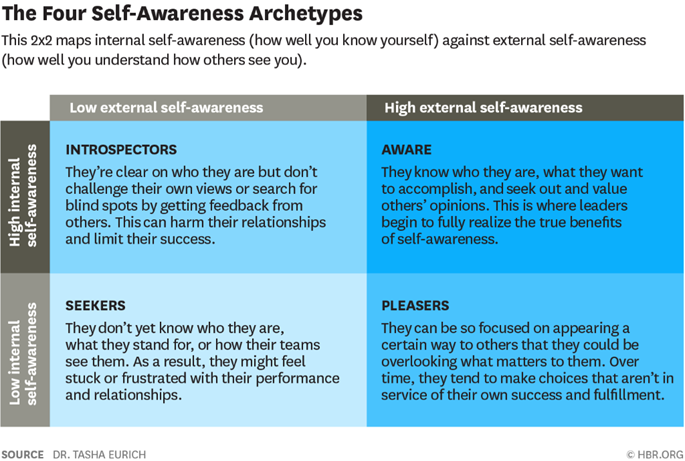
    There are two types of self-awareness that need to be expanded on: Internal Self-Awareness and External Self-Awareness.

    Internal Self-Awareness is how well you know yourself, and External Self-Awareness is how well you understand how others see you. Both of them are important, and neither alone is sufficient. The intersection of these two metrics is how you diagnose and solve the problems that you face personally.

    Unless you’re highly self-aware both internally and externally, you’re not living up to your full potential as an employee, or as a person.

    These two metrics were well explained by Dr Tasha Eurich, published in the Harvard Business Review and explained in the diagram to follow.

    4 Self Awareness

    I can speak to this chart personally.

    Early in my career I would focus on specific numbers, to the point where it was causing problems with work relationships, exactly what the “Introspectors” corner talks about in the diagram above.

    I would only focus on how right my numbers were, and any other opinions be damned: I was right.

    After years of frustration, I became more externally self-aware, realizing that the bottom line isn’t the end-all, be-all in arguments.

    Without the external self-awareness, I was unable to see the whole picture, much less have a road map for where I should be going.

    For yourself, you need to look inward and ask:

    What characteristics are you utilizing to be successful?

    What characteristics are you utilizing that you think should, but just aren’t working?

    Are you willing to acknowledge that you have room to improve?.

    These questions transition to talking about the above quadrants:

    1. Being honest about your current state, knowing who you are. This includes your identity, your communication style, your leadership style, core beliefs, biases and being aware of the biases
    2. Your reputation: are you a problem solver, do you eliminate problems, or do you simple give hope to people who will inevitably will be betrayed by your failure.
    3. Having a backbone
  • Self-Accountability Part 4

    Self-Accountability Part 4

    Step Two: Be Honest With Yourself

    Self-accountability is meaningless without honesty. It can be difficult to be honest with yourself, because then you’re pulling away all the excuses and rationalization that stand between you and what you want, but it’s the only way forward.

    This is a two-part process, the first part of which is simply putting your ego aside and realize that you don’t know everything. No one does, and it might be a tough pill to swallow, but you aren’t the exception. Having the courage to admit that you don’t know everything opens the door to the second part of this process: asking for help.

    I can speak personally about this, having spent around twenty years in my career thinking I knew everything and struggling all along the way.

    – If you want to spend your career making every single mistake possible, at the end of your career you could be the wisest and most experienced person in your field. You also spent decades learning and likely re-learning the same mistakes over and over again.

    – If you’re able to have a little humility and ask for help from people who have been where you are, you’ll find your growth will explode. Instead of a decade struggling on XYZ, you can find a veteran who can cut literally years off of your learning curve with a few sentences.

    – The old phrase about touching a hot stove isn’t really how the world works. In reality, there’s about 90% of people who have touched the stove once, keep touching it and constantly wonder why their hands hurt so much. Then there’s 9% who touch it once, and realize “that was a terrible idea” and don’t touch it again.

    Finally, we have the 1% who see everyone else cursing at the stove, holding their hands and have the courage to ask someone if they should touch the stove while everyone else gets burned.

    When you compound all of the time that asking for help can get you, it’s almost unbelievable how much faster you can develop than your peers. There’s no reward for re-inventing the wheel, and the vast majority of problems you’ll face in your career are similar to problems other people have faced.

    The best thing about asking others for help is they’ve already done the work, burned their hands and as long as you ask politely, you get the answers to the test.

    Now that we’re taking the fast lane towards success, let’s talk about the final step in becoming more self-accountable.

    Continued…

  • Self-Accountability Part 3

    Self-Accountability Part 3

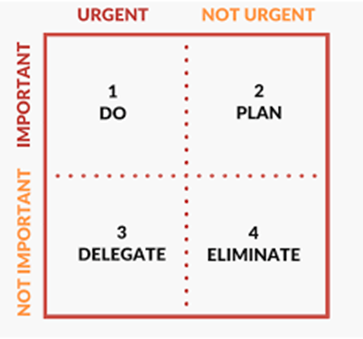
    A great tool to help diagnose where these problems come into play is using the four quadrants from Stephen Covey’s great book, “The Seven Habits of Highly Effective People” or sometimes called “The Eisenhower Matrix” after the famous General and President.

    Quad

    The quadrant is displayed at the left. Take any task that you need to perform and grade it on the two questions that follow.

    1. Is this urgent? – does this task require immediate attention or there will be negative consequences? Tasks that are urgent are like running water over a burned finger or paying rent on the first of the month. If you don’t handle them immediately, you’ll move significantly further from your goals.
    2. Is this task important? Will this specific task “move the needle” for whatever metrics you have designed in your personal development plan? This could be launching a marketing campaign for your business or applying to new jobs. The difficulty of a task can, but does not always, match the importance.

    The simple nature of the matrix is intuitive and easy to use, especially if you have experience running a team.

    The important and urgent (quadrant 1) is something you personally need to do immediately. This is the CEO returning the calls of the company’s attorneys: you don’t want the summer intern in charge of that, and you don’t wait until 3 months to call them back.

    The important but not urgent (quadrant 2) means you personally need to plan out where the process is going. When a home builder sells a home, one of the first steps is planning all of the components and craftsmen necessary to get the entire project done. If windows are on a 3 month lead time, not the usual 2 weeks, that’s not a problem the day the house is sold, but it’s an incredibly serious problem a month before turning the house over to the new owners. Taking that time to plan out what could turn from just important into important and urgent, and preventing those problems from happening is a huge return from a time perspective.

    Next is the urgent, but not important in quadrant 3. This could be something like “returning a current customer’s phone call about a non-critical issue”. If a customer wants clarification on a small item, it’s not something the CEO should focus on, but would be perfect for an hourly employee to do. The focus here is to delegate what is possible, to make sure you’re getting the best use of your time. Remember that as long as the task is done, you’re successful.

    Finally we have quadrant four, the least important and least urgent tasks. These are the easiest traps to fall into on your path to success, and eliminating these tasks completely is the goal.

    When entrepreneurs get started building their businesses, this is where so many get stuck in the mud: they want business cards, and logos, and talk about “what the company culture will be like”. Those tasks are great ways to avoid having to do the most important and urgent task entrepreneurs have: getting new, paying clients.

    – Jim Koch, the man who created the Boston Beer Company, best known for their Samuel Adams beer line, had a great story about when he was starting out. He had picked out the perfect logo, was looking at office space and had his eye on a massive computer system to handle processing all the orders he’d have.

    – The trouble was, he had zero orders. A family member who was an investor and had a background in finance finally sat him down and said “it doesn’t matter if you have the fanciest computer to process the orders, if you don’t have any orders to process.”

    – Jim was failing to properly categorize tasks using the quadrant above. He was luckily just wasted time, and not the precious start-up money, on the unimportant and not urgent tasks. After the conversation with the family member, he went into a bar with a six pack, sold his first few cases and now employs around 2000 people, generating over one billion dollars per year in revenue

    – Imagine what would have happened if he didn’t talk to the experienced family member? He could have spun his wheels for years, designing letterhead and who knows what other useless task, while the empire of Boston Beer Company faded away.

    The entire American craft brewing renaissance might not have happened if Jim didn’t have that one conversation – and more importantly – implement the action that was recommended.

    – How are you cutting yourself short in the impact that you’re able to make to the world? That’s what the quadrant is designed to improve, not just the insight, but how you can take the insights learned into action.

    – When you’re assessing your personal development plan, you can use this matrix on the front and back end, as both a planning tool and one for diagnosis of failure. If you’re finished with your whole plan, but before you implement it you do a quick check of all of the daily plans against this matrix, you can save yourself a ton of wasted time on the front end: could half of these tasks be delegated, and a quarter totally eliminated?

    – Next you can use it on the back end. Take time every three months, six months, whatever interval makes sense to do an audit of your activity. Were you actually delegating the urgent but not important? Did you spend two weeks building a social media presence for a business that isn’t necessary or likely to get new clients for your small consultancy? Did you prioritize your day to solve urgent and important problems, every single day?

    Use the feedback to change habits, not feel sorry for yourself, and your creativity at solving the problems will skyrocket, and so will your progress towards your goals.

    Once you’ve made the plan outlined above, you’re taking the daily action necessary to meet your specific goals that are all outlined and you’re taking a look at the plan every few months to make sure you’re not focused on unnecessary things, we can consider step one completed.

    The next thing we need to focus on is step two.

    Continued…

  • Self-Accountability Part 2

    Self-Accountability Part 2

    Step 1: Know your role and your responsibilities

    The first step in creating more self-accountability is to start by making an assessment of what your role is and what those specific responsibilities are.

    If you’re a father, your role and responsibilities are very different than if you’re the head of an emergency room, or if you’re coach of a basketball team. Every area of your life can have different roles, but the responsibilities of being a father, for example, can impact the responsibilities of being an entrepreneur. You will need to think about how late nights in the office can affect missing Timmy’s baseball game into your plan.

    No matter what your specific role is, you need to sit down and describe specifically what your responsibilities are. Without explicitly stating what your responsibilities are, you will never be able to hold yourself accountable.

    When you’re making this list of responsibilities, you’re going to break down each broad responsibility into the specific and measurable components that combine to form the responsibility. If the components are not specific, you won’t know that you’re working towards them, and if they’re not measurable, you won’t know if you’re succeeding or failing.

    Within each of these components that make up the responsibility, there’s going to be tactical strategies that will get you closer to the goal. These will be things that will be more day-to-day, so you can take down a larger goal one piece at a time.

    In practice, it could look like this:

    Role: A Father & Husband

    Responsibility 1) Make sure the family is financially stable

    Component A) Pay off wife’s student loan debt in 3 years

    1. Restructure current debt to reduce interest rate
    2. Add $50 more per payment to shorten duration to pay

    Component B) Increase income by $15,000 this year

    1. Pick up an extra shift every other weekend
    2. Earn a professional credential that raises your salary within the next six months

    III.          Help wife start tutoring local students

    Component C) Decrease spending by $1000 per month

    1. Pack lunch every day, saving $100/week
    2. Explore free hobbies that the kids enjoy

    Responsibility 2) Improve the family’s relationships

    Component A) Make routines more consistent

    1. Eat dinner together 5 nights a week

    Ii. Start a monthly tradition (family outing etc)

    Component B, C, D etc…

    You start by creating a list of just the responsibilities that the role requires: are you making sure that there are no injuries on the shift you supervise, reducing waste, mentoring junior employees, any imaginable amount of realistic responsibilities for whatever role you’re in.

    The four kinds of accountability mentioned at the beginning of the chapter should spark some creativity for responsibilities that might not be immediately obvious. The second shift supervisor is directly accountable to the Operations Manager he reports to, but he also has responsibilities to not setup the third shift supervisor for failure. If second shift is above quota every day, but third shift has started falling behind it means that somewhere, something is going wrong.

    Once you have the responsibilities, break them down into the components that would lead to success in that responsibility. Then break down each component into whatever metrics would be considered success in that component. This is where you’re going to focus your daily effort.

    Once you have broken down the strategic (higher level) into the tactical (day-to-day) steps necessary to move forward, now you have something that you can focus on every single day.

    Every day, you can look back and ask yourself if you were taking the steps necessary to get to the end position you want to be in, and this is what self-accountability is all about.

    This list of responsibilities is a document that should be referenced as often as necessary to get where you want to go. You should reassess the strategic level goals every three, six or twelve months to make sure that you’re still on the right general path.

    You should be checking weekly or every other week to see if you’re doing the tactical steps that will feed into the responsibilities success. If you spend two weeks without having done a single daily step, it’s critical to take a look at why you weren’t able to.

    This is where the self-accountability comes into play. If you are looking at getting back into shape as a goal, and you spend 2 weeks without exercising once, then there’s feedback that something needs to change. It’s important to note that this doesn’t mean that you’re instantly a failure and it’s time to give up all together.

    If your excuse was that you forgot your gym clothes at home, start putting a gym bag with two sets of clean work out clothes in the trunk of your car. If your gym is 30 minutes away, change your protocol to “if I don’t go to the gym on this day, I need to do 50 pushups before I can turn the TV on at home”.

    Continued…

  • Self-Accountability Part 1

    Self-Accountability Part 1

    In the last blog, we discussed why Self-Awareness is the starting point for any real change. If you aren’t able to honestly know where you are, you’ll never get on the proper path towards where you want to go. The next step in making forward progress is understanding how you got to where you are.

    This is where self-accountability comes into the conversation.

    Simply put, self-accountability is the understanding that you are the combined result of all of the decisions you make, and actions that you take.

    Throughout life, there’s roughly a 90/10 split on how much of life is based on your decisions, and 10% of what happens to you in life is just out of your control.

    For example, on the first day of your new job, you can go to sleep early, get your lunch prepared, have any paperwork needed for HR, time out your commute with plenty of slack in case traffic is worse, make sure you have a full gas tank so you make good time, but if you get in a car accident on the way, that’s just out of your control.

    The trouble most people have is that we spend the vast majority of our effort on the 10% that’s just beyond your control. People will blame circumstances, luck or whatever puts the burden of responsibility on anything but themselves.

    The reality is that the 90% portion is the only thing you have control over: if you can’t control it, it’s not worth worrying about, because you can’t control it.

    Once we’ve accepted the reality that the 10% is just out of our control, we get into self-accountability, and we’re able to start making serious progress on changing the path we’re on.

    As we move forward with accountability, it’s important to understand that there’s four general types of accountabilities.

    1. Individual Accountability: this is when one person is a part of the solution, for example, a coach who’s responsible for other people’s growth.
    2. Reciprocal Accountability: This is a group being individually responsible for a single goal, for example, the first, second and third shift managers of a single factory line. If second shift leaves a large mess, that can affect third shift’s productivity even though it might not be their fault.
    3. Team Accountability: This is how everyone on the sales team is responsible for hitting the quota, and the failure of the team as a whole is unacceptable, even if there are specific people who performed well enough.
    4. Self-Accountability: This means that you are responsible for your own choices and actions. You are the first and last line of defense for your own integrity.

    These four distinct areas of accountability can demonstrate the ways that you can have a single boss at your job, but that doesn’t mean you are only responsible to them. Salesmen might report into a sales manager, but if they can’t produce the revenue to cover payroll, the salesmen will find there’s quite a few people that rely on them!

    Every one of the components discussed in this blog can be difficult to implement, but self-accountability is the toughest for many people. It’s not a common trait to be able to look yourself in the mirror and not only know that you’re responsible for the vast majority of your problems, but that you’re the only one who has the power to fix them. The benefit to that skill is once you’re able to admit to yourself you can fix the problems, the solutions to those problems can start to show themselves, and they aren’t as big of problems to face as you originally thought.

    Now that we’ve outlined what self-accountability is we can talk more about what we can do to make ourselves more accountable. Luckily, we have a three-step plan to do just that!

    Continued…