You can’t fix all 30 losses at once. Even the best plants pick two or three a year. This is how you choose.
By now you can name the losses and size them in dollars. That creates a new and better problem: you can suddenly see more opportunity than you could possibly chase. So the skill that matters now isn’t finding losses. It’s choosing which ones to attack first.
The 80/20 pattern shows up here too
On any given line, about 80% of the loss is usually packed into just two or three of the 30 buckets. You don’t need a program that boils the ocean. You need to find those two or three in your specific plant, then match the right fix to each. Everything else can wait.
Three questions, in order
When you’re deciding where to point your effort, ask these in sequence:
- Which loss is biggest in dollars? Not hours. Dollars. And as you’ll see in a moment, an hour on the bottleneck is worth far more than an hour anywhere else.
- What will the fix cost? Capital, labor, and organizational change all count.
- How fast will it land? Quick wins matter more than they look, because they build the credibility that gets your slower, bigger projects approved.
Match the strategy to the loss
A breakdown is not fixed the same way as a speed loss. One of the most common mistakes is applying a single favorite tool to every problem. Here’s the rough mapping:
| Loss type | Best strategy |
| Breakdowns | Asset strategy optimization, reliability engineering, root cause analysis, precision maintenance, lubrication management |
| Process Failures | Process engineering, design improvements, operator training |
| Setup and Adjustments | Standardized procedures, centerline management, training, discipline |
| Speed Losses | Defect elimination, line condition, materials handling improvements |
| Minor Stops | Operator care routines, incoming material specs, centerlining, workplace organization |
| Startup Defects | Structured changeover reduction, centerline standards, PM effectiveness |
| In-Process Defects | Process control monitoring, in-process checks, supplier quality, operator training |
The bottleneck rule, and why it changes everything
This is the single most important idea in the post.
An hour saved on the bottleneck is an hour of brand-new throughput. An hour saved anywhere else is just less idle time on a machine that was never the constraint.
The bottleneck is the slowest step in the chain, the one that sets the pace for everything downstream of it. Always find it before you decide where to invest. The implications are blunt:
- Cut breakdowns on a non-bottleneck, and your total output may not move at all.
- Cut minor stops on the bottleneck, and every hour you save flows straight to shipments.
Real-world example: the same hour, two different outcomes. A snack-foods plant runs a slicer (1,200 lb/hr) feeding a fryer (1,000 lb/hr) feeding a packaging line (950 lb/hr). The bottleneck is the packaging line at 950 lb/hr, because it’s the slowest step. Now watch two equally hard engineering projects: reducing slicer breakdowns by 50% produces exactly $0 of new revenue, because the slicer was never the constraint. Reducing packaging-line minor stops by 30% directly increases shipments. Same effort, completely different financial result. Always start at the bottleneck.
Quick wins versus long plays
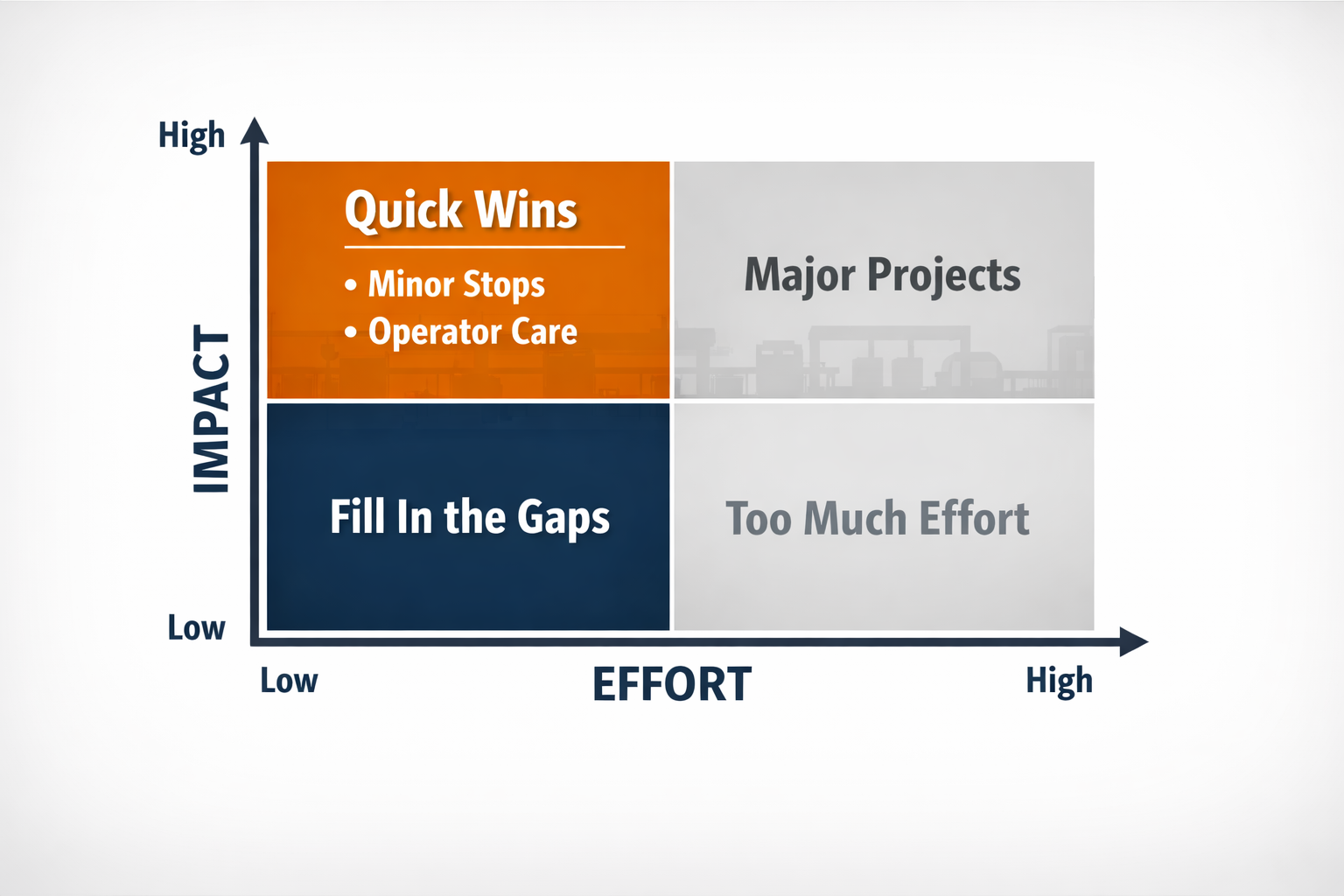
Sort your candidate projects on a simple grid of impact against effort.
| Low effort | High effort | |
| High impact | Do first. These quick wins build credibility. | Plan. These are your major projects. |
| Low impact | Do if easy. Fill in the gaps. | Avoid. Not worth the cycles. |
On a typical line, the two corners look like this:
- Quick wins: operator care routines, kitting parts before PMs, centerline standards, basic changeover improvements, and knocking out the top five minor-stop causes.
- Long plays: a predictive maintenance program, machine redesigns, capital projects, and control system upgrades.
Try it yourself
Go back to the OEE calculation you ran in the last post:
- Identify your top three losses by hours.
- For each, multiply hours per week by your contribution margin to get dollars per week.
- Plot each one on the grid above using your gut feel for effort and impact.
- Pick the upper-left item as your first project. Pick the upper-right item as your annual goal.
Key takeaways
- Pick the two or three losses that hold 80% of your dollar opportunity, and ignore the rest for now.
- Match the strategy to the loss type. Breakdowns and speed losses are not solved the same way.
- An hour saved on the bottleneck is worth more than an hour saved anywhere else. Always.
- Quick wins build the credibility that funds the long plays.
Wrapping up Part 3
You’ve now closed the gap between naming a loss and sizing it. You can calculate where a line really stands, translate any loss into annual dollars, and choose the two or three targets that matter most, with the bottleneck rule keeping you honest about which hours actually count.
That’s everything you need to walk into a room with a number. What you need next is the language that turns a number into an approved project: payback, ROI, and the cost of doing nothing. That’s Part 4.
Coming next, Part 4: Building the Business Case.
If you are ready to identify the two or three losses that hold most of your opportunity, ReliabilityX can help. Our team works directly with your data to pinpoint the bottleneck, quantify the dollar impact, and design the strategy that delivers measurable results.