If you can’t turn the loss into a number, the project won’t get funded. Here’s how you turn it.
Cost-Benefit Analysis
You’ve found the loss, sized it, and picked your target. Now you have to ask for money, and that means building a case. The most common tool for deciding whether a project is worth doing is the Cost-Benefit Analysis, and the good news is the math is simple. The hard part isn’t arithmetic. It’s being honest about both sides of the ledger.
A Cost-Benefit Analysis weighs the benefits, the gains and savings, against the costs, the spend and investment, required to get them. The goal is to answer two questions: is this project worth doing, and how fast does it pay back?
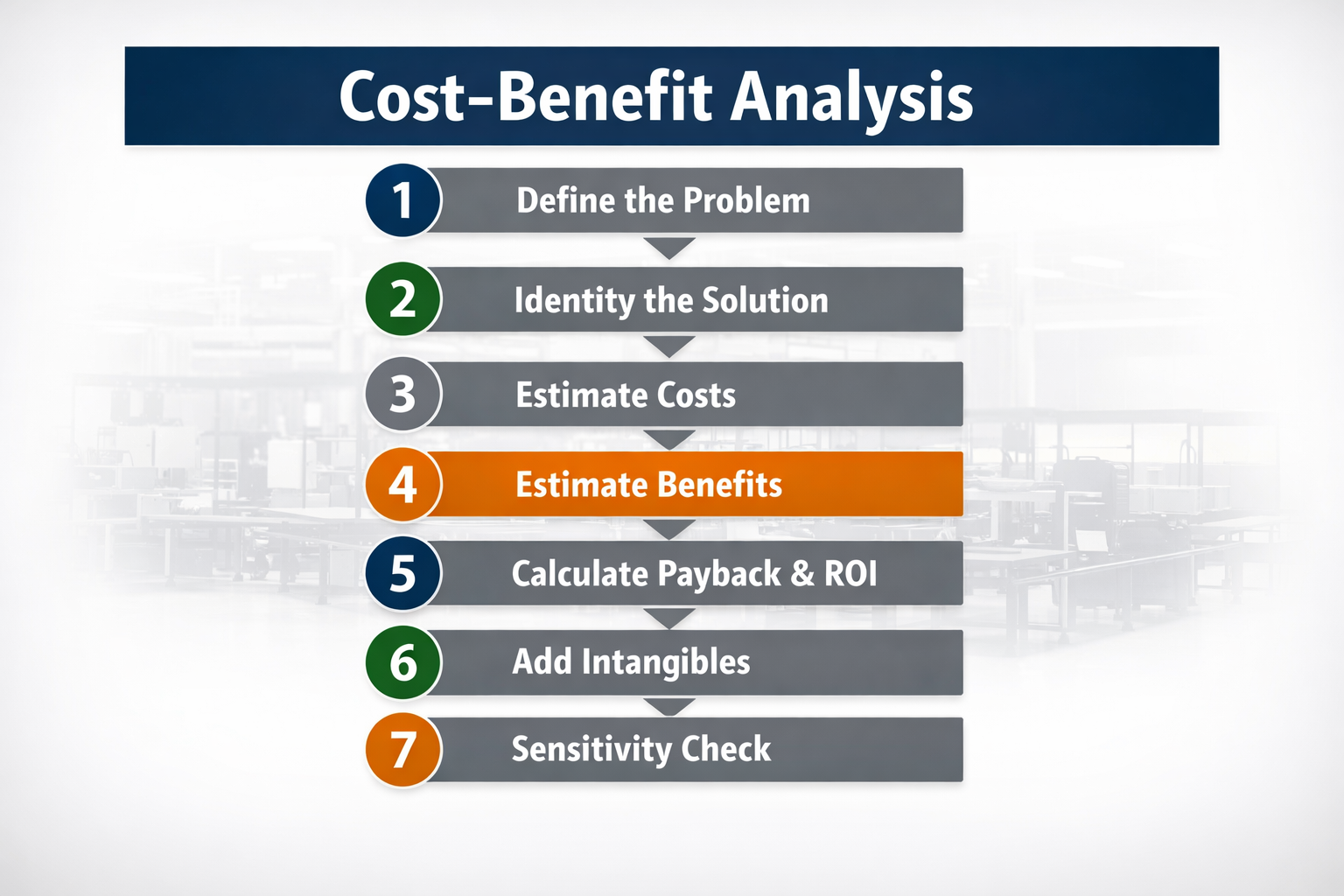
Here’s the whole process in seven steps. Not seventy. Seven.
Step 1: Define the problem or opportunity
Be specific. Vague problems attract vague solutions and zero dollars.
- Weak: “The packaging line breaks down a lot.”
- Strong: “Unplanned downtime on the packaging line averages 8 hours a month, costing $24,000 a month in lost contribution.”
The difference between those two sentences is the difference between a complaint and a business case.
Step 2: Identify the solution
Propose a specific intervention with a scope, a timeline, and an owner. For example: precision alignment and balancing training for the six mechanics, plus a laser alignment tool kit. Concrete enough that someone could actually approve and schedule it.
Step 3: Estimate all the costs
All of them, not just the obvious capital number. The hidden ones are what sink projects after approval, when the real bill comes in higher than the pitch.
- Capital cost, such as equipment and tools.
- Labor, including training time, install labor, and project management.
- Materials and consumables.
- Lost production during install or startup.
- Ongoing costs, such as software licenses, maintenance, and recalibration.
Step 4: Estimate all the benefits
List both kinds, but only put the hard ones in the math.
| Benefit type | Examples |
| Hard (use in the math) | Reduced downtime hours, less scrap and rework, less overtime, energy savings, longer asset life |
| Soft (mention, don’t count) | Improved morale, safer work, fewer customer complaints, less firefighting, easier hiring and retention |
The discipline of using only hard dollars in the calculation is what makes your number credible upstairs. Soft benefits are real, but the moment you count them in the math, a skeptical CFO stops trusting the whole case.
Step 5: Calculate payback and ROI
Payback Period = Total Cost / Annual Benefit
ROI % = ((Annual Benefit – Annual Cost) / Total Cost) x 100
Step 6: Add the intangibles, separately
List the soft benefits on their own. They don’t change the math, but they tip close calls and they matter in the leadership conversation. Just keep them clearly out of the numbers.
Step 7: Run a sensitivity check
Ask the obvious “what if” questions before someone else does:
- What if the downtime savings come in at only half what we projected?
- What if costs run 20% over?
- What if it takes twice as long to implement?
If the project still wins under reasonable downside assumptions, you have a solid case. If it only works when everything goes perfectly, you don’t.
Real-world example: a precision alignment program. Problem: 8 hours a month of downtime tied to bearing failures, misalignment, and vibration. At $3,000 an hour in contribution, that’s $24,000 a month, or $288,000 a year.
Solution: laser alignment tools, training, and precision standards.
Costs: alignment tools $15,000, training for six mechanics $10,000, implementation labor $5,000. Total cost $30,000.
Benefits: six fewer downtime hours a month at $18,000 a month is $216,000 a year, plus $6,000 a year from extended bearing life and $4,000 a year from fewer rebuilds. Total benefit $226,000 a year.
The math: payback is $30,000 / $226,000, about six to seven weeks. ROI is (($226,000 – $30,000) / $30,000) x 100, which is 653%.
Verdict: invest immediately.
A case like that doesn’t get debated. It gets approved, because every number in it is hard, conservative, and traceable.
Try it yourself
Pick a project off your wish list and build the CBA in seven lines:
- Problem statement, with the dollar value of the current loss.
- Solution.
- Total cost, all in.
- Annual benefit, hard dollars only.
- Payback period.
- ROI percentage.
- Sensitivity: does it still win if the benefit is only half?
If you can’t fill in that first line with a real dollar number, that’s your homework before you go any further.
Key takeaways
- CBA is seven steps, not seventy. Keep it simple.
- Include all costs, not just the obvious capital. Hidden costs are what sink projects after approval.
- Use only hard benefits in the math. Mention the soft ones separately.
- Always sensitivity-check at half the projected benefit. If it still wins, your case is strong.
Coming next, Part 4, Post 2: ROI, Payback, NPV, and BCR Made Simple.
If you are ready to turn your improvement ideas into funded projects, ReliabilityX can help. Our team works directly with your data to build clear, defensible business cases that leadership approves with confidence.