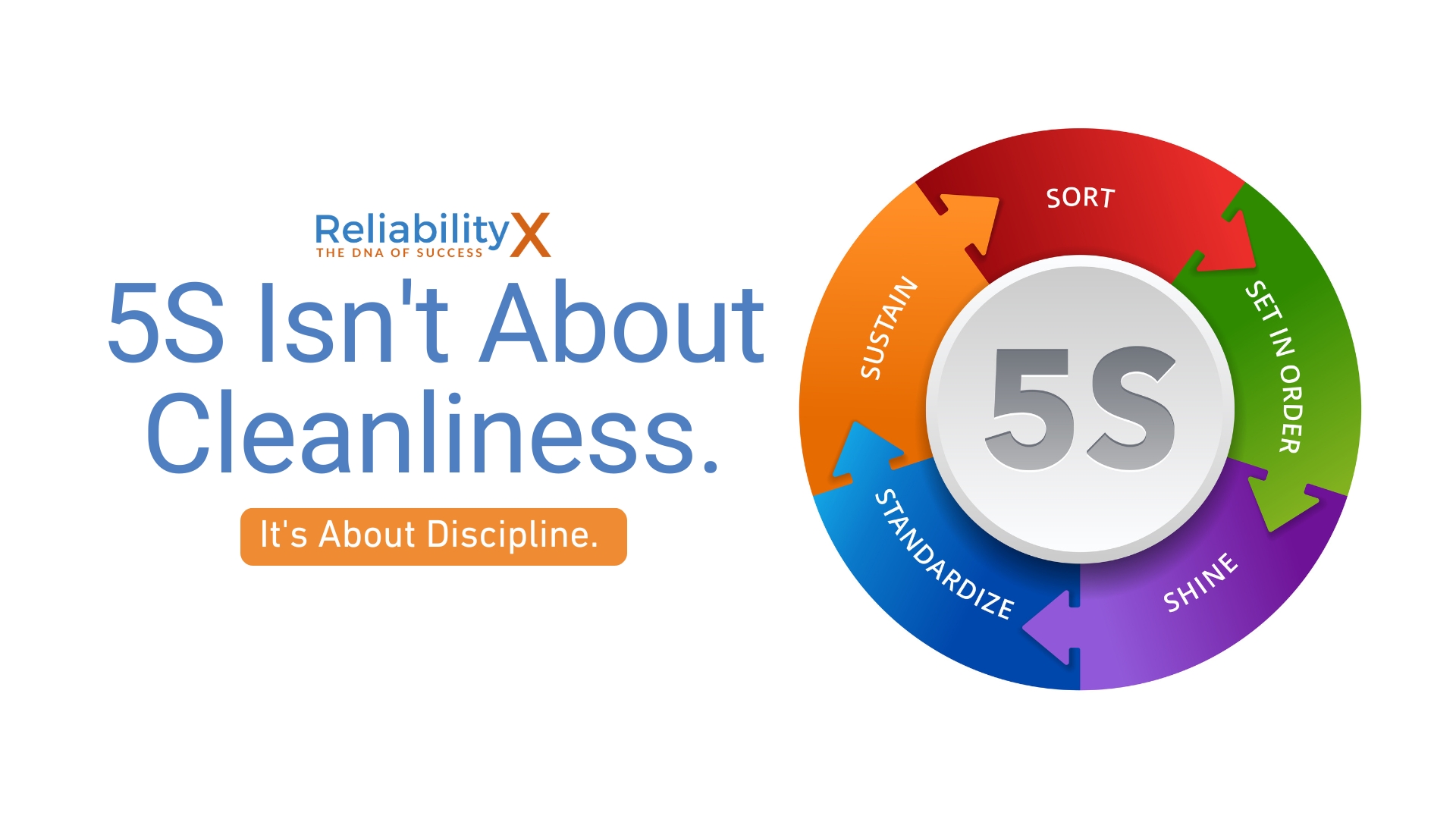
Walk into any plant in North America and ask about 5S, and you’ll get one of two responses. Either an enthusiastic explanation of the program leadership is rolling out for the first time or a tired half-laugh and the words “we’ve tried that, didn’t stick.”
That second response is more common than people want to admit. I’ve worked in plants that have launched and abandoned 5S programs five, ten, fifteen times over a couple of decades. Every time, leadership rolls it out with new energy, new posters, new audit forms. Every time, it falls apart within a year or two and gets quietly shelved until the next leadership team picks it up again.
Here’s what most people miss: the reason 5S keeps failing in your plant isn’t because 5S is the wrong tool. It’s because 5S isn’t actually about cleanliness. It’s about something much bigger and most organizations have no idea what that is.
This post isn’t aimed at any one department. It’s aimed at every leader in your plant from operations, quality, safety, engineering, warehouse, maintenance, to the front office because what 5S is really building belongs to all of you, equally.
A Quick Walk Through the Five Steps
Let’s get the basics out of the way fast. 5S is five sequential steps. Japanese terms with English equivalents that conveniently all start with the letter S:
- Sort. Throw out what isn’t being used. Strip the workspace down to what’s actually needed.
- Set in order. Define a place for everything that remains. Color-code it. Shadow-board it. Tape it off. Make it visually obvious where each item belongs.
- Shine. Clean the area thoroughly and design it to be easy to inspect. The cleanliness isn’t the point but the inspectability is. A clean, well-lit, organized workspace is one where developing problems surface before they bite.
- Standardize. Make sure the color coding, the layouts, the boards, the visual signals are consistent across the entire plant in every department, every area. Same conventions everywhere. So that anyone walking from one part of the facility to another understands the visual language immediately.
- Sustain. Keep doing it. Audit. Coach. Hold the standard.
Most 5S training spends 90% of its airtime on the first four S’s. The plant tour shows you the labeled boards, the taped-off floor lanes, the color-coded racks. It’s all very tangible. Very Instagram-able.
Then the trainer waves their hand at the fifth S, sustain, and says something generic like “and of course you have to keep it up over time” and moves on.
That’s the entire reason your 5S program keeps failing.
Sustain Is the Whole Point
Here’s the reframe that changes how you think about this.
The first four S’s deliver a visible workspace. The fifth S delivers something invisible and far more valuable: organizational discipline.
Discipline is the muscle that lets an organization hold a standard over time, even when no one is watching, even when leadership is distracted, even when the easy thing to do is let it slide. That muscle has to be built. It doesn’t appear because you wrote it on a poster. It appears because the organization repeatedly showed up, did the work, audited honestly, coached when standards slipped, and refused to let the discipline degrade.
That’s what sustain is. It’s not a janitorial activity. It’s the deliberate construction of the organizational reflex you’ll need to make every standard, in every department, hold over time.
This Diagnoses the Rest of Your Plant
Here’s the real value of understanding what 5S is actually building.
If your organization has launched and abandoned 5S programs multiple times, ask an honest question: how does discipline hold anywhere else?
- Does standard work on the production line hold over time, or does it drift the moment a new shift takes over?
- Do changeover times stay close to standard, or do they balloon?
- Do quality SOPs get followed precisely, or do operators improvise their own variations?
- Are safety procedures followed when no supervisor is watching? PPE, lockout/tagout, hot work permits, near-miss reporting?
- Does training compliance stay current, or do people drift months or years past their certification dates?
- Do continuous improvement projects actually get sustained after the kickoff, or do they fade out three weeks after the kaizen event ends?
- Do planned maintenance schedules hold, or do they erode into reactive habits?
The pattern is almost always the same. Plants that can’t sustain 5S, can’t sustain anything else either. All of those programs depend on the same underlying capability which is organizational discipline. That capability is precisely what sustain was supposed to build.
When clients tell me, “We can’t get anyone in this plant to follow a standard. Every initiative we launch dies in 18 months,” my first question back is, “Tell me about your 5S program.”
Nine times out of ten, that program is in shambles. And that’s the diagnosis. The lack of discipline showing up across every department is the same lack of discipline that’s been quietly killing your 5S program for years. They share a root cause.
The Fix: Go Back and Get Sustain Right
If this is hitting close to home, the fix isn’t a new initiative. It’s revisiting 5S and getting the sustain step right this time. Three things to change about how you approach it:
- Audit against the standard, on a real cadence across every department. Not a once-a-year leadership walkthrough of the production floor. Weekly area audits owned by each department, monthly cross-functional audits where leaders from operations, quality, safety, engineering, maintenance, and warehouse all walk each other’s areas. Documented findings. Real action items. The audit isn’t punitive. It’s the mechanism that makes the standard real. If no one is checking, the standard isn’t a standard. It’s a wish.
- Coach the why, not just the what. When a tool isn’t on its shadow board, the conversation isn’t “put the tool back.” The conversation is, “tell me why we have shadow boards in the first place.” When floor markings get scuffed and ignored, the conversation is about why we standardize visual cues across the plant. Every audit finding is a coaching opportunity. A chance to reinforce the purpose of the discipline. Coaching is the work that converts compliance into ownership, and ownership is what sustains.
- Treat sustain as a leadership behavior, not a worker behavior. Sustain dies when leadership stops modeling the discipline they’re asking for. If a plant manager, an operations supervisor, a quality lead, or a department head walks past a 5S violation without engaging with it, every employee in line of sight just learned that the standard doesn’t matter. Discipline is built top-down, and it crosses every department. The plant manager has to be visibly engaged with sustaining the standard, the department heads have to mirror it, and the front-line supervisors have to hold the line every day. If any layer of that chain disengages, the whole program collapses and so does every other initiative downstream of it.
The Bigger Payoff
When you get sustain right, something interesting happens. The visible benefits of 5S show up on schedule. The bigger payoff is the muscle you’ve built underneath the program.
Once your organization can sustain 5S, you’ll find that other things start sticking too:
- Operations — standard work compliance holds. Changeover times come down and stay down.
- Quality — SOPs are followed precisely. Defect rates fall and stay fallen.
- Safety — PPE compliance, lockout/tagout, and near-miss reporting all become reflexive rather than reactive.
- Engineering and CI — project follow-through improves. Kaizen events leave durable changes behind instead of flashes in the pan.
- HR and Training — certification compliance stays current. Onboarding consistency improves shift over shift.
- Warehouse and Logistics — staging discipline holds. Inventory accuracy stops degrading the week after the count.
- Maintenance — planning and scheduling sticks, PM compliance holds, predictive programs don’t slip back into reactive habits.
That’s the real reason 5S sits at the foundation of so many lean and operational excellence frameworks. It’s not because clean shops produce better products, though they do. It’s because the discipline you build through sustaining 5S is the same discipline you need to sustain every initiative, in every department, anywhere in the plant.
The Tip in Practice
If you take one thing from this post, take this: the next time you hear someone in your plant talk about 5S as a housekeeping or cleanliness program, push back. That misunderstanding is what kills the initiative. 5S is a discipline-building program with a clean workspace as a side effect, not the other way around.
Three concrete moves:
- Audit your current 5S state honestly, across every department. Walk operations, walk quality, walk maintenance, walk the warehouse, walk engineering, walk the offices. Be honest about how far each area has slipped against the standard you set the last time you rolled it out.
- If it has slipped, restart with sustain as the central focus. Don’t relaunch with new posters and a kickoff meeting. Relaunch with a real audit cadence, real coaching conversations, and real leadership engagement at every level; plant manager, department heads, front-line supervisors.
- Connect 5S explicitly to every other initiative in the plant. Make the link visible. When you talk to your people about 5S, talk about it as the foundation that makes standard work, safety procedures, quality SOPs, maintenance programs, training compliance, and CI projects all stick. Help them see that the discipline they’re building here is what unlocks everything else.
We underestimate the power of 5S because we don’t understand the purpose of sustain. Get that right, and every other standard you’ve ever tried to hold in your plant has a real shot at sticking this time. If you want support rebuilding the systems, behaviors, and leadership habits that make reliability sustainable, reach out. Your plant can hold the line. It just needs the right structure to do it.